


Your Cat's Bowl Is Boring. Make Her Hunt for Dinner.
Scent work for cats gets sold as a cute trick. It isn't. It's the only enrichment that restores the part of a house cat's day that the food bowl deleted, and it costs nothing to start tonight.

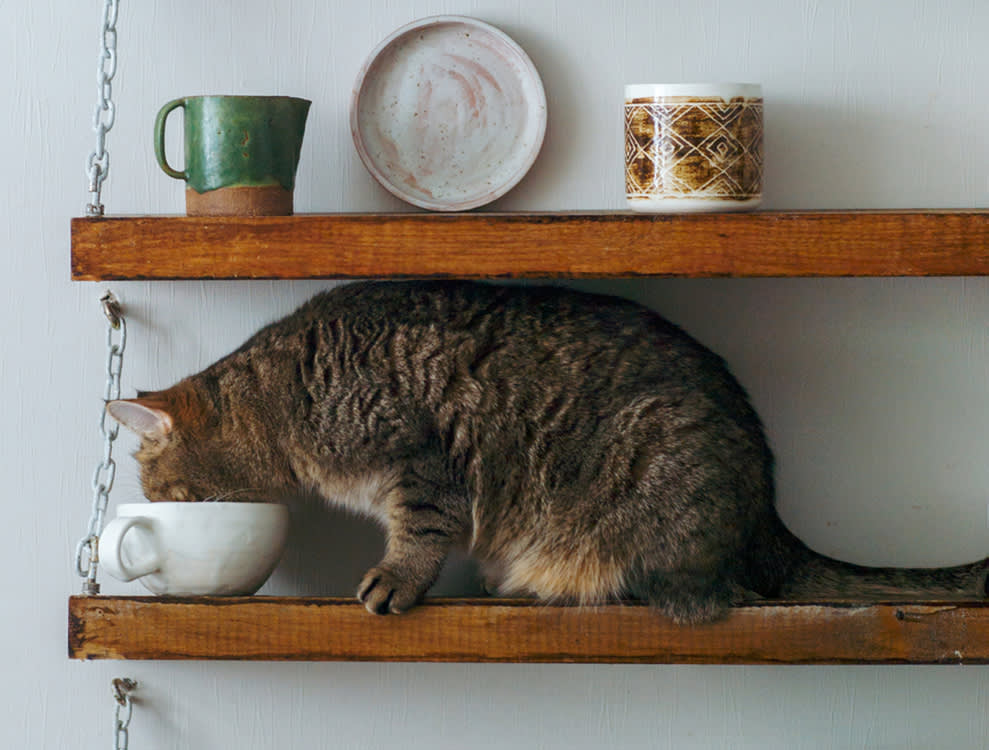
Somewhere in your cat’s ancestry is an animal that ate ten small meals a day and had to find every single one. Stalking, waiting, sniffing, missing, trying again. Most attempts failed. The whole day was structured around it.
Then we invented the bowl, and deleted all of that in one move.
We replaced a full day’s work with a ceramic dish that fills itself twice on a schedule, and then we wonder why an indoor cat sleeps sixteen hours and spends the other eight yelling at us or dismantling the sofa. She isn’t broken. She just has nothing to do, because we did the only job she was built for and we did it in four seconds.
Scent work, or nosework, is the cheapest available way to hand that job back. And the reason it usually fails when people try it is that they treat it as a trick, a cute thing to do after dinner. It isn’t a trick. It’s dinner.
What it actually is
Nosework means the animal locates a target odor using her nose. You hide something scented, she finds it, and finding it is the reward.
Dogs got here first. The K9 unit sniffing bags at the airport is running an industrial version of the same game, and dogs have the hardware for it: as canine cognition researcher Alexandra Horowitz has documented, their noses carry an order of magnitude more olfactory receptor cells than ours. Sniffing is how a dog does basic reconnaissance on the world.
Cats do not work that way, and this is the single most important thing to understand before you start. A cat’s sense of smell is excellent, but she doesn’t use it the way a dog does. A dog sniffs constantly and reflexively. A cat leads with her eyes and ears, and brings the nose in for confirmation. She can hunt by scent. She just doesn’t do it automatically.
Which means step one isn’t teaching her a search pattern. Step one is teaching her that her nose is worth using at all.
Why bother
Because the alternative is a cat whose entire mental life is watching a window.
The animal welfare case is strong and it is getting stronger. A 2024 study of 179 shelter cats found that cats in more enriched environments, with more resources to interact with, had roughly half the hair cortisol of cats with fewer. Half. Hair cortisol reflects long-run stress, not a bad afternoon, and that is about as concrete a result as this field produces.
The everyday case is simpler. A cat with a job is a cat who isn’t inventing one. Scent work burns energy, occupies a hunting brain, works for shy cats who won’t chase a wand toy, works for arthritic seniors who can’t leap, and requires no athleticism at all. And it turns the most boring two minutes of your cat’s day, standing at a bowl, into fifteen minutes of the thing she was actually designed to do.
The bowl is the most under-examined object in the house. It is the only thing your cat interacts with every single day, and we have engineered every ounce of effort out of it. Give the effort back and you’ll see behavior you thought your cat didn’t have.
Start tonight, with things you own
Take dinner out of the bowl. Not extra food. Her food, the amount she already eats. You are moving calories, not adding them, and this is the guardrail that keeps enrichment from turning into an obesity problem. Treats are for the first couple of sessions. After that, this is just how she is fed.
Begin with a snuffle mat, in front of her. A snuffle or sniff mat is a fabric pad with folds and fronds you can scatter food into, and it’s the standard on-ramp. The first session should be nearly free: she watches you drop the food in, she noses it out, she wins. What she is learning is not “search.” It is “my nose gets me paid.”
Then build a waiting room. Put her in a bathroom or bedroom for two minutes while you set up. This is the piece people skip, and it’s the piece that converts feeding into hunting. She needs to not see where the food went.
Hide three portions, and make them easy. Behind a chair leg. Under the flap of an open cardboard box. On a low shelf. Nearly visible is fine. Then open the door and say nothing. Don’t point, don’t lead her, don’t narrate. Let her figure out the game.
Escalate over weeks, not days. Harder hides. Higher hides. Containers she has to shove open. And crucially, move the hides into the parts of your home she never visits, the guest room, the corner behind the bookcase, the hallway she treats as a no-man’s-land. A cat who has to physically travel her whole territory to eat is a cat using her whole territory. Spreading mats and puzzles into unused rooms is one of the most useful things you can do with this exercise, and it costs nothing.
Always end on a find. If she loses the thread and stalls out, go over and quietly make the last hide obvious. Never let a session end in failure. That’s how a cat learns the game is a waste of time.
Can you use something other than food?
Yes, with a catch.
Catnip and silvervine both work as target odors, and they raise an interesting option: a target that is inherently interesting rather than edible. The catch is that you now have a two-step problem, because your cat has to learn that finding the herb predicts a treat, rather than the herb being the payoff.
But there’s a good reason to bother, and it’s a genuinely useful piece of buying information most cat owners don’t have. A 2017 study in BMC Veterinary Research tested 100 cats on four plants and found:
- Silvervine: 79 percent of cats responded
- Catnip: 68 percent
- Tatarian honeysuckle: 53 percent
- Valerian: 47 percent
And here’s the part that matters: roughly one cat in three does not respond to catnip at all. Of those cats, nearly 75 percent did respond to silvervine.
So if your cat is a catnip dud and you’ve concluded she’s simply immune to plant chemistry, you’re probably wrong. You’ve just been buying the wrong plant. Silvervine sticks are cheap, widely sold, and worth trying before you give up.
The three things that will go wrong
She won’t see the point at first. This is normal, and it’s the real difference between cats and dogs here. Dogs arrive already sniffing. Cats have to be shown that the nose has a payroll. Expect slow starts, keep the first sessions embarrassingly easy, and remember that the goal is enrichment, not performance. A cat who takes three weeks to get it has not failed. You just have a cat.
Your hides will be too good or not good enough. This is the fiddly, unglamorous part. The hide has to conceal the odor while still letting her self-reward, which means she has to be physically able to get to it without you helping. Unless you buy purpose-built containers light enough for a cat to shove open, you will spend some time propping paper bags at weird angles and hoping the heating vent doesn’t knock the whole setup over. Cardboard boxes with a hole cut in them are the cheap, reliable version.
She will not wait quietly. Once she knows the game, the two minutes in the bathroom become the loudest two minutes of your evening. She’s not distressed, she’s anticipating. Give her a licking mat, a scratching pad, or a favorite toy to occupy the wait.
Of the three, this last one is the best problem to have. A cat complaining because she can’t wait to start hunting is a cat who has her job back.
References
- Bol, S., Caspers, J., Buckingham, L., et al. “Responsiveness of cats (Felidae) to silver vine (Actinidia polygama), Tatarian honeysuckle (Lonicera tatarica), valerian (Valeriana officinalis) and catnip (Nepeta cataria).” BMC Veterinary Research, vol. 13, 2017, article 70. doi.org/10.1186/s12917-017-0987-6
- “The Impact of Environmental Enrichment on the Cortisol Level of Shelter Cats.” Animals, 2024. pmc.ncbi.nlm.nih.gov/articles/PMC11083262
- Vitale Shreve, K. R., Mehrkam, L. R., Udell, M. A. R. “Social interaction, food, scent or toys? A formal assessment of domestic pet and shelter cat (Felis silvestris catus) preferences.” Behavioural Processes, vol. 141, 2017, pp. 322–328. doi.org/10.1016/j.beproc.2017.03.016
- Vinke, C. M., et al. “Dealing With Stress in Cats: What Is New About the Olfactory Strategy?” Frontiers in Veterinary Science, vol. 9, 2022. doi.org/10.3389/fvets.2022.928943
- American Association of Feline Practitioners and International Society of Feline Medicine. “Feline Environmental Needs Guidelines.” catvets.com
Dr. Solis is a board-certified veterinary dermatologist with over twelve years of clinical experience. She advises on skin conditions, allergies, and grooming practices that affect coat and skin health. All dermatology and allergy content at The Pet Times is reviewed by her team before publication.
Meet our experts ↗Keep reading
 TrainingThe Laser Pointer Isn't the Problem. The Missing Ending IsDr. Ravi Mehta · 5 min
 TrainingYes, You Can Train a Cat. You've Just Been Offering the Wrong Deal.Tom Hadley · 7 min
 TrainingDo Cats Understand What You Say? The Science of Talking to Your CatNina Vasquez · 7 min
 TrainingCats Are Not the Loners We Made Them Out to BeDr. Nina Kohl · 4 min
 TrainingYour Cat Is Not Judging You. Your Cat Cannot Judge You.Dr. Mara Chen · 9 min
 TrainingYour Cat Isn't Begging at Dinner. They're Waiting for You to Sit Still.Dr. Nina Kohl · 7 min