


The Laser Pointer Isn't the Problem. The Missing Ending Is
The laser-pointer debate is stuck on yes-or-no. The real variable is whether your cat ever gets to catch something. Here's the research, and a simple protocol that fixes it.

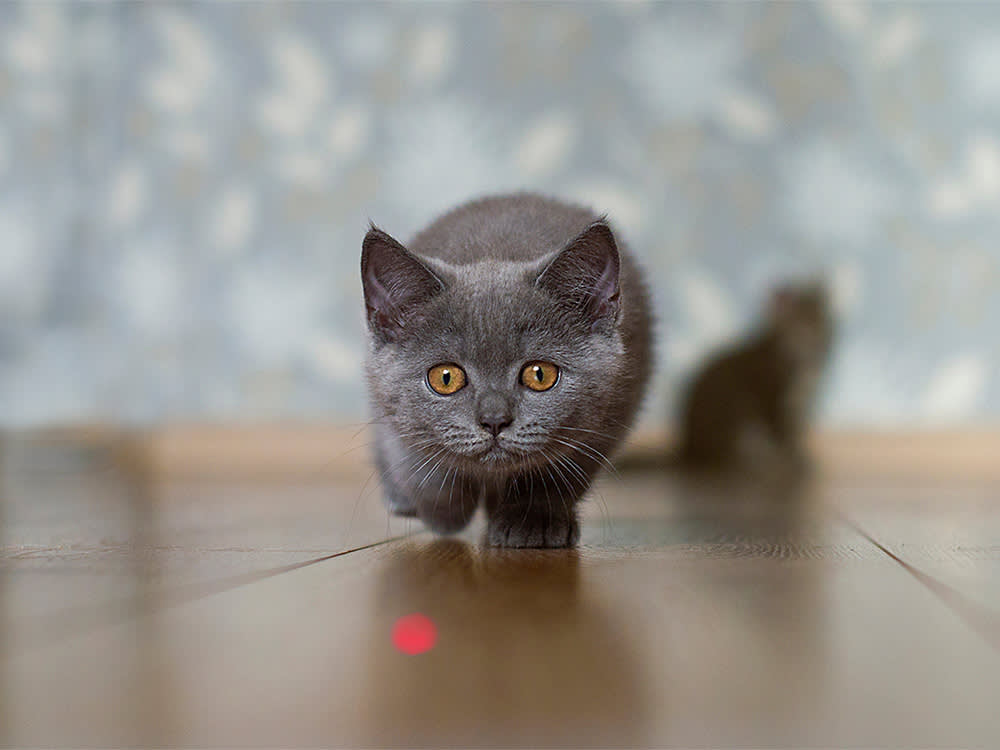
Ask cat people about laser pointers and you’ll get a small holy war. One camp calls the red dot the greatest cat toy ever invented. The other treats it like a loaded weapon you should never point at a cat. Both are answering the wrong question. Whether a laser is good or bad for your cat is not really a property of the laser. It is a property of how the game ends.
That reframe is the whole article. A laser session that finishes with your cat catching something real is enrichment. The exact same session that just stops, with nothing caught, is the version behaviorists worry about. Once you see the problem as a missing ending rather than a dangerous object, the “should I or shouldn’t I” question dissolves into a simple technique.
Why cats fall so hard for the dot
Start with why the laser works at all, because it explains everything that follows. A cat’s play is hunting rerouted. The full sequence is stalk, chase, pounce, catch, and bite, and a healthy cat is wired to run that whole chain to completion. The laser is irresistible because it nails the front half beautifully. That darting, unpredictable point of light triggers the stalk and the chase better than almost any physical toy, and it does it while you sit on the couch flicking your wrist. Big stimulation, near-zero effort, endlessly entertaining to watch. No wonder it’s popular.
The unfinished hunt, and what the research actually found
The problem lives in the back half of that sequence, the catch and the bite, which a beam of light can never deliver.
The core issue isn’t the light, it’s that the hunt never resolves. Your cat stalks, chases, and pounces, and then closes their paws on nothing, over and over. For an animal built to finish the kill, that’s not a fun tease, it’s a genuine source of frustration. And frustration that repeats is the raw material for compulsive behavior.
This isn’t just theory. A 2021 study in the journal Animals by researchers Lori Kogan and Emma Grigg looked at survey data from 618 cat guardians and found that the more frequently people played with laser pointers, the more likely their cats were to show specific abnormal repetitive behaviors: spinning and tail-chasing, chasing lights and shadows, and staring obsessively at lights, reflections, or electronics. The authors were careful to call it an association rather than proof of cause, and a follow-up in the Journal of Applied Animal Welfare Science revisited the question and found the link held up regardless of how participants were recruited, which strengthens the signal. The behavioral explanation is exactly the unfinished-hunt one: an animal that can never complete the sequence stays keyed up and stressed.
You can often see that leftover charge in your own living room. A cat who finishes a dot-only session still revved will frequently redirect onto the nearest moving thing, which in practice means feet, hands, jacket sleeves, bag straps, pant legs, and any other pet in range.
There is also a separate, simpler hazard that has nothing to do with psychology: laser light can permanently damage the eyes of cats, dogs, and people if it catches them directly. That one is a hard rule, not a nuance.
The fix: never end on the light
Here is the technique the whole reframe points to. You do not have to ban the laser. You have to refuse to let a session end on the dot. Give your cat a real, catchable conclusion every single time, and you keep the exercise while removing the frustration engine.
- Open with the laser, close with a toy. Use the dot to get your cat moving and locked in, then transition to something they can actually pounce on and pin, like a wand toy with a fluttering end or a stuffed fleece or crinkle toy. The laser becomes the warm-up, not the whole workout.
- Land the dot on a physical prize. Steer the light onto a toy sitting on the floor, and the instant your cat pounces on that spot, switch the laser off. Now the toy is what they “caught,” and the hunt resolved on something solid.
- Reward the capture directly. For a clicker-trained cat, click the moment they successfully “catch” the light, then hand over a high-value treat. You decide what earns the click, whether that’s pouncing squarely on the dot or making a particularly fast, committed lunge. The treat is the catch.
- Watch for the warning signs, and quit if they show. If your cat starts fixating on shadows, flicking lights, spinning, or tail-chasing outside of play, retire the laser for good. Those are the exact behaviors the research flags, and no game is worth building them.
- Never shine it near eyes. Yours, your cat’s, another pet’s, a visitor’s. This is the non-negotiable one.
The takeaway
The laser pointer debate has a boring answer once you stop arguing about the object. Lasers are fine as a starter and a mover, and they become a problem only when they are the entire game with no payoff at the end. Build every session so your cat catches something tangible, keep the light out of everyone’s eyes, and watch for the fixation signs the research warns about. Do that and you’ve kept the best part of the red dot, the joyful sprint, while cutting out the part that leaves a cat frustrated and staring at the wall.
References
- Kogan, Lori, and Emma Grigg. “Laser Light Pointers for Use in Companion Cat Play: Association with Guardian-Reported Abnormal Repetitive Behaviors.” Animals, vol. 11, no. 8, 2021, 2178.
- Grigg, Emma, and Lori Kogan. “Associations between Laser Light Pointer Play and Repetitive Behaviors in Companion Cats: Does Participant Recruitment Method Matter?” Journal of Applied Animal Welfare Science, vol. 27, no. 2, 2024.
- Delgado, Mikel M., and Julie Hecht. “A review of the development and functions of cat play, with future research considerations.” Applied Animal Behaviour Science, vol. 214, 2019, pp. 1-17.
Dr. Mehta is a board-certified veterinary nutritionist who evaluates pet food formulations, ingredient quality, and the science behind dietary trends. He writes and reviews all nutrition content at The Pet Times, including our food rankings and feeding guides.
Meet our experts ↗Keep reading
 TrainingYes, You Can Train a Cat. You've Just Been Offering the Wrong Deal.Tom Hadley · 7 min
 TrainingYour Cat Can Learn to High-Five. The Secret Is a Sticky Note.Tom Hadley · 7 min
 Health & WellnessStop Wrestling Your Cat for Pills. Train Them Instead.Dr. Lena Park · 9 min
 TrainingDo Cats Understand What You Say? The Science of Talking to Your CatNina Vasquez · 7 min
 TrainingYour Cat's Bowl Is Boring. Make Her Hunt for Dinner.Dr. Amara Solis · 7 min
 TrainingYour Cat Isn't Being Weird. Your Bowl IsDr. Ravi Mehta · 8 min