


Yes, You Can Train a Cat. You've Just Been Offering the Wrong Deal.
Cats aren't untrainable, they're unbribable on your terms. Start in kittenhood, work with their instincts instead of against them, and skip the spray bottle entirely. A calm, positive playbook for teaching a cat real cues.


Let’s clear up the biggest myth in cat ownership first: cats are absolutely trainable. Not “sort of,” not “a few tricks if you’re lucky.” You can teach a cat to sit, to touch a target, to come when called, to tolerate nail trims and medication, even to high-five. And the best time to start is when they’re a kitten, brand new to the world and soaking up everything.
The reason so many people believe otherwise isn’t the cat. It’s the deal we tend to offer. Dogs will often work to please us; cats will not. A cat runs a strict barter system, and they only participate if the payment is worth the effort and the terms are clear. Train a cat like a dog, with pressure, repetition, or a spray bottle, and you’ll get nothing but a worse relationship. Train a cat like a cat, with the right currency and their own instincts on your side, and you’ll be amazed how fast they learn. Here’s how to do the second thing.
Start with honest expectations
You cannot train away instinct. A hungry cat will seek food. A cat will scratch to leave their scent, stretch their body, and mark territory, because that’s hardwired, not naughty. What training can do is channel those drives and add new behaviors on top. You can grow the behaviors you want, teach the ones that make care easier, like accepting nail trims or coming when called, and have genuine fun with cues like targeting and tricks. Reframe the goal from “make my cat obey” to “make the behavior I want the easy, rewarding choice,” and everything downstream gets simpler.
Find your cat’s currency
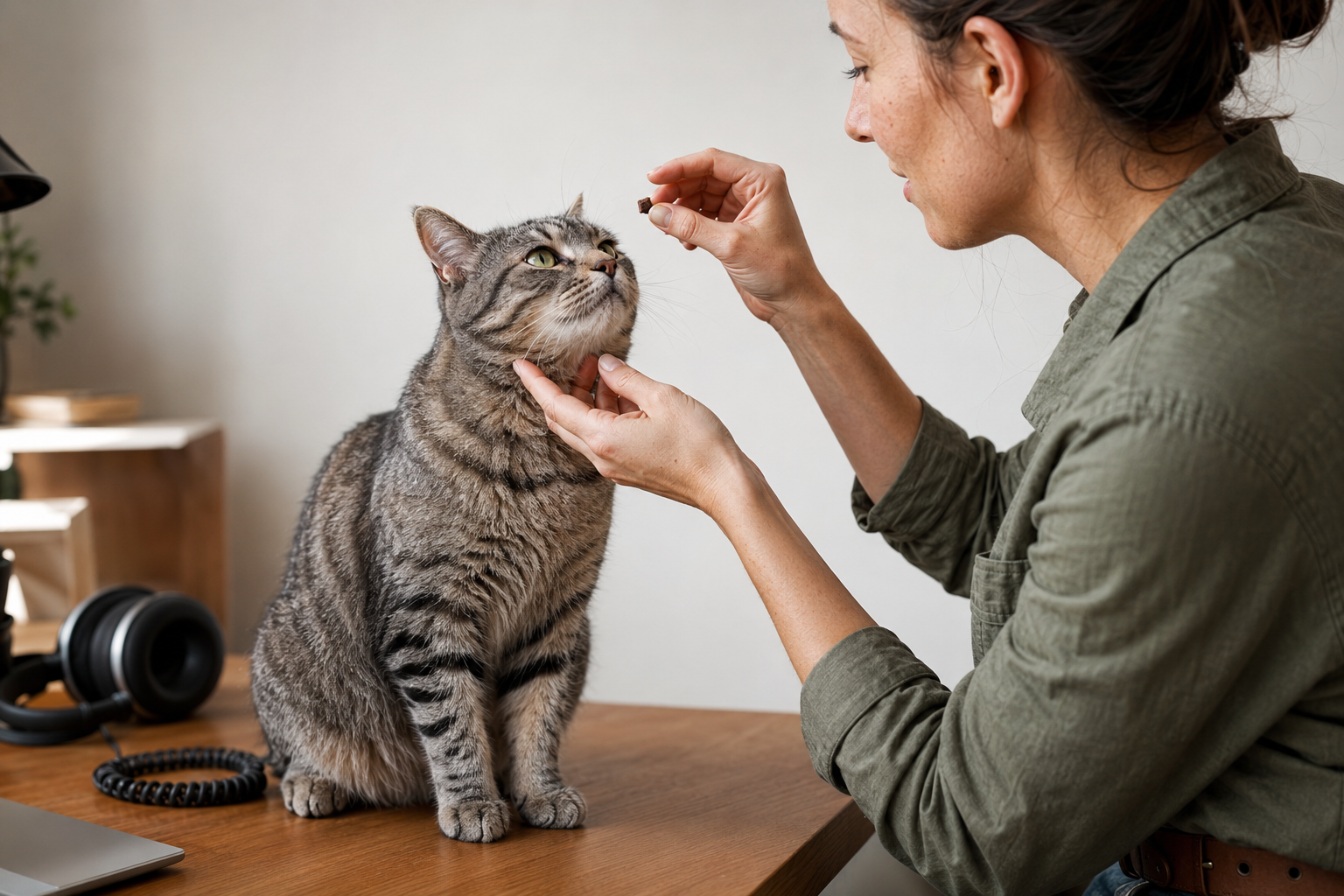
Cats who learn fastest are the ones who are clearly, obviously motivated, and the motivator differs by cat. For most it’s food, especially a high-value treat they don’t get otherwise, but for some it’s a favorite toy, praise, or a good chin scratch. Your first job is to find what your particular cat will actually work for, because that reward is the entire engine of training.
Then keep the ask reasonable. If you’re demanding too much at once, or the cat can’t figure out what earns the reward, or you’re trying to stamp out a behavior without offering another way to meet the same need, you’ll stall. Keep sessions short, a few minutes, keep the steps tiny, and quit while your cat is still interested.
Why clicker training works so well on cats
The single most useful tool for cat training is a clicker, a small device that makes a short, distinct sound. The concept is simple: first you teach your cat that click means a reward is coming, then you use that click to “mark” the exact instant they do the thing you want. It’s a way of telling your cat, with split-second precision, “yes, that, that’s what earns the treat.”
That precision is what makes it click, so to speak, for a species that doesn’t care about your approval. The cat isn’t working to please you; they’re working the system, and the clear signal makes the system legible. You don’t strictly need a clicker, a consistent spoken “yes” works too, but the crisp, identical sound of a clicker is easier for a cat to lock onto than a voice that changes with your mood.
The reason a clicker lands with cats is that it takes your feelings out of it. A cat doesn’t train for your happiness, they train for a clear cause and effect. The click is the cleanest way to say exactly which half-second earned the reward, and once a cat understands that contract, they’ll run experiments on you to trigger it. That’s a cat choosing to work with you.
Two starter cues worth teaching
If you want concrete first lessons, these two are the classics, and both use the same capture-and-mark method.
“Look at me.” This gives you a way to redirect your kitten’s attention on cue, which is genuinely useful when they’re fixated on something they shouldn’t be. Make a small sound or motion that gets your kitten to glance your way. The instant they look, click or say “yes” and reward. Repeat a bunch, then start adding the words “look at me” as they turn. After many reps, try the phrase alone. If they look, they’ve got it. If not, back up and pair the cue with the sound or motion a while longer.
Target touch. Teaching your cat to boop their nose against a target is the Swiss Army knife of cat training, because you can later use it to guide them onto scales, into carriers, and off counters. The full step-by-step is in the how-to box above, but the shape is the same as everything else: present the target, mark the exact moment of the touch, reward, and gradually fade the bait until the behavior stands on its own.
Litter box “training,” by the way, is barely training at all. If the boxes are set up to suit your kitten’s instincts, clean, quiet, and in the right spots, you mostly just have to show them where the boxes are. A little clicking and rewarding after they use one doesn’t hurt, but nature does most of the work here.
Redirect problems, don’t punish them
For a behavior you want to discourage, scratching the couch, say, the trick is to work out what need it meets before you try to stop it. Is your cat marking scent? Stretching after a nap nearby? Choosing that spot because their flimsy scratching post wobbles and the couch doesn’t?
Then give them a better option that meets that exact need. Put a sturdy scratcher of a similar material right in front of the couch, matched to how they like to scratch, vertical or horizontal, standing or crouched. Reward them for using it, make the couch less appealing by covering it or blocking access, and calmly interrupt without drama if they go for the furniture. Given a little time, your cat will drift to the choice that pays, no punishment required.
Which brings us to the hard rule: skip the spray bottle, and skip “discipline” entirely. Punishment doesn’t teach a cat what to do instead, it just teaches them that you, or hands, or that room, are unpredictable and unpleasant. It breeds fear and anxiety and damages the exact relationship you’re trying to build, and it won’t override thousands of years of instinct anyway. Every problem behavior is a need looking for an outlet. Find the outlet.
FAQs
Is squirting my cat with water a good training tool?
No. Spraying causes stress and fear without teaching your cat what you’d rather they do. It erodes your relationship and tends to make behavior problems worse, not better. Redirect to an acceptable alternative and reward the choice you want instead.
Should I harness train my cat?
Harness training is a great skill for cats, offering safer outdoor time and a way to secure your cat in an emergency without a carrier. Go slowly, keep every step positive, and never push your cat past their comfort zone.
How quickly will my cat learn a new cue?
There’s no fixed timeline. It depends on the behavior, how clear your marking is, how motivated your cat is, and how consistently you practice. Drop the deadlines and work at your cat’s pace in short, upbeat sessions.
What newer research adds
The science has caught up with what good trainers already knew. In one study, researchers took 100 shelter cats, not pampered pets, and taught them four cued behaviors, touching a target, sitting, spinning, and giving a high-five, using clicker training across a couple of weeks of short sessions. The cats measurably improved on all four. Notably, the food-motivated cats and the bolder cats learned fastest, which is exactly the currency-and-temperament point in action.
Other work has quietly demolished the “cats don’t care about us” trope. When cats were given the choice between food, toys, scent, and human interaction, social time with a person came out as the single most-preferred option for the largest share of them, ahead of food. The takeaway for training is encouraging: a lot of the belief that cats can’t be trained really traces back to people not knowing what their cat wanted to work for. Offer the right reward, keep it positive, and the “untrainable” cat tends to disappear.
References
Tom Hadley writes about training and behavior, helping owners understand what their pets are trying to tell them. His work covers everyday manners, decoding common behaviors, and the small changes at home that make dogs and cats easier to live with.
Meet our experts ↗Keep reading
 TrainingYour Cat Isn't Attacking You. You Became the Best Toy in the House.Dr. Priya Nair · 6 min
 TrainingYour Kitten Isn't Kissing You. It's Filing You Under 'Family.'Dr. Amara Solis · 7 min
 First DaysYour Older Cat Doesn't Hate the Kitten. It Hates the Energy.Dr. Priya Nair · 7 min
 TrainingYour Cat's Bowl Is Boring. Make Her Hunt for Dinner.Dr. Amara Solis · 7 min
 Health & WellnessStop Wrestling Your Cat for Pills. Train Them Instead.Dr. Lena Park · 9 min
 TrainingCats Are Not the Loners We Made Them Out to BeDr. Nina Kohl · 4 min