


Do Cats Understand What You Say? The Science of Talking to Your Cat
Does your cat actually understand you, or just recognize patterns? The answer is more nuanced than you'd think. Here's what cats grasp about human words, and how to communicate better.

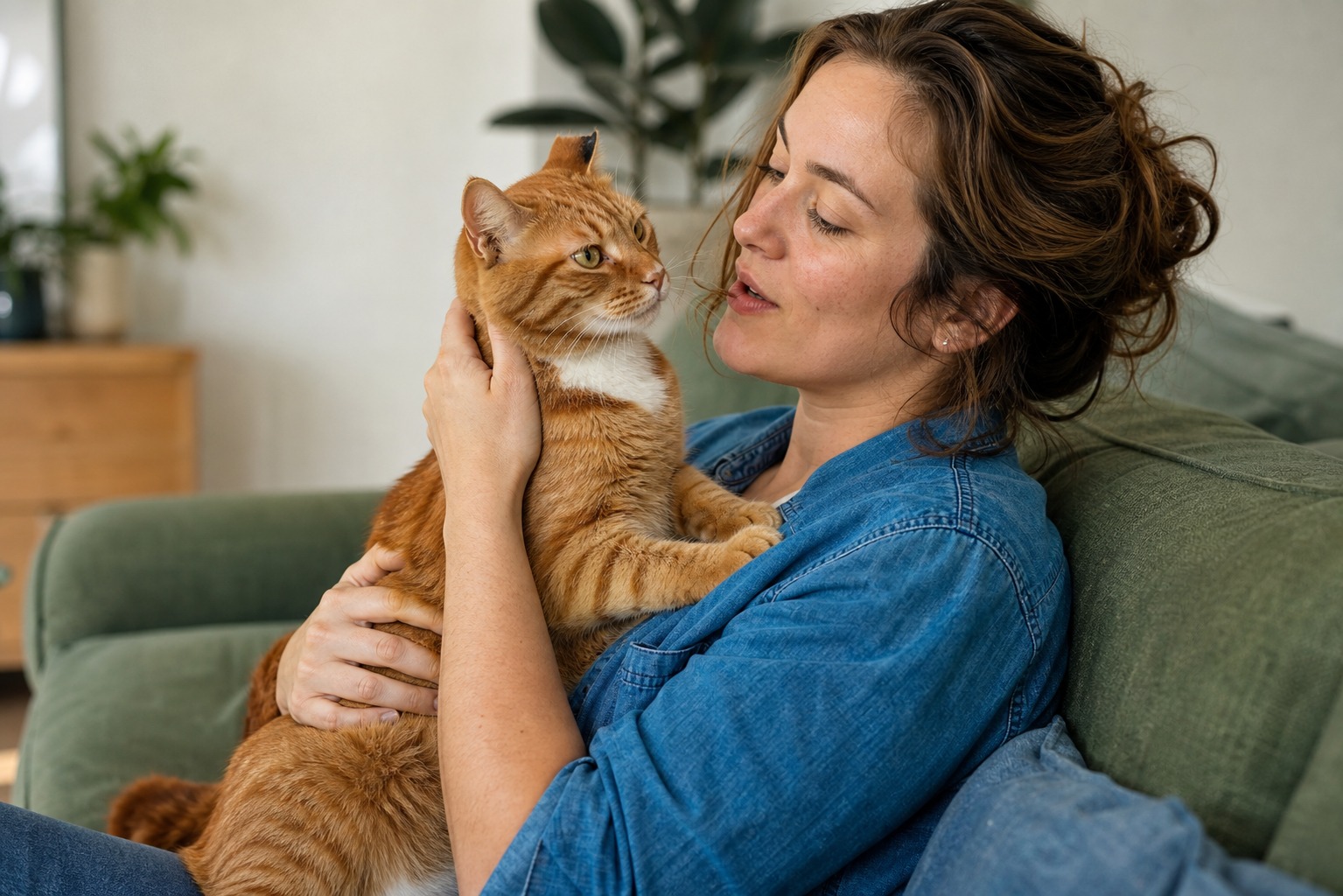
It seems like a simple question: does your cat understand you when you talk to them? It’s actually trickier than it looks.
Research on cats lags far behind research on dogs. Cats started out as mysterious little creatures and have stayed that way, partly because they’re so individual. Each cat has their own knack for learning, and how much we interact with and try to teach them hugely shapes what they pick up. Naturally, most of us are convinced our cat is the smartest one alive and understands nearly everything we say. The reality is more interesting than a simple yes or no.
Can cats understand words?
Cats rarely rely on a single sense like hearing. They’re constantly blending multiple senses to make sense of their world, and that includes their interactions with us. It’s not just what you say but how you say it, how consistently you’ve said it, and what your cat has learned that word tends to predict. All of that helps a cat link a particular word to a particular outcome.
When people ask whether their cat understands them, the honest answer is that the cat is reading the whole package. The word, your tone, your posture, the time of day, what usually happens next. Strip the word out of that context and it loses most of its meaning to them.
Tone and body language
Your tone and body language can matter as much as the word itself. Say you regularly use a bright, upbeat voice and relaxed, friendly body language when you say “treat” and then hand over a treat. Your cat reads the body language, tone, and word together and learns they predict a snack.
Now say the same word, “treat,” in a flat, sad tone while waving your arms over your head and facing away from your cat. They’re far less likely to connect it to a treat — not because they think you’ve lost your mind, but because the familiar bundle of cues that means “treat” to them is missing.
Recognizing vs. understanding
Here’s a useful distinction. Cats are thought to be better at recognizing words than understanding them.
Recognizing means a cat has linked two things using basic senses — sight, sound, touch, smell. Hearing “treat” (along with your tone and body language) connects to a memory of getting a treat after that word. With repetition, the cat learns the word predicts a snack. That’s believed to be how cats learn words at all.
Understanding is deeper: knowing what a treat actually is, how it’s made, what’s in it. That level of comprehension is thought to be beyond a cat’s natural cognitive abilities — though ongoing research will keep refining these ideas.
Do cats know their names?
They can! Cats learn their names the same way they learn any other word — through repetition, tone, and body language paired with the sound. It’s not that they grasp the concept of a name; it’s that they’ve learned what reliably follows it.
This is actually a perfect example of how tone and body language shape a cat’s response to the same word. You’ve probably said your cat’s name countless times to invite them to something good — mealtime, a petting session — using a warm voice and relaxed body language without even thinking about it. Other times, you’ve likely paired their name with a frustrated tone, maybe after they swept something off a shelf. Same word, very different delivery, and your cat reads the difference instantly. In the first case, the name means “come get something great.” In the second, it means “what did you break?”
That’s exactly why it helps to reserve your cat’s name for positive moments. The more consistently the name predicts good things, the more reliably your cat will come when called.
How to communicate better with your cat
By now you’ve probably spotted the recurring theme. Repetition, consistency, tone, body language, and what happens next — those are the levers that help your cat learn words, cues, and even your moods.
Repetition and consistency
Pick the right word and say it the same way every time. Sounds obvious; it’s harder than it looks. Imagine teaching “sit.” The cue should be a clean “Sit.” But in practice we drift: “Sit, buddy.” “Sit, please.” “Can you sit down?” “I need you to sit.” Each variation comes with its own tone, which makes it harder for your cat to recognize what you’re asking. Keep it short and identical — “Sit,” same tone, every time — and you make the connection between cue and behavior much easier to learn (and reward).
Body language
Body language isn’t only loud when we’re annoyed. Vasquez offers a familiar scenario: a friend who can never get her cats into their carriers, while a calm visitor manages it with ease. “The difference is almost always the human’s body language,” she says. “If you walk in tense, braced like you’re about to wrestle the cat into the carrier, they read that energy immediately and bolt. If you sit down, pet them, treat it like no big deal, and then gently scoop them in, it’s a completely different experience for the cat.” Cats are masters of body language — odds are they read ours better than we read theirs.
Tone and emotion
It’s the same story with tone and emotion. Cats pick up on shifts in our mental and emotional state, and those shifts shape how they interact with us, how safe they feel, and whether they expect something good or bad. All of that affects your ability to communicate with and teach them, so it’s worth staying aware of what you’re projecting.
What about talking buttons?
You may have seen videos of cats “talking” by pressing recordable soundboard buttons. It’s the same learning principle scaled up: a cat learns that pressing a particular button reliably produces a particular outcome. Whether that amounts to genuine language or sophisticated association is exactly the recognizing-versus-understanding debate playing out in real time — and it’s one of the most exciting frontiers in feline cognition research right now.
What’s new since this was written
Interest in feline cognition has surged, and researchers are increasingly studying how cats associate words with meaning. A notable 2024 study from Japanese scientists found that cats can rapidly form associations between words and images — picking up a word-picture link after just a few exposures, in some cases faster than human infants do in comparable tests. It’s early, but it suggests cats may be quicker word-learners than the old “recognize, don’t understand” framing implies.
The animal-interactive-device (AAC button) movement has also become a serious research subject rather than just a social-media trend, with universities running large studies on how cats and dogs use soundboards. The findings so far reinforce the core message of this piece: consistency, repetition, and context are what let a cat connect a sound to an outcome — whether that sound comes from your mouth or a button under their paw.
References
- Saito, Atsuko, et al. “Domestic cats (Felis catus) discriminate their names from other words.” Scientific Reports, vol. 9, 2019. https://www.nature.com/articles/s41598-019-40616-4
- Takagi, Saho, et al. “Cats learn the names of their friend cats in their daily lives.” Scientific Reports, vol. 12, 2022. https://www.nature.com/articles/s41598-022-10261-5
- Vitale, Kristyn R., et al. “Attachment bonds between domestic cats and humans.” Current Biology, vol. 29, no. 18, 2019. https://www.cell.com/current-biology/fulltext/S0960-9822(19)31086-3
Common questions
How many human words do cats understand?
There's no firm number, and the word itself isn't the whole story. A gesture or a tone can mean as much to a cat as the word does. Every cat has their own capacity for learning, shaped by how much you interact with and teach them.
Can cats learn human language?
Cats can learn to recognize human language, but for a cat, 'language' includes body language and tone, not just words. They make connections between what we say and do and what tends to happen next.
Do cats know their own name?
Cats can learn to respond to their name. Research suggests they recognize the word more than they understand the concept of a name. They know that hearing it, in a happy tone, usually means something good is coming.
Nina Vasquez writes about life at home with pets and the relationships at the heart of it. Her work covers day-to-day living, people-and-pet stories, and the products that fit into a real household, with a warm, grounded take on everyday pet ownership.
Meet our experts ↗Keep reading
 TrainingYes, You Can Train a Cat. You've Just Been Offering the Wrong Deal.Tom Hadley · 7 min
 TrainingCats Are Not the Loners We Made Them Out to BeDr. Nina Kohl · 4 min
 Health & WellnessStop Wrestling Your Cat for Pills. Train Them Instead.Dr. Lena Park · 9 min
 TrainingYour Cat's Bowl Is Boring. Make Her Hunt for Dinner.Dr. Amara Solis · 7 min
 First DaysTake a Kitten Home Too Early and You'll Pay for It for 15 YearsDr. Lena Park · 10 min
 TrainingYour Cat Sleeps Sitting Up Because Part of It Never Clocks OutDr. Nina Kohl · 6 min