


It Was Never the Baby Voice. Your Cat Is Listening for You
The famous study says cats respond to baby talk. Read it closely and the pitch turns out to be a red herring. What cats actually track is you, specifically, and that changes how you bond with them.

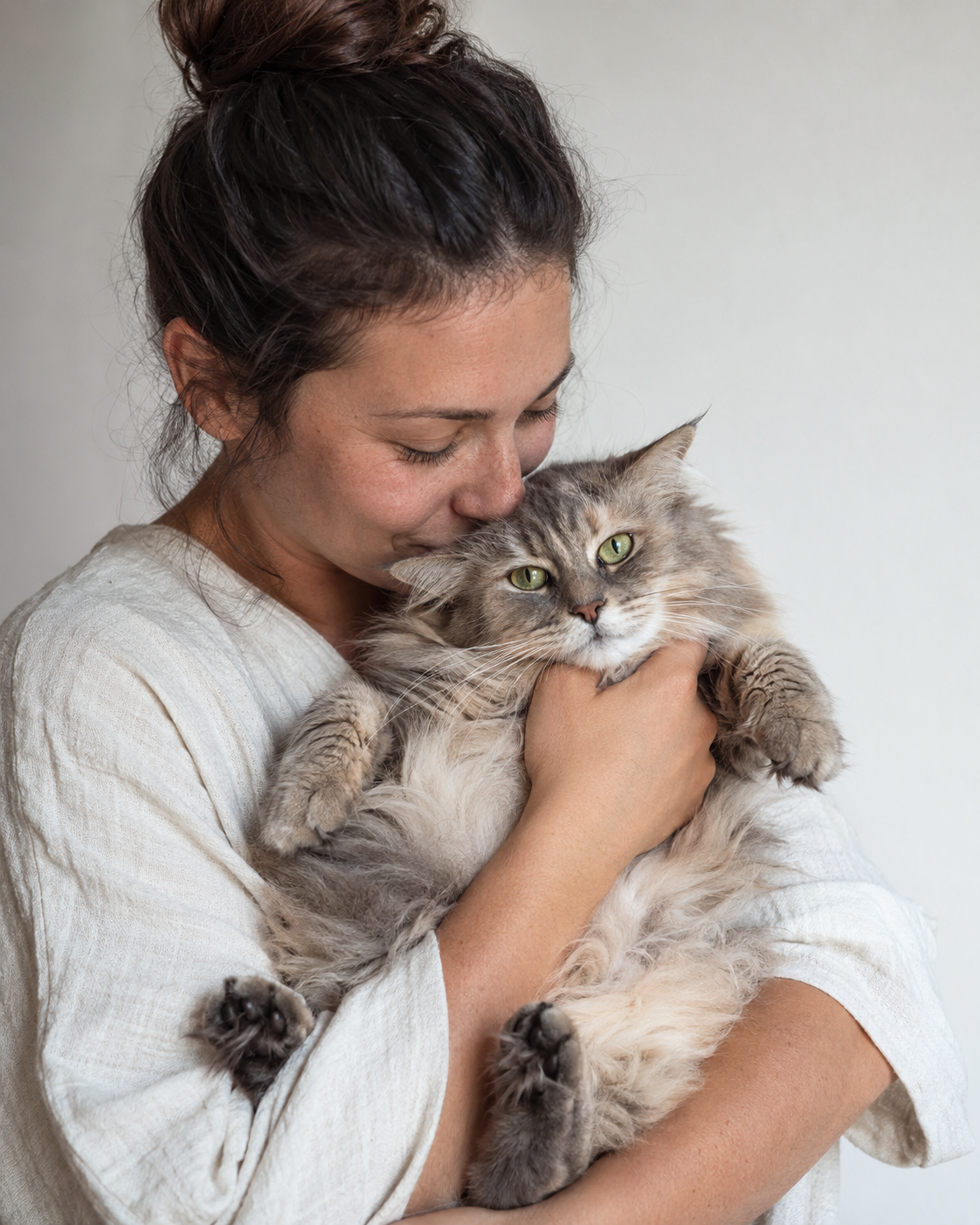
The headline you have probably seen is that cats like baby talk. It is a charming finding and it is not quite what the research shows. Read the actual study and the sing-song voice turns out to be a red herring. The thing your cat is really responding to is not a pitch at all. It is you, specifically, as a known individual. That distinction sounds small, but it flips the practical advice completely, from “change how you talk” to “be someone your cat recognizes.”
So if you are one of the deadpan among us, greeting your cat in the same flat register you use with a coworker, relax. The science does not say you are doing it wrong. It says something more interesting about the relationship you already have.
Read the study closely and the voice disappears
The much-cited work is a 2022 study led by Charlotte de Mouzon at Paris Nanterre University, published in Animal Cognition. Her team played 16 cats recordings of human voices, from both the cats’ own owners and strangers, speaking two ways: in a normal adult tone, and in that high, cooing “here, kitty-kitty” register.
Here is the part the headlines flatten. The researchers did not just note that cats liked baby talk more. They watched what happened over a sequence of phrases. When cats heard their owner speaking in an ordinary adult tone, their attention faded with each phrase, a reaction score that started around 13 sliding down to about 4 as they habituated and tuned out. Then, when the owner switched to cat-directed baby talk, the score leapt back up to roughly 14. The cats snapped back to attention.
But run the identical test with a stranger’s voice and the effect vanished. The stranger’s score dropped to around 5 and never recovered, baby talk or not. The cooing did nothing coming from someone the cat did not know.
That is the tell. If baby talk itself were the magic ingredient, it would work from anyone. It did not. The pitch only mattered as a signal layered on top of a voice the cat already recognized as theirs. The recognition is doing the work. The voice is just how it is delivered.
A second study points to the same thing
This is not one lab’s fluke. Separate research from the University of Tokyo found that cats reliably register when their own owner is talking to them, they are simply undramatic about it.
“The cats responded to human voices not by communicative behavior like vocalizing or moving their tail, but by orienting behavior like moving their ears and head,” those authors wrote, and that subtle response held even when cats were called by name. So the next time your cat appears to ignore you completely, take heart. The ears almost certainly moved. They heard you. They are just maintaining the brand.
Put the two studies together and they converge on one point. Cats carry a specific mental model of their own person, distinct from every other human, and they respond to that person in ways they do not for anyone else. Pitch is a minor variable. Identity is the main event.
The vets are skeptical of the voice, and that fits
Before you commit to a lifetime of cooing, it helps to hear from clinicians who work with cats daily, and they tend to wave off the baby-talk angle in a way that lines up neatly with the research.
Whether baby talk works really comes down to the individual cat and what it grew up with. For one, that sing-song pitch sparks a happy little greeting; for another, none of it registers and what actually gets through is being spoken to in an even tone, hearing the name it already knows, a session with a beloved toy, or an open invitation to hop up beside you. The through-line is that cats lock onto a familiar person, not a magic register. It’s the bond doing the heavy lifting, not the vocal trick.
That is genuinely good news for the flat-toned. If your love language is settling onto the cushions and letting your cat come to you, plenty of cats are fluent in exactly that. The honest clinical consensus is that receptiveness to baby talk varies cat to cat and mostly comes down to habit: a cat raised on sing-song responds to sing-song, a cat used to a normal voice responds to that. Many vets slip into an “overly jolly but calm” voice with cats on instinct, without being sure it changes anything measurable.
What to do with this, if not baby talk
If the pitch is optional, what actually moves the needle? Everything that strengthens your cat’s model of you and their map of your shared language.
Teach your cat their name. It is step one to communicating, because it lets your cat know a given sound is aimed at them and not just noise in the room.
Stay consistent with your phrases. Use the same words for the same favorite things, treats, food, being picked up, and your cat learns to map sound to meaning far faster than if you vary the wording each time.
Add a signal beyond words. Pairing a word with a distinct motion or sound, a specific shake of the treat bag, a particular click, gives your cat a second cue to lock onto and reinforces which human is offering it.
Tune in to the quiet stuff. Most of us catch only the loud, obvious signals. Widening your attention to the subtle ones, the slow blinks, the tail flicks, the shifting ear angles, deepens the relationship from your side. And that is the real lesson buried under the baby-talk headline: your cat has already built a detailed model of you. The bonding advice that works is the advice that helps you build an equally detailed model of them.
So coo at your cat or do not, whichever feels natural. The research suggests they might enjoy the cooing, but only because it is coming from you, and it is the “from you” that was always the point.
References
- de Mouzon, Charlotte, et al. “Discrimination of cat-directed speech from human-directed speech in a population of indoor companion cats (Felis catus).” Animal Cognition, 2022. link.springer.com/article/10.1007/s10071-022-01674-w
- Saito, Atsuko, and Kazutaka Shinozuka. “Vocal recognition of owners by domestic cats (Felis catus).” Animal Cognition, 2013. pubmed.ncbi.nlm.nih.gov/23525707
Dr. Nair is a veterinarian focused on diet and feeding. She covers everyday nutrition, treats, and the many "can they eat this?" questions owners ask, grounding each answer in what is actually safe and sensible for dogs and cats.
Meet our experts ↗Keep reading
 TrainingYour Cat Has Been Trying to Talk to You. Slow Blink Back.Dr. Nina Kohl · 5 min
 TrainingYou Can Tell When Your Cat Is Happy. That's the Problem.Dr. Priya Nair · 7 min
 TrainingThe Solicitation Purr: How Your Cat Uses Sound to Get Their WayDr. Nina Kohl · 5 min
 LivingYour Cat Isn't Trying to Cuddle. They're Doing Math.Dr. Nina Kohl · 6 min
 TrainingIntroducing Two Cats? Go Slower Than You ThinkDr. Nina Kohl · 7 min
 TrainingYour Cat Isn't Getting 'Brain Rot' From That Video. It Thinks It's HuntingDr. Ravi Mehta · 5 min