


Your Cat Has Been Trying to Talk to You. Slow Blink Back.
Researchers proved cats respond to a slow blink the way we respond to a smile, and a follow-up study found the cats who blink back get adopted faster. Here is how to hold the conversation.

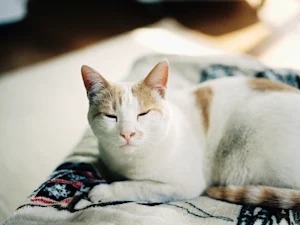
Here is something worth trying the next time your cat is settled across the room, half-watching you: soften your eyes, and let them slowly close. Odds are good your cat will do it right back. That little exchange is not a coincidence or wishful thinking. It is one of the few pieces of cat-to-human communication that scientists have actually put to the test, and the result is that you have a working phrase in your cat’s language, whether or not you knew you were using it.
The thing cats do with their eyes
You have almost certainly seen the slow blink even if you never had a name for it. A relaxed cat looks at someone they trust, narrows their eyes into a soft squint, and lets the lids drift shut for a beat before opening again. It is unhurried and gentle, nothing like the wide, locked-on stare a cat gives a rival or a threat.
Behavior researchers describe it as a sequence of half-blinks that end in a long, narrow-eyed squint or a full, slow eye closure. The comparison people reach for is a smile, and it is a fair one. In humans, the genuine, reaches-the-eyes smile involves the muscles that narrow the eyes, and in a number of other species, narrowed eyes show up in calm, positive moments rather than tense ones. A cat easing their eyes shut in your direction is doing the feline version of relaxing their whole face at you.
A hard, unblinking stare is a challenge in cat language, so when a cat deliberately softens and closes their eyes near you, they are doing the opposite of a threat. They are telling you they feel safe enough to stop watching you so closely. That is a real compliment from an animal built to stay alert.
What the research actually showed
The reason we can say this with any confidence comes from a team at the University of Sussex, led by animal behavior scientists whose work was published in the journal Scientific Reports. They ran two experiments, and both are simple enough to picture.
In the first, owners sat about a meter from their own cat and, on cue, slow blinked at them. Compared with times when the owner was just present in the room but not blinking, the cats were more likely to slow blink back. So the signal travels in both directions: blink at your cat and your cat tends to answer.
The second experiment swapped in a researcher the cats had never met. This stranger either slow blinked at the cat or held a neutral, no-eye-contact expression, then offered a flat, open hand. The cats not only slow blinked back at the stranger more often after being blinked at, they were also more likely to walk over and approach the outstretched hand. In other words, the slow blink did not just get returned by a familiar, comfortable cat. It made an unfamiliar human more approachable.
Put those together and you get a genuinely useful takeaway: a soft, slow blink is a low-stakes way to tell almost any cat, including one who does not know you, that you come in peace.
How to actually do it
The technique is forgiving, which is part of why it is worth teaching every cat owner and every cautious houseguest.
Get roughly at your cat’s level and a comfortable distance away, not looming over them. Relax your face. Narrow your eyes as if you are about to smile with them, then let your eyelids close for a second or two and open them again slowly. Then look slightly away rather than snapping back to a hard stare. If your cat answers with a blink of their own, or looks away and back, you are having a conversation.
A few things to avoid: do not hold a wide, fixed, direct stare, which a cat reads as confrontational. Do not lean in or reach at the same time. And do not force it on a cat who is already frightened or overstimulated. The slow blink is an opener, not an override.
What newer research adds
The Sussex work opened an obvious question: if cats read a returned blink as friendly, does it change how they get treated in the real world? A follow-up study, published in the journal Animals in 2020 by some of the same researchers, looked at shelter cats, and the finding is a small heartbreaker in the best way. Cats that responded to a human slow blink with more, and longer, eye closures tended to be rehomed faster than cats that did not.
The researchers were careful about what that does and does not prove. It does not mean a blinky cat is objectively “better,” and they noted that more nervous cats sometimes produced these blink sequences too, which suggests the behavior can show up in both affectionate and appeasing situations. But for anyone visiting a shelter, it hands you a practical tool. Sitting quietly by a kennel and offering a few soft slow blinks is a gentle, no-pressure way to invite a wary cat into an interaction on their terms, and it may be part of what tips a hesitant adopter toward “this one.”
The larger point that newer work keeps reinforcing is that cats are far more socially tuned to us than their aloof reputation suggests. They read our faces, respond to our cues, and, it turns out, will hold up their end of a very quiet conversation if we bother to learn the words.
References
- Humphrey, T., Proops, L., Forman, J., Spooner, R., and McComb, K. “The role of cat eye narrowing movements in cat-human communication.” Scientific Reports, 2020. https://www.nature.com/articles/s41598-020-73426-0
- Humphrey, T., Stringer, F., Proops, L., and McComb, K. “Slow Blink Eye Closure in Shelter Cats Is Related to Quicker Adoption.” Animals, 2020. https://www.mdpi.com/2076-2615/10/12/2256
Common questions
What does it mean when a cat slow blinks at you?
It is a friendly, non-threatening signal, often compared to a human smile. A cat who narrows their eyes and slowly closes them near you is telling you they feel safe and are not a threat. Researchers have shown cats are more likely to do it back when you do it first.
How do I slow blink at my cat?
Relax your face, narrow your eyes as if you are smiling with them, then let your eyelids drift closed for a second or two and open them again slowly. Keep it soft and unhurried. Do not hold a wide, fixed stare, which reads as a threat to a cat.
Does slow blinking actually work on cats?
In controlled experiments, yes. Cats slow blinked back at owners and even at unfamiliar people more often after a human slow blinked at them, and were more likely to approach a stranger's outstretched hand afterward. A separate shelter study linked blinking back to faster adoption.
Dr. Kohl is a board-certified veterinary dentist with a particular interest in preventive oral care. She reviews all dental health content at The Pet Times and contributes practical guides on home dental routines, professional cleaning, and oral disease prevention.
Meet our experts ↗Keep reading
 TrainingWhy a Cat Will Nurse a Duckling, and Why You Should Still Watch CloselyDr. Amara Solis · 6 min
 TrainingYour Cat Keeps a Separate Setting for Every Person. Men Get the Loud OneDr. Mara Chen · 4 min
 TrainingYour Cat Isn't Being Dramatic. 8 Things That Genuinely Wound ThemDr. Nina Kohl · 6 min
 LivingYour Cat's 5 A.M. Screaming, Translated (and Why It Really Happens)Tom Hadley · 4 min
 LivingYou Bought the Bed. She Sleeps in the Drawer. She's Not Being Rude.Dr. Nina Kohl · 6 min
 TrainingYour Cat Isn't Plotting Revenge. They Already Forgot.Dr. Nina Kohl · 5 min