


Your Cat Keeps a Separate Setting for Every Person. Men Get the Loud One
A study of 31 cats found they meowed about 4.3 times to greet men versus 1.8 for women. The real story is not that men don't listen. It's that cats build a custom signal for each person.

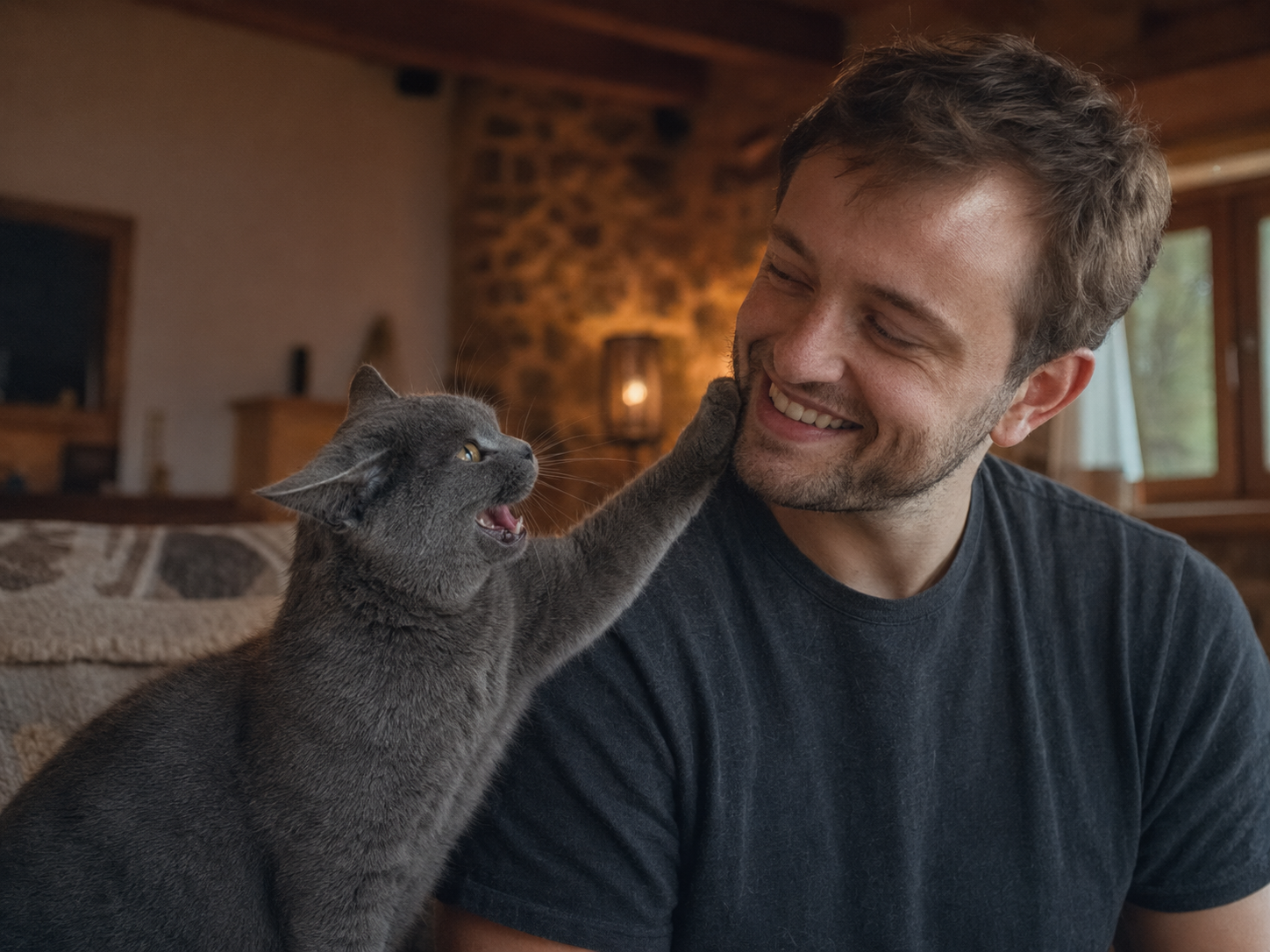
The headline version of this study writes itself, and it is unkind to men: cats yell at the guys because the guys don’t pay attention. It is a fun line, and there is a grain of truth in it. But it buries the more remarkable finding underneath a punchline. What the researchers actually documented is that a cat runs a different communication setting for every person it lives with, and tunes the volume of each one to how much that person tends to notice. Men just happen to get the loud setting.
That is not an insult. That is social learning, and it is genuinely impressive.
The one number that tells the story
A team at Ankara University in Turkey, led by Yasemin Salgırlı Demirbaş, filmed 31 cats greeting their people and published the results in the journal Ethology. The method was clever and low-tech: each caregiver clipped a small camera to their chest and recorded the first few minutes of coming home. The researchers then analyzed the opening 100 seconds of each reunion, frame by frame, logging every meow, chirp, stretch, yawn, and tail flick.
Here is the figure that matters. In those first 100 seconds, cats averaged about 4.3 vocalizations when greeting men, compared to roughly 1.8 for women. More than double. Every cat was at least eight months old and every person had lived with their cat for at least six months, so these were established relationships with a shared history, not first impressions.
It wasn’t about dinner
One of the cleanest results was a thing that didn’t happen. The team also tracked food-related behavior, trotting to the bowl, starting to eat, and it did not line up with the greeting at all. The cats were not simply shaking anyone down for a meal.
A greeting is a relationship behavior, not a transaction. When a cat meets you at the door and vocalizes, they are managing the bond, easing back into closeness after a separation, not filing a dinner order. That is why the food data is so telling. Strip out hunger, and the talking is still there.
Why the volume knob moves, and nothing else does
After accounting for the cat’s breed, sex, and how many other cats shared the home, one variable stood out above all the others: the sex of the person being greeted. And notice what did not change. The stretching, the crouching, the tail signals, all of it stayed the same across men and women. Only the vocal volume moved.
That specificity is the point. The cats were not “acting differently around men” in some broad way. They were adjusting exactly one channel, the audio, while leaving every other channel untouched. That looks a lot like a targeted strategy, not a mood.
The researchers’ proposed explanation is the humbling one for the guys, and it is worth stating fairly. On average, women in the study talked to their cats more, were better at reading subtle feline body language, and were more likely to mimic cat sounds. When your quiet signals already land, a cat doesn’t need to escalate.
“If a soft chirp gets a response from you, the cat learns to stay soft,” Dr. Chen explains. “If it takes a loud, repeated meow to get noticed, the cat learns to lead with volume. They are optimizing for the listener in front of them. The men in the house are simply getting the version calibrated to them.”
How much to trust it
The authors are candid about the limits. All the cats and people were in Turkey, and cultural habits around how we talk to our pets could shift the numbers elsewhere. They also could not pin down exactly how long each person had been away before coming home, which can affect how enthusiastic a greeting gets. Thirty-one cats is a real study, but a modest one.
Still, it slots neatly into a growing pile of evidence that cats are quietly fluent in us. Separate research from Paris Nanterre University found that cats can tell when their own person is using that sing-song “kitty-kitty” voice and respond to it, while ignoring the same cooing from a stranger. They are not reacting to noise in the room. They are reacting to a specific relationship.
Put it together and the takeaway is sweeter than the punchline. Your cat is not a passive listener with one generic meow. They keep a mental profile of each person, how attentive you are, what gets through, how loud they need to be, and they update it over time. If your cat bellows at one housemate and murmurs at another, they are not being rude. They are being efficient, and they have been paying closer attention than most of us realized.
References
- Salgırlı Demirbaş, Yasemin, et al. “Greeting Vocalizations in Domestic Cats Are More Frequent With Male Caregivers.” Ethology, 2025.
- de Mouzon, Charlotte, Marine Gonthier, and Gérard Leboucher. “Discrimination of Cat-Directed Speech From Human-Directed Speech in a Population of Indoor Companion Cats.” Animal Cognition, 2022.
Dr. Chen is a small-animal veterinarian who leads health and safety coverage at The Pet Times. She writes and reviews the bulk of our illness, condition, and safety content, translating clinical guidance into clear, practical advice owners can act on at home.
Meet our experts ↗Keep reading
 TrainingYou Can't Discipline a Cat. Trying Is Making the Behavior WorseDr. Nina Kohl · 8 min
 TrainingKitten Biting Has a Closing Window. This Is What You Do in It.Dr. Amara Solis · 6 min
 TrainingYour Cat Sleeps Sitting Up Because Part of It Never Clocks OutDr. Nina Kohl · 6 min
 TrainingYour Cat Didn't Choose You. You're Just the Safe One.Dr. Nina Kohl · 6 min
 TrainingYour Cat Might Be Catching Your Stress. A 3,000-Person Study Says So.Dr. Mara Chen · 5 min
 LivingYou Bought the Bed. She Sleeps in the Drawer. She's Not Being Rude.Dr. Nina Kohl · 6 min