


The Solicitation Purr: How Your Cat Uses Sound to Get Their Way
Researchers found that cats tweak their purr to nudge our behavior. Here is how your cat may be using their voice to get exactly what they want, exactly when they want it.

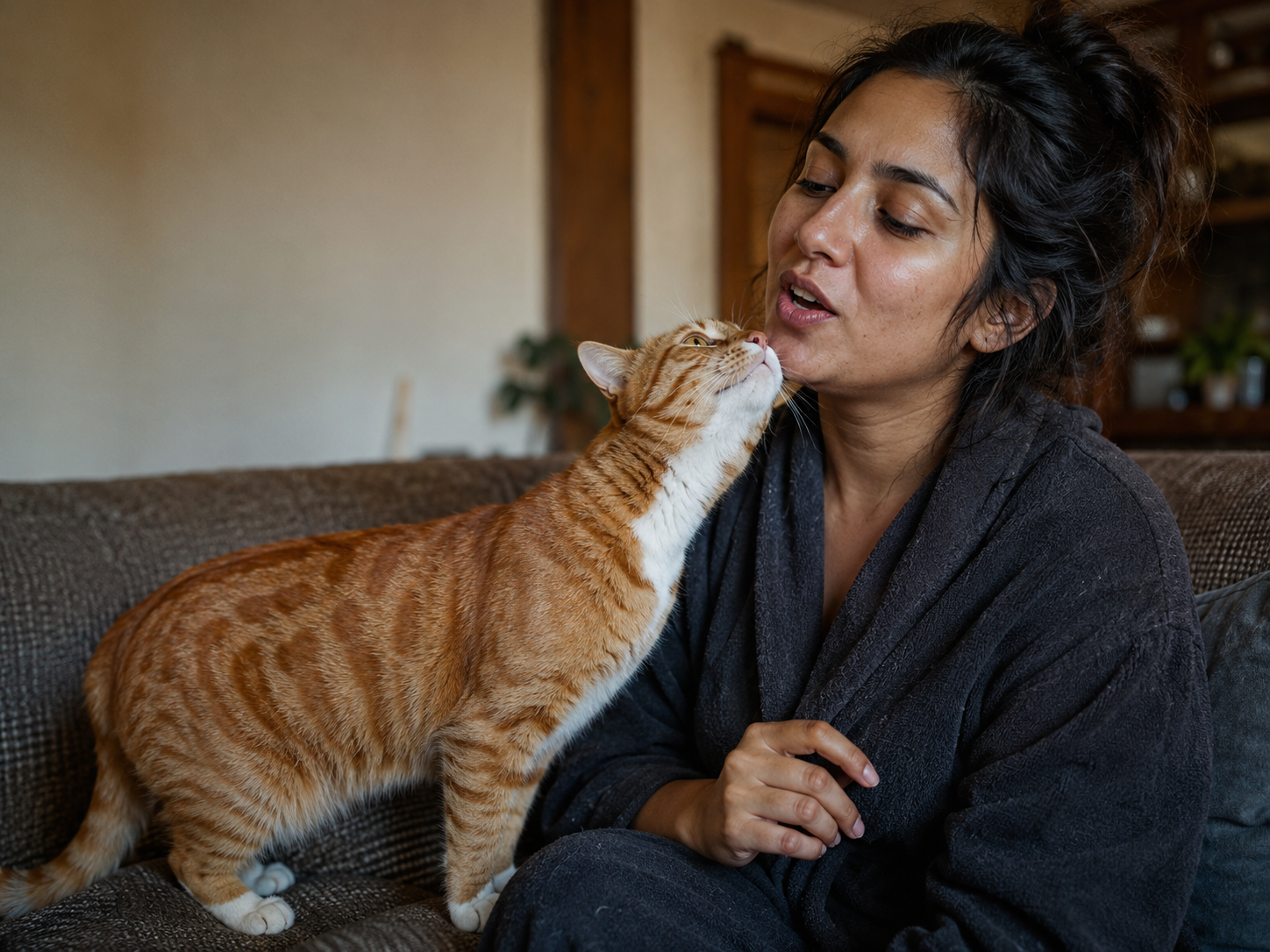
You feed your cat, you clean up after your cat, and somewhere along the way you may have realized who actually runs the household. If you have ever suspected your cat of gently working you for an early breakfast, you are not imagining it. There is research to back you up.
A 2009 study published in Current Biology found that cats can change the quality of their purr to shape how people respond to them. The same cat does not purr the same way in every situation. When they want something from you, particularly food, the purr shifts in tone and timing, and people can reliably hear the difference even if they have never owned a cat.
What makes the “solicitation purr” different
A regular contentment purr is a low, steady rumble. The purr a cat produces when they are asking for something carries an extra layer on top of that rumble: a higher-pitched voiced element, almost a cry or a small meow, created when air moves across the vocal folds. That added note is what tips us off.
In the study, listeners described these food-seeking purrs as more urgent and less pleasant than ordinary purrs. That is not an accident. The high-frequency component sits in a range that overlaps acoustically with the distress cries of a human infant.
A solicitation purr hides a little cry inside a sound we usually find soothing. Your brain registers the comforting rumble and the urgent signal at the same time, which makes it very hard to tune out.
Human babies cry the way they do for a reason. Those cries evolved to be nearly impossible to ignore, so that even an exhausted, distracted parent will get up and tend to an infant. We are wired to respond, and that response is what keeps babies alive. The food-soliciting purr appears to borrow that same lever. In effect, a hungry cat is tapping into the part of you that cannot walk away from a crying child.
Why this works so well for cats
Cats are leaning on our instinct to care for the vulnerable, and it pays off for them. Honestly, it works out fine for us too. We love our cats, we want to look after them, and a clear request is easier to act on than a mystery. Any signal that helps two different species understand each other is a small marvel, and it lets us meet our cats’ needs more accurately, which makes their lives better.
It also helps that cats seem to aim much of their vocalizing at us rather than at each other. Many house cats are far chattier with people than they are with other cats, which suggests they are talking to us. And anything that gets results gets repeated.
“This is positive reinforcement in its purest form,” Dr. Kohl explains. “If a 5 a.m. purr-cry gets a person out of bed to fill the bowl, the cat has learned a strategy that pays. They will run it again tomorrow.”
Tellingly, the cats most likely to exaggerate that urgent, baby-like cry are the ones with a close, one-on-one bond with a single person. The stronger the relationship, the more finely tuned the request.
You can read this two ways. One is that your cat has figured out how to hijack your empathy for a second helping of dinner. The other, just as fair, is that responding to your cat’s clearest form of communication is simply another way you show them love. Manipulation or devotion, the bowl gets filled either way.
What to do when the purr-cry runs your morning
Understanding the mechanism is satisfying, but the practical question most owners actually have is how to stop a 5 a.m. purr-cry from dictating breakfast. The answer follows directly from the science above: because the behavior is positively reinforced by your response, the fix is to change what your response reinforces, not to try to ignore a sound your brain is wired to notice.
“You cannot out-stubborn a solicitation purr, because it is targeting a reflex, not a decision,” Dr. Kohl says. “What you can do is break the link between the sound and the payoff. If the purr-cry reliably produces food, it will continue. If it reliably produces nothing, and food instead arrives on a schedule the cat cannot influence, the strategy stops working and fades.”
The most effective single change is to decouple waking you from feeding. Feed on a fixed schedule, or use an automatic timed feeder, so the meal is no longer something your cat can summon by getting you up. An early-morning feeder that dispenses before your cat’s usual wake-you window is often the whole fix, because it removes you from the equation entirely. Pair that with a real play session and a snack right before bed to blunt overnight hunger, and resist the urge to respond in the moment, since even an irritated “stop it” is attention, and attention is the reward. It can take a week or two of consistency for the old strategy to extinguish, and it will often get briefly louder before it quiets, which is a sign it is working, not failing.
References
- McComb, Karen, et al. “The Cry Embedded within the Purr.” Current Biology, vol. 19, no. 13, 2009, pp. R507–R508. https://doi.org/10.1016/j.cub.2009.05.033
- International Cat Care. “Cat Communication.” https://icatcare.org/advice/cat-communication/
Dr. Kohl is a board-certified veterinary dentist with a particular interest in preventive oral care. She reviews all dental health content at The Pet Times and contributes practical guides on home dental routines, professional cleaning, and oral disease prevention.
Meet our experts ↗Keep reading
 TrainingThe Cat-Stress Study's Real Twist: Knowing Isn't the ProblemDr. Nina Kohl · 5 min
 TrainingYour Shoes Are the Most Interesting Thing You Own. Just Ask Your CatSasha Ford · 6 min
 TrainingYour Cat Holds a Picture of You in Their Head, Even When You Leave the RoomDr. Mara Chen · 4 min
 Health & WellnessYour Male Cat Isn't Being Spiteful. He's Leaving You a Note.Dr. Mara Chen · 7 min
 TrainingThe Paw on Your Mouth at 4 A.M.? You Trained That.Dr. Amara Solis · 6 min
 LivingYour Kid Isn't Scaring the Cat on Purpose. Here's the Fix.Dr. Nina Kohl · 6 min