


That Sneer Is Your Cat Tasting the Air. Here's the Organ Doing It
The curled-lip grimace cats make is the Flehmen response, and it runs on a scent organ in the roof of the mouth most owners have never heard of. Here is how it works, plus a field guide to your cat's other mouth expressions.

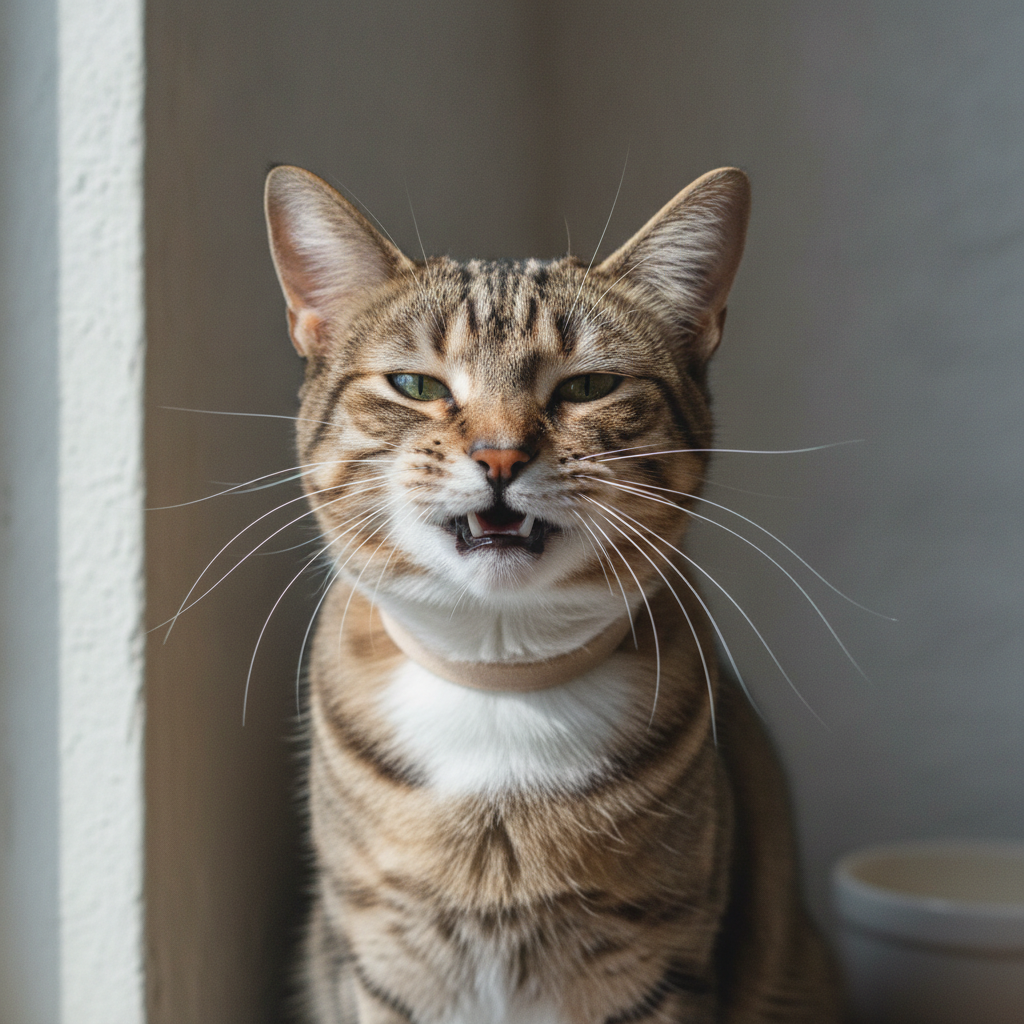
You know the look: your cat, mouth slightly open, upper lip peeled back, wearing an expression of frozen disgust, as if it just caught you doing something unforgivable. It reads as a sneer. It is not. That face is one of the more sophisticated things your cat’s body does, and once you know the machinery behind it, the whole catalog of feline mouth expressions gets easier to read. So instead of running through cat faces as a list of quirks, let us start with the anatomy that explains the strangest one, then work outward.
The sneer has a name and a dedicated organ
The grimace is the Flehmen response, and cats are far from the only animals that do it (horses and big cats are famous for it too). What looks like disdain is actually your cat routing a scent to a sensory organ you cannot see: the vomeronasal organ, also called Jacobson’s organ.
Here is the mechanism, which the “cats are just judging you” framing completely misses. On the roof of your cat’s mouth, just behind the upper front teeth, is a small fleshy bump called the incisive papilla. Behind it sit two tiny, fluid-filled sacs (the vomeronasal organ) connected to the mouth and nose by narrow nasopalatine ducts. When your cat curls its lip and holds its mouth open, it creates a small vacuum that pulls scent-laden air and dissolved chemical particles up through those ducts and into the organ. The organ then fires signals along its own nerve pathway to the brain, essentially letting the cat taste a smell.
The Flehmen response is not an emotion at all, it is a second sense of smell switching on. The vomeronasal organ specializes in heavy, low-volatility molecules like pheromones that ordinary sniffing does not pick up well. So when your cat makes that grimace over another cat’s spot on the couch, or a bit of your laundry, it is gathering social intelligence: who was here, their reproductive status, their mood. It is investigation, not insult.
That is why you most often see the Flehmen face around scent-heavy targets: another animal’s urine or marking, a spot where a cat has rubbed its cheek, or something carrying strong pheromones. It is a feature, not a snit.
The rest of the mouth: a quick field guide
Once you stop reading every open mouth as commentary on your life, the other expressions sort out cleanly.
The slack, open-mouthed “disbelief” look. Usually nothing. Some cats simply forget their mouth is open, and a few habitually leave the tongue tip sticking out after grooming (the “blep”). No meaning to decode.
The trembling-whisker chatter. Mouth open, whiskers quivering, an odd low chattering or chirping noise, often aimed at a bird or squirrel through a window, sometimes at a toy. It comes with shifts in posture, ears, and eyes. The exact reason is not fully understood, but it most likely reflects excitement or the frustration of thwarted hunting.
The soft “smile.” Technically cats can smile, though most feline expressions relate more to fear, aggression, or pain than to happiness. That said, a deeply relaxed, content, almost trance-like face is a genuinely positive expression, and some cats even drool a little when they hit that state.
The one mouth expression that is a warning
Here the lighthearted lip-reading turns serious, and it is worth pinning down the difference. During or right after vigorous play, some cats pant, breathing hard with the mouth open. On its own, just after zoomies, that is usually harmless: cats get winded like we do, more so if they are carrying extra weight. Give them a short break and they are typically ready to go again in seconds.
Open-mouth breathing outside of heavy activity is a different animal:
If a cat pants when it has not just been tearing around the room, treat it as urgent, not cute. In cats, open-mouth breathing at rest can signal respiratory infection, asthma or other lung disease, a foreign object or choking, heart failure, or even the aftermath of a seizure. Cats hide illness well, so resting open-mouth breathing is one of the clearest distress signals they give. That is a same-day vet call, not a wait-and-see.
The tidy summary: the sneer is your cat tasting the air, the chatter is excitement, the slack jaw and the soft smile are nothing to worry about, and the only mouth expression that should actually alarm you is panting when your cat has been sitting still. You will probably still suspect your cat is judging you. That part may never fully go away.
References
Dr. Solis is a board-certified veterinary dermatologist with over twelve years of clinical experience. She advises on skin conditions, allergies, and grooming practices that affect coat and skin health. All dermatology and allergy content at The Pet Times is reviewed by her team before publication.
Meet our experts ↗Keep reading
 TrainingYou Can't Discipline a Cat. Trying Is Making the Behavior WorseDr. Nina Kohl · 8 min
 TrainingYour Cat Might Be Catching Your Stress. A 3,000-Person Study Says So.Dr. Mara Chen · 5 min
 TrainingYour Cat Isn't Kissing You. Watch What Happens Three Seconds Later.Dr. Mara Chen · 7 min
 TrainingKitten Biting Has a Closing Window. This Is What You Do in It.Dr. Amara Solis · 6 min
 TrainingYour Cat Is Probably Securely Attached. Here's Why That's the Useful PartNina Vasquez · 5 min
 TrainingYour Cat Isn't Losing It in the Mirror. Here's What's Really Going OnDr. Mara Chen · 5 min