


Your Cat Isn't Losing It in the Mirror. Here's What's Really Going On
Viral videos make it look like cats panic at their reflections. The science says it is mostly curiosity, not a meltdown, and the reason is all about scent.

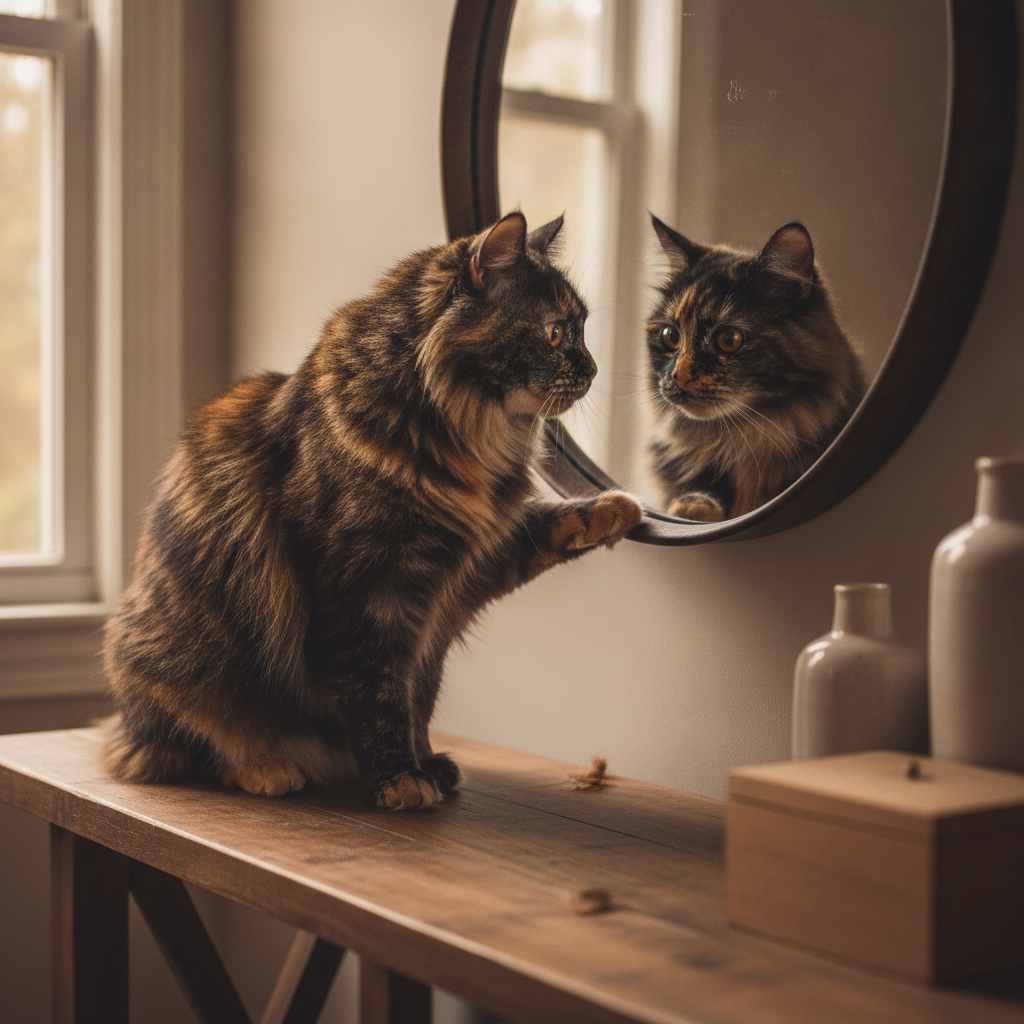
Your cat is smart, sweet, a little hyper, and undeniably a little weird. If TikTok is your evidence, one of their weirdest habits is apparently flipping out at the sight of their own reflection. A glance in the mirror, and suddenly there is an arched back, a fluffed tail, ears flat, the whole drama.
Except that is probably not what is happening. What looks like a freak-out is, more often than not, plain curiosity. And in this case, curiosity does not kill the cat. It just makes them look ridiculous on a video with two million views.
What the mirror test actually measures
We can say this with some confidence because of a long-running experiment called the mirror self-recognition test, or MSR. American psychologist Gordon Gallup Jr. developed it in 1970 to probe whether an animal has self-awareness, specifically whether it recognizes its reflection as itself or treats it as another creature entirely.
Cats have a zero percent success rate on this test. They typically read their reflection as another cat, an irrelevant blip, or a mildly interesting thing to investigate and then ignore. That is not a knock on cats. The club of animals that pass the test is tiny: humans, great apes, bottlenose dolphins, and a handful of birds.
Less freak-out than you think
Despite the viral footage, the actual numbers on mirror reactions are calm. Aggressive responses, including hissing, defensive crouching, and territorial displays, make up only about 10 percent of behaviors cats direct at reflections. The large majority react with curiosity, not fear.
When a cat truly believes another cat has entered its space, you see real fear and territorial stress, because a rival could take its resources. That reaction is mostly missing at the mirror, and the reason is simple: there is no scent.
That scent point is everything. Cats identify other animals primarily by smell, not sight. Their visual systems are tuned for motion and night vision rather than detailed facial recognition, which creates a basic mismatch with a test built entirely on vision. To a cat, the reflection is a moving thing worth a look, a bit like the squirrel outside the window, not an intruder worth defending the house against.
Not recognizing yourself does not mean you are dim
A cat’s evolutionary backstory helps explain all of this. Highly social animals like apes, elephants, and dolphins have to track complex group dynamics and recognize individuals, so self-other distinction earns its keep. Cats evolved as solitary hunters, where telling self from other offered fewer survival payoffs, so they never developed the same neural wiring for it.
That gap is about lifestyle, not intelligence. A 2022 study published in Animal Behavior and Cognition analyzed 57 YouTube videos of cats meeting mirrors and found no evidence of self-recognition, identifying five distinct behavior patterns that boiled down to confusion, brief investigation, and the occasional flash of aggression.
Reactions also vary by individual. Breed and age play a role. One study of more than 5,000 cats found Turkish Vans showed the highest aggression toward other animals, while kittens in the key social window of eight to 16 weeks are more likely to respond to a “new cat” with play.
Cats absolutely have a sense of self
Here is the part that clears cats’ name. Failing a vision-based test does not mean a cat has no self-awareness.
“A cat with no self-awareness would have no way to gauge whether a jump onto the fridge is within reach,” Dr. Chen notes. “That calculation requires knowing your own body and its limits. The mirror simply is not a fair test of feline cognition.”
The evidence backs that up. Cats are strong at independent problem-solving, spatial memory, and observational learning. A 2015 study found that 79 percent of cats showed referential looking between their owner and an object when faced with something unfamiliar, meaning they read their human’s emotional cues to decide how to act in a new situation. Other research has found cats demonstrate fully developed object permanence, the understanding that things still exist when out of sight, starting as young as eight weeks.
There is hardware to match. A cat’s brain shares roughly 90 percent of its structure with the human brain, with around 300 million neurons in the cerebral cortex, the region that handles complex thought, decision-making, and problem-solving.
And cats gather information in ways a mirror can never capture, chiefly through that extraordinary nose. You may have caught your cat in a flehmen response, the open-mouthed “stank face” that lets them taste and smell a scent at the same time. Sight is simply not their primary tool, so a sight-only test was always going to sell them short.
The bottom line
Your cat is not having a breakdown in the mirror, and they are not stupid for failing to recognize themselves. They are a scent-driven, motion-tuned predator encountering a silent, odorless moving shape, and they are doing exactly what curious predators do: checking it out. As neuroimaging and better-designed tests develop, we will likely uncover forms of feline self-awareness that today’s methods miss. Translation: more ways to measure how clever your cat is, and more reasons to brag.
References
- Gallup, Gordon G. “Chimpanzees: Self-Recognition.” Science, vol. 167, no. 3914, 1970, pp. 86-87. https://www.science.org/doi/10.1126/science.167.3914.86
- Takagi, Saho, et al. “Cats Learn the Names of Their Friend Cats in Their Daily Lives.” Scientific Reports, vol. 12, 2022. https://pmc.ncbi.nlm.nih.gov/articles/PMC9095720/
- Merola, Isabella, et al. “Social Referencing and Cat-Human Communication.” Animal Cognition, vol. 18, 2015, pp. 639-648. https://doi.org/10.1007/s10071-014-0832-2
- “How Do Domestic Cats Respond to Their Reflections?” Animal Behavior and Cognition, vol. 9, no. 2, 2022 (analysis of 57 YouTube videos of cats and mirrors). https://www.animalbehaviorandcognition.org/
Dr. Chen is a small-animal veterinarian who leads health and safety coverage at The Pet Times. She writes and reviews the bulk of our illness, condition, and safety content, translating clinical guidance into clear, practical advice owners can act on at home.
Meet our experts ↗Keep reading
 Health & WellnessYes, Female Cats Spray. Spaying Doesn't Always Stop It.Dr. Lena Park · 7 min
 TrainingYour Cat Isn't Nocturnal. They're Running on Your ClockDr. Lena Park · 8 min
 TrainingYour Cat Isn't Broken. But 3 of These 7 Habits Deserve a Vet Call.Dr. Nina Kohl · 8 min
 TrainingStop Watching Who's Winning. The Real Tell in a Cat Fight Is Who Trades PlacesNina Vasquez · 5 min
 LivingThe Shoulder-Cat Photo Everyone Tried to Copy. Here's Why Yours Won't Work.Sara Lim · 6 min
 TrainingYour Cat Isn't Grateful. They're Telling You They Feel Safe, Which Is BetterClaire Sutton · 6 min