


Your Cat Isn't Nocturnal. They're Running on Your Clock
The real reason your cat wakes you at dawn isn't a wild instinct you can't fight. Indoor cats largely sync to their humans, which means the 4 a.m. wake-up is a schedule problem you can solve.

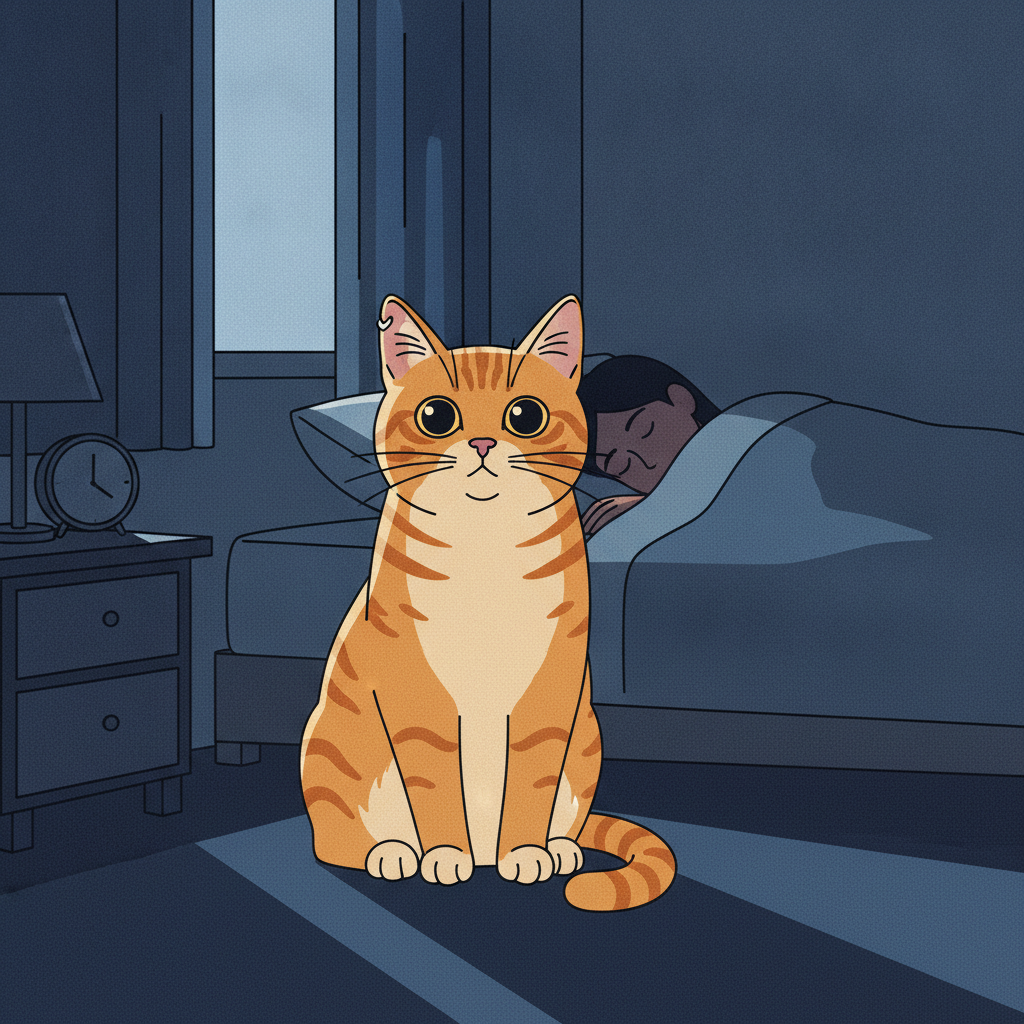
Here is the question worth asking, and it is not the one you searched for. You did not really want to know whether cats are nocturnal. You wanted to know why yours is yowling outside your door at 4 a.m. The honest answer is more useful than the label: your cat’s nighttime schedule is mostly negotiable, and a good deal of it is set by you.
The myth says cats are creatures of the dark, hardwired to prowl while you sleep, and there is nothing to be done about it. The science says something more hopeful. Indoor cats are remarkably flexible about when they are active, and the biggest single influence on a house cat’s daily rhythm turns out to be the human they live with. That changes the whole conversation. A fixed instinct is something you endure. A learned schedule is something you can change.
The label everyone gets wrong
Cats are not nocturnal. Truly nocturnal animals, like bats, owls, and raccoons, do their feeding, mating, and socializing in full darkness and sleep through the day. Cats do not work that way.
The textbook answer is that cats are crepuscular, meaning they are built to be most active in the low light of dawn and dusk. There is good reason for that wiring. At twilight, a hunting cat can see well enough to stalk small prey while staying hard for larger predators to spot. Their eyes are exceptional at amplifying faint light, which is why they move with confidence in conditions that would leave you squinting. Crepuscular company includes rabbits, deer, hamsters, and guinea pigs, all animals that evolved to exploit those in-between hours.
So far this matches the standard explanation. Here is where it falls apart for the cat actually living in your apartment.
Why “crepuscular” stops describing an indoor cat
When researchers strapped activity monitors to cats and tracked them around the clock, the tidy crepuscular story held up only for cats with real outdoor access. A study comparing cats in different housing conditions found that outdoor cats kept strong, reliable dawn-and-dusk activity peaks, exactly what the textbook predicts. Indoor cats with limited access to the outside world did not. They showed no innate daily rhythm of their own. Instead, they adopted their owner’s schedule.
Sit with that for a second. The instinct is real, but it is not destiny. Strip away the outdoor cues a wild rhythm depends on, and a house cat largely re-times itself around you, your alarm, your meals, your comings and goings. Activity studies of indoor cats have clocked their busiest stretches rising right around the times their humans get up and come home, near the start and end of a typical human day rather than at true dawn and dusk.
This is the thesis worth holding onto. Your cat is not fighting a primal urge you cannot influence. Your cat is reading you, and reflecting the routine you have, knowingly or not, taught them.
How much do cats sleep, and why it feels random
Part of why cats seem nocturnal is simply how their sleep is built. Adult cats sleep somewhere in the range of 12 to 16 hours a day, and that sleep is fragmented into a long series of short naps rather than one consolidated block like ours. Individual naps average a little over an hour, often falling somewhere between 50 minutes and just under two hours.
Because the day is chopped into so many naps and wake-ups, a cat is never far from being alert. They surface, scan the room, and either settle again or decide it is a fine time to do laps. A cat that has slept through your entire workday has plenty of unspent energy to burn at midnight, and a body clock that is perfectly happy to wake repeatedly through the night. None of that requires nocturnality. It only requires boredom plus a nap-heavy sleep pattern plus a human who occasionally rewards the 4 a.m. performance.
The 4 a.m. wake-up is a feedback loop, not a fate
Most “my cat keeps me up” problems are not mysteries. They are reinforcement.
If waking you produces something good, food appears, the door opens, you talk to them, even if you talk to them crossly, your cat learns that early morning is when the human becomes useful. Cats are excellent at noticing what works. Repeat the payoff a few mornings in a row and you have trained a habit that runs like clockwork, no instinct required.
A useful way to think about it: your cat is not plotting against you, and they are not acting on some unstoppable wild compulsion. They have a need that is not being met during the day, plus a track record showing that nighttime gets results. Change both and the wake-ups fade.
A plan that actually moves the schedule
Because an indoor cat’s rhythm bends toward yours, you have more leverage than the myth suggests. The goal is to load activity and feeding into daylight and the early evening, then make the overnight hours genuinely boring.
Run a real hunt before bed
A few minutes of half-hearted wand waving will not do it. Aim for a structured session that mimics a hunt: a wand or toy that darts and hides like prey, a chase that builds for 10 to 15 minutes, and a clear “catch” at the end so your cat gets the satisfaction of a kill rather than an interrupted, frustrating game. Tire the body and the brain.
Feed the largest meal after that session
Cats are wired to hunt, catch, eat, groom, and sleep, in that order. Lean into the sequence. A substantial meal right after the pre-bed play session triggers the natural wind-down that follows a successful hunt. A cat who plays hard, eats well, and grooms is a cat heading for a long sleep, not a sprint down the hallway.
Fill the empty workday
If your cat sleeps off the entire day because there is nothing else to do, the energy resurfaces at night. Leave out puzzle feeders, rotate a small set of toys so they stay novel, set up a window perch for bird-watching, and consider a second cat or scheduled midday enrichment if the days are long. The aim is to spend energy on your clock, not theirs.
Stop reinforcing the wake-ups, on purpose
This is the hard part, because consistency is everything. If you sometimes ignore the 4 a.m. yowl and sometimes cave and feed them, you have built a slot machine, and slot machines are extremely good at keeping people pulling the lever. Pick a response and hold it. Do not punish, which only frightens them and frays the relationship, and do not reward, which cements the habit. An automatic feeder set to dispense a small breakfast on a timer can break the link between waking you and getting fed, because the food now comes from the machine on a schedule rather than from you on demand.
Use the bedroom door without guilt
If the overnight campaign at your door continues during the retraining, it is completely reasonable to close your cat out of the bedroom, provided they have a comfortable setup elsewhere: a warm bed, water, a litter box, and enough daytime stimulation that they are not stir-crazy. Both of you need sleep. A consistent boundary is kinder than a household running on broken nights.
When night activity is worth a vet visit
Most nighttime restlessness is behavioral, but a sudden change deserves attention. A cat who was settled and abruptly starts pacing, yowling, or waking through the night, especially an older cat, may be telling you something. Increased nighttime vocalizing in senior cats can point to hyperthyroidism, high blood pressure, pain, or feline cognitive decline. If new overnight behavior appears out of nowhere and does not respond to more daytime activity, book an exam rather than assuming it is just a phase.
The bottom line
Cats are wired toward dawn-and-dusk activity, but the indoor cat sharing your home is not a slave to that wiring. House cats are flexible, and the strongest pull on their daily rhythm is the schedule of the person they live with. The 4 a.m. wake-up is not an instinct you have to surrender to. It is a pattern you can rewrite by loading play and food into the day, refusing to reward the night shift, and being relentlessly consistent. Your cat is already running on your clock. The only question is whether you set it on purpose.
References
- Piccione, Giuseppe, et al. “Daily Rhythm of Total Activity Pattern in Domestic Cats (Felis silvestris catus) Maintained in Two Different Housing Conditions.” Journal of Veterinary Behavior, vol. 8, no. 4, 2013, pp. 189-194. https://www.sciencedirect.com/science/article/abs/pii/S1558787812001220.
- Merčnik, Neva, et al. “Chronobiology of Free-Ranging Domestic Cats: Circadian, Lunar and Seasonal Activity Rhythms in a Wildlife Corridor.” Applied Animal Behaviour Science, Dec. 2023. https://www.sciencedirect.com/science/article/abs/pii/S0168159123002666.
- “How Does Your Cat See the World?” Animal Eye Associates, P.A. https://animaleyegroup.com/blog/how-does-your-cat-see-the-world.
- “Hyperthyroidism in Cats.” Cornell Feline Health Center, Cornell University College of Veterinary Medicine. https://www.vet.cornell.edu/departments-centers-and-institutes/cornell-feline-health-center/health-information/feline-health-topics/hyperthyroidism-cats.
Common questions
Are cats nocturnal or crepuscular?
Neither label fully fits an indoor cat. Cats are wired toward crepuscular activity, meaning peaks at dawn and dusk, but research on house cats shows indoor animals largely abandon that pattern and shift their activity to match their owner's daily schedule instead.
Why does my cat wake me up at the same time every morning?
Because you have taught them that early morning pays off. If waking you reliably produces food, attention, or an open door, your cat learns the routine and repeats it. The timing feels like instinct but is usually a learned habit reinforced by your response.
How many hours a day do cats actually sleep?
Adult cats sleep roughly 12 to 16 hours a day, broken into many short naps rather than one long stretch. Their naps average a little over an hour, which is why they cycle between asleep and alert so often, day and night.
Will keeping my cat awake during the day make them sleep at night?
Largely, yes. A cat with little to do during your workday banks energy and spends it overnight. Structured play, puzzle feeders, and a hunt-style session before bed redistribute that energy into daylight hours and quiet the night shift.
Is it cruel to shut my cat out of the bedroom at night?
No, as long as the rest of their needs are met. A cat with a warm bed, water, a litter box, and enough daytime stimulation is fine sleeping outside your room. Both of you need rest, and consistent boundaries are kinder than broken sleep for everyone.
Dr. Park is a board-certified emergency and critical care specialist. She reviews our health and safety content for clinical accuracy and contributes guides on recognising urgent conditions. Her focus is helping owners act quickly and correctly when it matters most.
Meet our experts ↗Keep reading
 LivingYour Cat Didn't 'Imprint' on You Like a Duckling. What Actually Happened Is BetterDr. Nina Kohl · 7 min
 TrainingYour Cat Remembers More Than You Think, Especially the Things You Wish They'd ForgetDr. Mara Chen · 6 min
 TrainingThat Sneer Is Your Cat Tasting the Air. Here's the Organ Doing ItDr. Amara Solis · 5 min
 TrainingYour Cat Knows Its Name. It's Deciding Whether You're Worth AnsweringDr. Amara Solis · 8 min
 TrainingThe Couch Isn't the Problem. It's Where You Put the Scratching Post.Dr. Nina Kohl · 7 min
 Health & WellnessYour Cat Eating Your Shoelaces Isn't a Quirk. It Might Be Pica.Dr. Mara Chen · 7 min