


Your Cat Isn't Grateful. They're Telling You They Feel Safe, Which Is Better
Cats don't do gratitude, but they do something more honest: six behaviors that prove they trust you. Two behaviorists explain how to read the signals that say you've earned a cat's confidence.

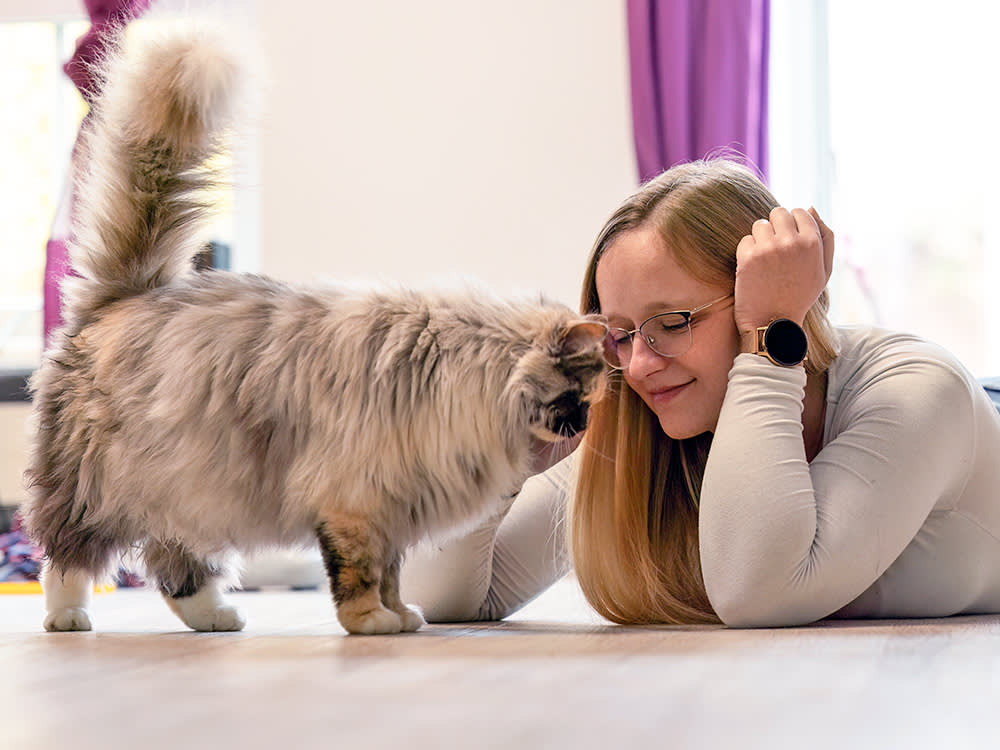
We want our cats to be grateful. We scoop the box, buy the fancy food, and come home from trips to a swarm of fur, and some part of us reads it as thanks. Behaviorists will gently tell you it is not. Cats do not have the cognitive machinery for gratitude the way we mean it. But here is the part the disappointment misses: what they do instead is more honest and, frankly, more flattering. A cat cannot thank you, but a cat can show you they feel safe, and feeling safe around a person is the highest compliment a creature built for self-preservation can pay.
“The whole idea of a thank-you belongs to us, not to them, and hunting for one can blind you to what your cat is actually telling you,” says Heather Alvey, a certified cat behavior consultant. “Every meal, every gentle interaction, is a deposit in an account of safety. These behaviors are your cat showing you the balance.”
That reframe changes what you are watching for. Stop scanning for thank-you notes and start reading a trust audit. Each of the behaviors below is a small report card on whether your cat feels secure with you, and there are six worth knowing.
1. They slow-blink at you
Start here, because it is the clearest and most studied. When a relaxed cat looks at you and slowly closes and opens their eyes, that languid blink is a recognized signal of comfort and non-threat, sometimes called a cat kiss. Researchers have even shown that cats are more likely to approach a stranger who slow-blinks at them first, which means the gesture is a genuine two-way trust signal, not folklore. Closing your eyes near another animal is an act of vulnerability, and a cat who does it with you is saying you are not a danger. Try returning it: a slow blink back is a real conversation.
2. They choose to be near you
Cats feel no social obligation. They will not sit with you to be polite, and that is exactly what makes their company meaningful. When a cat chooses to sleep in your bed, share the couch, or trail you to the bathroom, they are spending a resource, their presence, on you for no reason but preference.
“When a cat trusts you enough to relax around you and chooses to spend time with you, that is all the thanks I need,” Alvey says. “It tells me I have supported their sense of safety and wellbeing.”
3. They bunt you
Bunting, the gentle headbutt a cat delivers with the top of their skull, is reserved for the people and animals a cat truly trusts. It is a deliberate social gesture, a way of pressing their scent onto you and reinforcing the bond, and cats simply do not offer it to anyone they feel wary of. A head bump after play or a favorite activity is about as close to “I like what just happened” as a cat gets.
4. They rub against you
Winding around your legs, arms, or face looks like affection, and in a sense it is. Cats carry scent glands in their cheeks and along their bodies, so when they rub on you they are marking you as part of their safe, familiar territory, mingling your scent with theirs. It is one of the clearest signs a cat is pleased to have you around, says Alvey’s colleague, and some cats add flourishes, an upright, quivering tail held high, which is itself a happy-to-see-you signal.
5. They purr near you
Purring is the behavior people most associate with a content cat, and for good reason. It tends to surface when a cat is enjoying something, a warm lap, a good petting session, simple closeness, so a cat who settles in and purrs beside you is reporting that this moment feels good and safe. It is worth a small caveat: cats also purr to self-soothe when stressed or in pain, so read it in context. A loose, sprawled, purring cat is the trust version. A tense, hiding, purring cat may be telling you something else.
6. They fully relax around you
The deepest signal is the most physical. A cat stretched out with their belly exposed, paws loose, eyes at half-mast, is a cat with their guard completely down. The belly is a cat’s most vulnerable area, and exposing it near you is a statement that they feel no need to protect themselves. (A caution worth keeping: an exposed belly is a trust display, not always an invitation to rub it, since many cats will reflexively grab a hand that touches there.) Loose, unguarded body language like this is among the strongest evidence that a cat trusts their environment, and you in it.
How to earn more of it
Because these are trust signals rather than rewards, you cannot demand them, but you can build the conditions that produce them. Keep routines predictable, since cats relax into reliability. Let the cat set the pace of contact rather than reaching for them. Respect a “no,” a flicking tail, a turned head, a walk-away, so your cat learns that being near you never gets forced. And do not take preferences personally: a cat who refuses a new food or ignores a new toy is expressing taste, not ingratitude.
“If your cat turns up their nose at a flavor, it is not a rejection of you,” notes Class Act Cats founder Joey Lusvardi. “They just do not like that flavor, much like we do not like every flavor.”
Do this consistently and the slow blinks, the bunts, and the belly come more often, because you are giving your cat more and more reasons to feel safe.
The bottom line
Your cat will never write you a thank-you note, and chasing one will only frustrate you. What they offer instead is better information: a running, honest signal of whether they feel secure with you. Learn to read the slow blink, the choice to stay close, the bunt, the rub, the purr, and the fully exposed belly, and you will stop wondering if your cat appreciates you. You will know, in the only language a cat actually speaks, that they trust you, and for a cat, that is the whole relationship.
References
- Humphrey, Tasmin, et al. “The Role of Cat Eye Narrowing Movements in Cat-Human Communication.” Scientific Reports, vol. 10, 2020, article 16503.
- Vitale, Kristyn R., et al. “Attachment Bonds between Domestic Cats and Humans.” Current Biology, vol. 29, no. 18, 2019, pp. R864-R865.
- “Understanding Feline Body Language.” International Cat Care, icatcare.org.
Claire Sutton writes about life with pets, from the first days home to the small daily routines that make a household work. Her reporting spans people-and-pet relationships, training basics, and the practical side of bringing a new animal into the family.
Meet our experts ↗Keep reading
 TrainingCats Copy Each Other's Faces. AI Caught Them Doing It.Dr. Nina Kohl · 4 min
 Health & WellnessYour Cat Isn't Being Weird. Plastic Bags Smell Like Food.Dr. Mara Chen · 7 min
 TrainingYou Can Tell When Your Cat Is Happy. That's the Problem.Dr. Priya Nair · 7 min
 TrainingThe Cat Your Kitten Becomes Is Mostly Decided by Week SevenDr. Nina Kohl · 7 min
 TrainingYour Cat's Trust Isn't Affection. It's a Threat Assessment You Keep Passing.Dr. Lena Park · 8 min
 TrainingYes, Cats Are Ticklish. The Real Skill Is Knowing When to StopSasha Ford · 6 min