


Your Cat Isn't Kissing You. Watch What Happens Three Seconds Later.
A cat licking your hand is a social act, not a kiss, and the three seconds after the lick tell you whether it was affection, a request, or a warning you're about to get bitten.

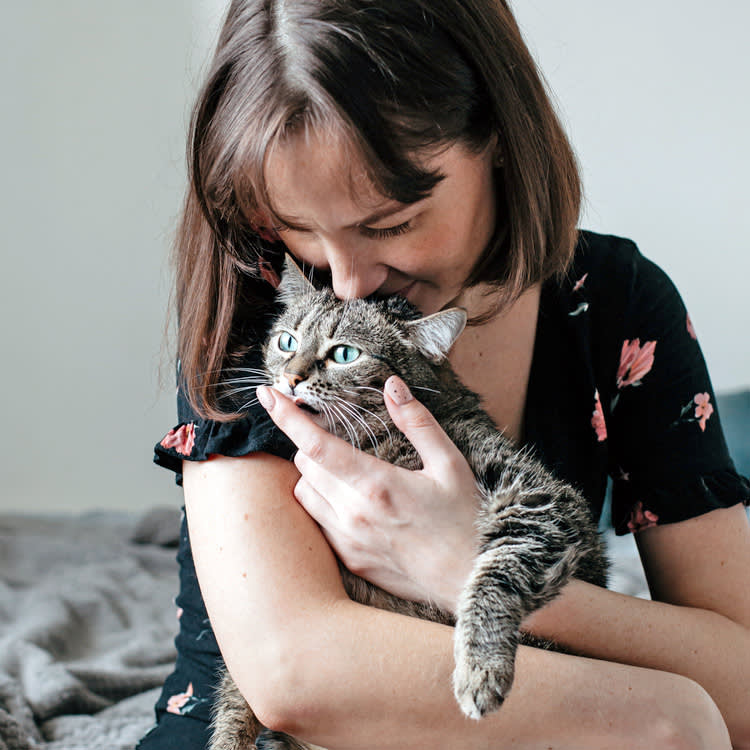
The sandpaper tongue arrives out of nowhere. You’re scratching behind an ear, everything is peaceful, and suddenly your cat has captured your hand and is going at it like it owes them money.
The internet will tell you this means love. That’s the easy answer and it’s incomplete, because the same behavior, from the same cat, on the same hand, can mean I’ve claimed you, I’m anxious, feed me, or stop touching me right now — and the last one comes with teeth.
The lick doesn’t tell you which. What happens in the next three seconds does.
The three-second rule
Cats groom each other. It’s called allogrooming, and among cats it does two jobs at once: it maintains the bond, and it manages tension. It is not purely sweet. It’s social machinery.
When your cat turns that machinery on you, they’re treating you as a social partner, which is genuinely a compliment. But the machinery has more than one setting, and you find out which one you got by watching the seconds right after the tongue.
Lick, then settle. Body loose, eyes soft, purr continues, tongue slows down and stops. That’s affiliative grooming. It’s the good one. Nothing to do but enjoy it.
Lick, then look at you and vocalize. Tongue plus a chirp plus a walk toward the kitchen is not romance. That’s a request with a follow-up.
Lick, then bite. This is the one that matters. If your cat licks and then delivers a quick nip, and especially if the tail is flicking, the ears are swiveling back, the skin along the back is rippling, or the pupils have widened, you have hit overstimulation. Petting-induced overstimulation is a real, well-documented thing: the same touch that felt good ninety seconds ago now feels like too much, and the lick-then-bite is the escalation on the way out.
That is not a betrayal. It’s a warning shot, and it’s a courteous one. The correct response is to stop petting, not to keep going and then act surprised.
The bite after the lick is the part people fixate on, and it’s the part they usually cause. The cat gave you three or four signals before the teeth. If you learn to stop at the tail flick, you almost never get to the tooth.
Why cats lick people in the first place
Once you’ve read the three seconds, the underlying reasons matter. Here they are, roughly in order of how often they’re the answer.
Grooming you as social maintenance. Mother cats groom kittens constantly, and the behavior carries into adulthood between bonded cats. Interestingly, allogrooming in cats isn’t evenly distributed: research on group-living cats has found that higher-ranking individuals tend to do more of the grooming than they receive, which complicates the sentimental reading. Your cat licking you is not necessarily deference. It may be management.
You taste like something. This is a big one and people underrate it. Cats explore with smell and taste, and your skin carries food residue, sweat salt, lotion, sunscreen, and whatever else you’ve touched. If the licking is enthusiastic, targeted at one spot, and happens right after you’ve cooked, exercised, or moisturized, it’s flavor, not devotion.
Worth flagging: this is also the reason to be careful about what’s on your skin. Cats should not be licking hormone creams, prescription topicals, or medicated ointments off you. Some topical human medications are genuinely dangerous to cats. If you’re using one, cover it and wash your hands.
Scent-marking. Saliva carries scent. Licking deposits it. In a multi-pet home especially, licking is often part of a broader claiming routine, and you’ll see it packaged with head-butting, cheek-rubbing, and kneading. Together, those mean “this human is on my list.”
Attention that has worked before. If licking your hand once made you laugh, look up, or produce food, your cat filed that away. Cats are subtle, but they are not subtle about learning what works. If the licking is well-timed to mealtimes or to the moment you sit down at your laptop, you’re being operated.
Self-soothing. Licking is a comfort behavior, the feline equivalent of a nervous habit. A cat under stress may lick you the same way they’d over-groom themselves. This one is worth watching, because the same stress can produce psychogenic alopecia, a condition where compulsive over-grooming thins or bares the cat’s own coat. If the licking is compulsive rather than casual, and especially if you’re also seeing bald patches, the question isn’t “why is my cat licking me,” it’s “what changed in this house?” New pet, new person, a move, a schedule change, a neighbor cat visible at the window.
Something hurts. Excessive, sudden, out-of-character licking can be medical. Nausea, dental pain, and gastrointestinal discomfort all push cats toward compulsive licking as self-soothing, and some skin and neurological conditions do too. A cat who suddenly starts licking far more than usual, particularly alongside weight loss, restlessness, or any other behavioral change, needs a vet visit rather than an explanation.
Is it safe to let your cat lick you?
Mostly, with two hard rules.
Cat saliva carries bacteria. For a healthy adult with intact skin, the risk from a lick on the hand is very low.
Never let a cat lick an open wound. That’s the rule with no exceptions. Bacteria that live harmlessly in a cat’s mouth are not harmless in a break in your skin.
If you’re immunocompromised, be more careful than the average person, and talk to your doctor about what’s reasonable for you. That includes anyone on immunosuppressive therapy, anyone pregnant, and anyone recovering from a significant illness.
Beyond that, if your cat goes outdoors or hunts, they’re carrying a wider cast of bacteria and parasites than an indoor cat. Wash your hands afterward and get on with your life.
How to make it stop, if you want it to
Gently, and without ever punishing the cat.
- Remove the hand. Slowly, not with a jerk. A sudden pull looks like prey moving and can trigger a grab.
- Swap in a target. A wand toy, a lick mat, a treat puzzle. Redirect the mouth to something that isn’t you.
- Change the reward. If your cat licks to summon you, don’t come. Come when they’re being quiet instead.
- Never yell or shove. Both are unpredictable to a cat, and both make the next interaction worse.
- Find the trigger, if it’s stress. Removing the stressor beats managing the symptom every time.
And with the lick-then-bite version, the fix is almost entirely on your side of the interaction: stop the petting session before your cat asks you to. Short sessions, ended by you while the cat is still enjoying it, are the single best way to eliminate the bite.
What newer research adds
Two things worth knowing that the standard explainer never covers.
Cats have a preferred petting map, and your hand is probably in the wrong place. Studies of feline handling preference have found that cats consistently respond best to being touched in the facial region, around the cheeks, chin, and base of the ears, where their scent glands sit. Petting along the back is tolerated. The tail base is the most common flashpoint. A large share of “my cat suddenly bit me while I was petting them” comes down to a hand that drifted toward the tail and stayed too long.
Duration matters more than technique. The overstimulation response is cumulative. It builds. The cat who bites at minute four would have been fine at minute one, and the reason so many owners feel ambushed is that they read the purr as an unlimited license.
Put those together and you get an actual protocol: pet the head end, keep it short, and stop while everyone is still happy.
Bottom line
The lick is a social act, not a kiss. It means your cat is treating you as one of their own, which is a real thing to be pleased about.
What it means specifically is written in the next three seconds. Loose body and a slowing tongue is affection. A chirp and a walk to the kitchen is a request. A flicking tail and a rippling back is a warning.
Read the three seconds. You’ll get bitten a lot less.
FAQs
Why does my cat lick my hand after I pet them? Most often it’s reciprocal grooming, a social behavior cats use with companions they’re bonded to. But if the lick is followed by a nip or a flicking tail, it’s a sign they’ve had enough petting.
Why does my cat lick me and then bite me? That’s overstimulation. The petting has crossed from pleasant to overwhelming, and the lick-then-bite is the escalation. Stop petting at the first tail flick or skin ripple, before the teeth arrive.
Is it safe to let my cat lick me? Generally, yes, on intact skin. Never let a cat lick an open wound, and take extra care if your immune system is compromised. Wash your hands afterward, especially with an outdoor cat.
Does licking mean my cat loves me? It means your cat treats you as a social partner, which is closer to family than to a kiss. It can also mean they’re claiming you, asking for something, or self-soothing.
When is cat licking a health problem? When it’s compulsive, suddenly much more frequent, or paired with over-grooming, bald patches, weight loss, restlessness, or appetite change. That combination is worth a vet visit.
References
- “Cats That Lick Too Much.” Cornell Feline Health Center, Cornell University College of Veterinary Medicine. https://www.vet.cornell.edu/departments-centers-and-institutes/cornell-feline-health-center/health-information/feline-health-topics/cats-lick-too-much
- van den Bos, Ruud. “The Function of Allogrooming in Domestic Cats (Felis silvestris catus): A Study in a Group of Cats Living in Confinement.” Journal of Ethology, vol. 16, 1998, pp. 1–13. https://doi.org/10.1007/BF02896348
- Soennichsen, Sarah, and Arnold S. Chamove. “Responses of Cats to Petting by Humans.” Anthrozoös, vol. 15, no. 3, 2002, pp. 258–265. https://doi.org/10.2752/089279302786992577
- Ellis, Sarah L. H., et al. “The Influence of Body Region, Handler Familiarity and Order of Region Handled on the Domestic Cat’s Response to Being Stroked.” Applied Animal Behaviour Science, vol. 173, 2015, pp. 60–67. https://doi.org/10.1016/j.applanim.2014.11.002
- “Feline Behavior Problems: Aggression.” Cornell Feline Health Center. https://www.vet.cornell.edu/departments-centers-and-institutes/cornell-feline-health-center/health-information/feline-health-topics/feline-behavior-problems-aggression
Dr. Chen is a small-animal veterinarian who leads health and safety coverage at The Pet Times. She writes and reviews the bulk of our illness, condition, and safety content, translating clinical guidance into clear, practical advice owners can act on at home.
Meet our experts ↗Keep reading
 LivingYour Cat Isn't Trying to Cuddle. They're Doing Math.Dr. Nina Kohl · 6 min
 TrainingYour Cat Doesn't Care About the Bathroom. They Care That You Finally Sat Down.Dr. Priya Nair · 8 min
 LivingHating Cats Doesn't Make You a Narcissist. The Rush to Diagnose Says More.Claire Sutton · 6 min
 TrainingCat Behavior Has a Photo Problem. Someone Finally Drew Their Way Out of It.Dr. Mara Chen · 7 min
 LivingYour Kid Isn't Scaring the Cat on Purpose. Here's the Fix.Dr. Nina Kohl · 6 min
 TrainingBonding With a Cat Is Subtraction, Not AdditionDr. Mara Chen · 7 min