


Can a Cat Heal Itself by Purring? The Science Is Stranger Than You Think
A purr is not just a happy noise. Research suggests the low-frequency vibration may help cats soothe pain and even mend bone. Here is how it works.

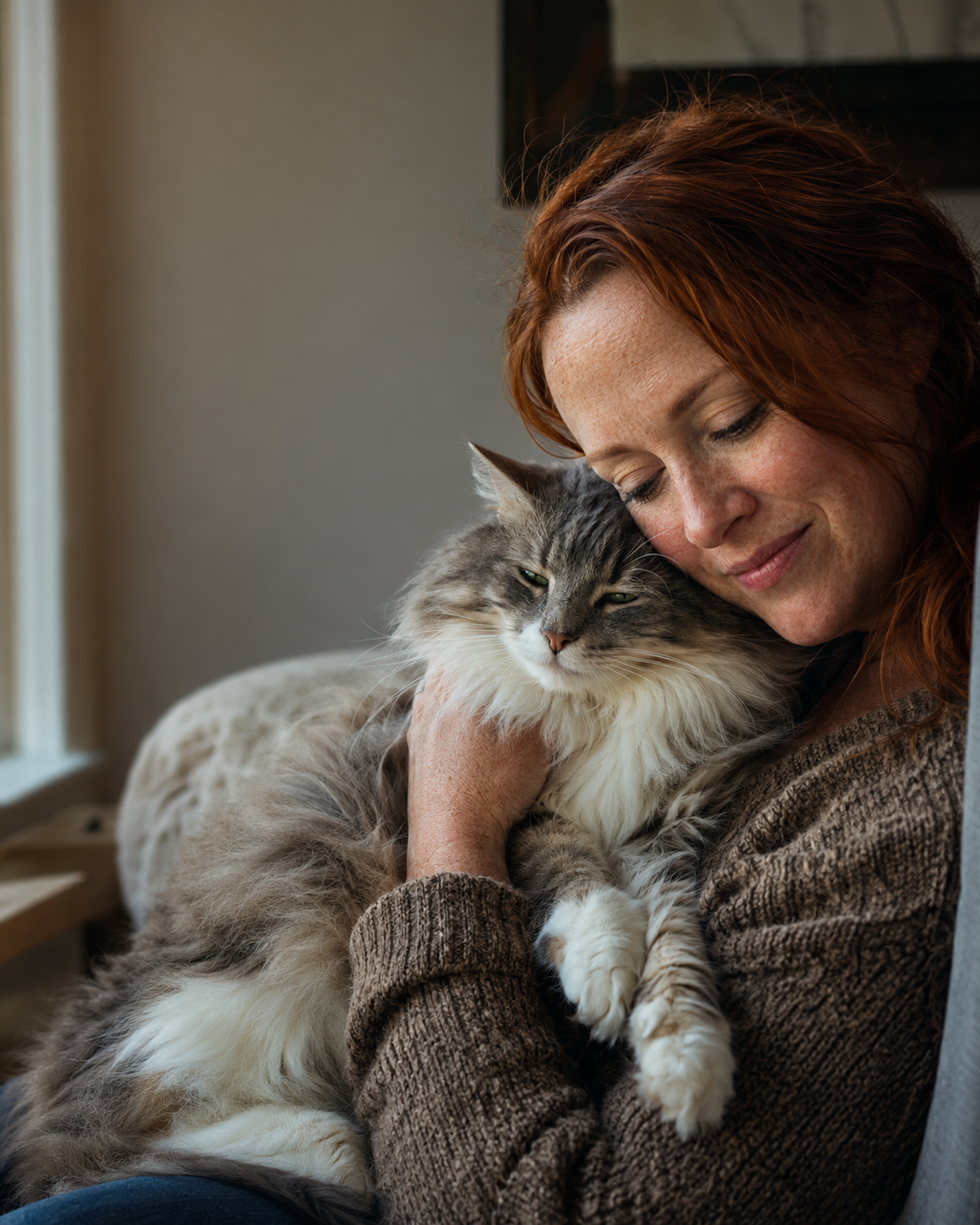
Cats get a reputation they do not fully deserve. Next to the eager, tail-wagging dog, a cat’s independence reads to a lot of people as coldness, even spite. Anyone who has actually lived with a cat knows better. Their affection is real. It just has to be earned.
The purr is a good example of that complexity. We assume we know what it means, but it carries far more than one message, and one of its quieter functions is genuinely remarkable: a purr may help a cat ease its own pain, in both body and mind.
Purring is not just “I’m happy”
Start with the myth.
People assume purring is a simple sign of happiness, but it is a much more complex behavior than that. Cats purr across a wide range of situations and stages of life, and not all of them are pleasant.
Yes, cats purr while being petted, while enjoying catnip, while greeting a favorite person. But a lot of what we believe about purring is observational. We connect dots, noticing what a cat is doing when the sound shows up and inferring meaning from there. Most of the time a purring cat does look calm and content, so contentment is a fair default reading.
It goes further, though. Purrs can be requests. A cat circling your legs while you scoop food may purr in a faster, more urgent register than the slow rumble it makes draped across your lap. And cats sometimes purr when they are injured, frightened, or even dying. Because we mostly meet the happy purr, we are often unequipped to recognize the other kinds, which is exactly why this sound is worth understanding better.
So why purr when it hurts?
There are two leading explanations, and they are not mutually exclusive.
The first is comfort, plain and simple. A purr may be self-soothing, a way for a cat to steady itself the way a person might queue up a favorite old album or rewatch a comfort show during a hard stretch. The familiar feeling takes the edge off. Purring may do something similar for a cat in distress.
The second is more mechanical. Purring may actually interfere with how pain signals travel to the brain. The idea is that the vibration floods the nervous system with so much input that pain signals get lost in the noise. Human medicine uses the same trick. Create strong vibration near an injection site and the nerves there get so much competing input that the pain signal partly drowns out. It does not erase the pain, but it can dampen it.
There is a developmental clue too. Kittens are born blind, deaf, and unable to walk, yet purring is one of the very first things they can do. Because a purr can be felt as a vibration, a newborn kitten can experience it even before its eyes and ears work. The act feels good and tends to lead to being fed, so positive associations may form early and stick for life.
The bone-healing frequency
This is where the research gets eye-catching. A 2001 study looked directly at whether purring does more than signal contentment, testing the idea that it could be a healing tool. Researchers recorded the purrs of 44 animals across the larger cat family, including cheetahs, ocelots, pumas, servals, and domestic cats. Every one of them purred at a frequency between roughly 25 and 150 hertz, a range that overlaps with the frequencies used in medical treatments for bone growth and pain relief.
Domestic cats specifically clustered between about 25 and 50 hertz, two low frequencies known to promote bone growth and fracture healing. The implication is striking: purring may have evolved partly as a built-in healing mechanism, helping cats recover faster and hold onto physical strength even during long stretches of rest. Picture a self-administered, low-grade physical therapy that runs while the cat naps.
“The frequency range cats purr in really does line up with what we associate with tissue and bone healing,” Dr. Kohl adds. “It is well within reason that purring helps a cat switch on its own natural repair processes. We need more research, but the idea is not a stretch.”
What purrs do for us
Cats help their people too. Research has found that cats can reduce stress and anxiety in their owners, and the mental health side of cat companionship is hard to overstate. Beyond the obvious love and company, there is the simple, grounding act of petting and being near an animal that does not judge us, does not talk back, and comes to us without any baggage. We tell our cats things we would not say to another person, and the physiological side of that comfort is measurable, not just sentimental. In a long-running analysis of more than 4,000 adults, researchers reported that people who had never owned a cat carried roughly a 30 percent higher risk of dying from cardiovascular disease, and about a 40 percent higher risk of a fatal heart attack, than current or former cat owners. The likeliest explanation, the authors noted, is that the daily routine of living with a cat quietly lowers stress, which is exactly the state a lap-bound, purring cat tends to induce.
That benefit is not trivial. Clinicians who work in mental health sometimes hear patients in crisis name their cat as a core reason to keep going, a fixed point in a hard time. A cat is not a cure for depression or any clinical condition. But the comfort it provides is real, even when it cannot be neatly measured. When your cat is curled on your lap purring, the contentment you feel is partly just a reflection of theirs.
The takeaway
A purr means more than one thing, and not all of it is sunshine. That is the real value of it. When you learn that purring can also show up with sickness or fear, the sound becomes one of your best windows into how your cat is actually doing. Sometimes that little rumble is contentment. Sometimes it is a cat trying to soothe itself through pain, and that tip-off might be the thing that gets them to the vet in time. That is its own kind of healing power.
What newer research adds
Newer work on cat vocalization has reinforced just how individual and meaningful the purr is. A 2025 study published in Scientific Reports, led by researchers at the Museum für Naturkunde Berlin and the University of Naples Federico II, found that a cat’s purr is so consistent it works almost like a fingerprint, with software identifying individual cats from their purrs far more reliably than from their meows. The researchers note that purring appears early in life and shows up across wild cat species too, which fits the idea that it is a deep, ancient behavior rather than a learned trick for charming humans.
That does not prove the bone-healing hypothesis on its own, but it strengthens the broader picture: purring is older, more stable, and more biologically embedded than the simple “happy cat” story suggests.
References
- von Muggenthaler, Elizabeth. “The Felid Purr: A Healing Mechanism?” The Journal of the Acoustical Society of America, vol. 110, no. 5, 2001, p. 2666. https://pubs.aip.org/asa/jasa/article/110/5_Supplement/2666/550913
- Qureshi, Adnan I., et al. “Cat Ownership and the Risk of Fatal Cardiovascular Diseases. Results from the Second National Health and Nutrition Examination Study Mortality Follow-up Study.” Journal of Vascular and Interventional Neurology, vol. 2, no. 1, 2009, pp. 132-135. https://pmc.ncbi.nlm.nih.gov/articles/PMC3317329/
- “Meows Encode Less Individual Information than Purrs and Show Greater Variability in Domestic than in Wild Cats.” Scientific Reports, 2025. (Museum für Naturkunde Berlin and University of Naples Federico II.) https://phys.org/news/2025-12-cats-purrs-reveal-meows.html
Dr. Kohl is a board-certified veterinary dentist with a particular interest in preventive oral care. She reviews all dental health content at The Pet Times and contributes practical guides on home dental routines, professional cleaning, and oral disease prevention.
Meet our experts ↗Keep reading
 TrainingStop Watching Who's Winning. The Real Tell in a Cat Fight Is Who Trades PlacesNina Vasquez · 5 min
 LivingYour Cat Isn't Jealous of Your Sex Life. It's Mad About the Door.Dr. Priya Nair · 5 min
 TrainingYour Cat's 3 A.M. Meltdown Isn't Random. It's a Schedule You BuiltDr. Nina Kohl · 4 min
 TrainingThe Study Says Your Cat Is a Psychopath. Read the Questions.Dr. Ravi Mehta · 6 min
 TrainingYour Cat Isn't Getting 'Brain Rot' From That Video. It Thinks It's HuntingDr. Ravi Mehta · 5 min
 TrainingYour Cat Isn't Running Hot and Cold. They're Running a Consent System.Dr. Amara Solis · 7 min