


Your Cat Is Leaving Invisible Notes All Over Your House
Every cheek rub, scratch, and 'who farted?' face is part of a scent language you can't smell. Here's how feline pheromones actually work.

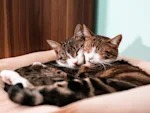
Your cat is running a communication network in your home that you will never see, hear, or smell. Every time they rub a cheek on the doorframe, scratch the side of the couch, or knead a blanket, they are posting a message written in chemicals. And every time they freeze mid-sniff with their mouth slightly open, wearing that unmistakable “who farted?” expression, they are reading one. Once you understand what is being said, a lot of otherwise baffling cat behavior starts to make sense.
The messages are made of pheromones, and they are the reason a scent-driven animal can feel calm, threatened, bonded, or territorial about a space that looks completely ordinary to you.
What pheromones actually are
Pheromones are chemical substances that influence an animal’s behavior and emotional state. Cats use them as one of several ways to communicate with each other, releasing them by scratching, urinating, and rubbing against surfaces. A mother cat even releases pheromones from glands near her mammary area to tell her kittens they are safe. In broad terms, pheromones broadcast information about a cat’s identity and reproductive state, plus a running commentary on what territory belongs to whom.
Here is the key idea to hold onto: this is a parallel language. It sits alongside the meows and tail flicks you already read, but it operates on a channel your senses simply cannot access.
How your cat reads the notes
Cats do not detect pheromones with an ordinary sense of smell. They use the vomeronasal organ (VMO), a specialized sensory structure in the nasal cavity with ducts that open into the front of the hard palate. When a cat senses a pheromone worth investigating, they work to route more of it to the VMO, often by licking their nose or scrunching up their face.
That scrunch has a name: the flehmen response. The cat opens their mouth, curls back their lips, and stares off as if lost in thought. It is entirely voluntary, and it is your cat opening their chemical inbox. So the next time your cat makes that faintly disgusted, philosophical face after sniffing a spot on the floor, they have not smelled something gross. They have found another cat’s message and are giving it their full attention.
The different kinds of messages
Pheromones are grouped by the job they do rather than by their exact chemistry. These are the main categories, and knowing them helps you interpret what your cat is up to.
Feline facial pheromones are the “feel good” signals cats deposit when they rub their face on you, the furniture, and the corners of walls. They have been divided into five fractions, labeled F1 through F5, though the exact role of some remains unknown. F2 is tied to male mating behavior. F3 marks objects and areas as familiar territory, which is why your cat bunts the same corners over and over. F4 marks individuals, including you and other pets, as known and safe, expressed through “allorubbing” (rubbing on one another) and “allogrooming” (grooming one another). F1 and F5 are still not well understood. When your cat headbutts your ankle, they are literally filing you under “mine, and fine.”
Cat-appeasing pheromones, sometimes called mother cat pheromones, are produced by a nursing mother from glands around her nipples, from birth until around weaning. They help kittens feel comforted and bond with their mother, their littermates, and anyone the mother has marked as safe. This is the biological basis for why a sense of “family safety” can be chemically communicated.
The feline interdigital semiochemical is released from glands in the paws. When a cat scratches or “makes biscuits” on a surface, they leave scent behind, and the visible scratch marks act as a second, visual signpost that the spot is claimed. Scratching, in other words, is not just about claw maintenance. It is publishing.
Male cat pheromones are broadcast largely through urine spraying. They tell nearby female cats a potential mate is around, and they tell rival males that a competitor has passed through. An aggressive tomcat may read this as a challenge, while a more timid one reads it as a reason to leave.
How synthetic versions are used to help
Because researchers have mapped clear links between specific pheromones and specific behaviors, manufacturers have created synthetic copies aimed at nudging cat behavior in a calmer direction.
Synthetic feline facial pheromones are used to make objects and spaces feel more familiar, which has a calming effect on many cats and can help them settle into stressful or unfamiliar situations. They are marketed to reduce urine spraying, furniture scratching, compulsive grooming, and hiding. Synthetic cat-appeasing pheromone, meanwhile, is aimed at multi-cat households: because the natural version signals safety and belonging among littermates, the synthetic version is used to ease tension between cats, smooth the introduction of a new cat, and reduce squabbling over space, attention, and food.
Situations where a cat might benefit include stressful environmental changes like new people, places, or pets; introducing a new cat; anxiety-inducing car rides and vet visits; unwanted scratching; inappropriate urination; and aggression or extreme fear toward people or other animals. Results vary a lot from cat to cat, which is worth setting expectations around before you buy anything.
Pheromone products are a real tool, but they work best as one piece of a plan, not a magic spray. I tell owners to think of them as tilting the odds toward calm while you also fix the actual stressor, whether that’s a crowded litter box situation or a rocky introduction. On their own, they rarely fix a problem they were never designed to solve.
The synthetic products come in a few forms so you can match one to your cat’s situation. Diffusers plug into an outlet and disperse pheromones into the air, ideally in the room where the cat spends the most time; placed well, one can cover a sizable area and last several weeks. Sprays offer a travel-friendly option for pre-treating a carrier before a car ride or spot-treating a scratched piece of furniture, and wipes work similarly on objects. Collars release pheromones slowly over weeks and suit cats who travel, go outdoors, or are dealing with a big change. One important safety note across all of them: sprays and wipes are made for objects and environments, never to be applied directly onto your cat.
What newer research adds
Pheromone products have been on the market long enough that people reasonably ask whether they actually do anything or just make owners feel better. The honest answer from the research is “sometimes, and modestly.” A 2023 systematic review in Veterinary Evidence looked specifically at the synthetic F3 facial pheromone (the active ingredient in the widely sold Feliway Classic) for reducing acute stress in veterinary settings. Across five studies, including several double-blinded randomized controlled trials, four found improvement in at least some measures of stress, such as easier handling and a calmer impression during routine exams.
The nuance is what matters. The benefits were real but selective, not dramatic across the board, which lines up with what many vets see in practice. Placebo effects and owner expectation play a genuine role, so the most reliable approach is to treat a pheromone product as a helpful assist that you pair with fixing the underlying stressor, not as a standalone cure. If your cat’s anxiety, spraying, or aggression is significant or persistent, that is a conversation for your veterinarian rather than a job for a plug-in alone.
References
- Vitale Shreve, Kristyn R., and Monique A. R. Udell. “Stress, Security, and Scent: The Influence of Chemical Signals on the Social Lives of Domestic Cats.” Applied Animal Behaviour Science, 2017. doi.org/10.1016/j.applanim.2017.02.006
- “Effectiveness of F3 Feline Facial Pheromone Analogue for Acute Stress Reduction Within Clinical Veterinary Practice.” Veterinary Evidence, 2023. veterinaryevidence.org/index.php/ve/article/view/669
- Frank, Diane, et al. “Systematic Review of the Use of Pheromones for Treatment of Undesirable Behavior in Cats and Dogs.” Journal of the American Veterinary Medical Association, 2010. pubmed.ncbi.nlm.nih.gov/20513197
- “The Vomeronasal Organ.” Anatomy and function overview, Cornell University College of Veterinary Medicine. vet.cornell.edu
Common questions
Do cat pheromones work on humans?
No. Cat pheromones are not detectable by people and have no effect on human behavior. Your cat communicates with you through other channels, like body language, vocalizations, and rubbing on you to mark you as familiar.
What do cat pheromones smell like?
To us, nothing. Cat pheromones do not have an odor humans can detect. With synthetic pheromone products, any faint smell you notice comes from the carrier oil or other ingredients, not the pheromone itself.
Why does my cat make a strange open-mouth face after sniffing something?
That is the flehmen response. Your cat is pulling a scent up to the vomeronasal organ in the roof of their mouth to analyze it more closely, often after detecting another cat's pheromones. It can look like a sneer or a grimace, but it is simply deep sniffing.
Dr. Nair is a veterinarian focused on diet and feeding. She covers everyday nutrition, treats, and the many "can they eat this?" questions owners ask, grounding each answer in what is actually safe and sensible for dogs and cats.
Meet our experts ↗Keep reading
 TrainingYour Cat Isn't Aloof. Science Counted 276 Faces to Prove ItDr. Amara Solis · 6 min
 TrainingYour Cat's Trust Isn't Affection. It's a Threat Assessment You Keep Passing.Dr. Lena Park · 8 min
 TrainingYour Cat Isn't Being Dramatic. 8 Things That Genuinely Wound ThemDr. Nina Kohl · 6 min
 TrainingWhy a Cat Will Nurse a Duckling, and Why You Should Still Watch CloselyDr. Amara Solis · 6 min
 TrainingYour Cat Is Probably Securely Attached. Here's Why That's the Useful PartNina Vasquez · 5 min
 TrainingYour Cat Isn't Kissing You. Watch What Happens Three Seconds Later.Dr. Mara Chen · 7 min