


Your Dog Isn't Bored. They're Underemployed. 8 Puzzles That Fix It.
Stop shopping by difficulty level. Pick a treat puzzle by how your dog quits — the chewer, the flipper, the giver-upper — and you'll actually use it more than twice.

Affiliate disclosure. This article contains affiliate links. We may earn a small commission if you buy through a link, at no extra cost to you. How we handle recommendations.
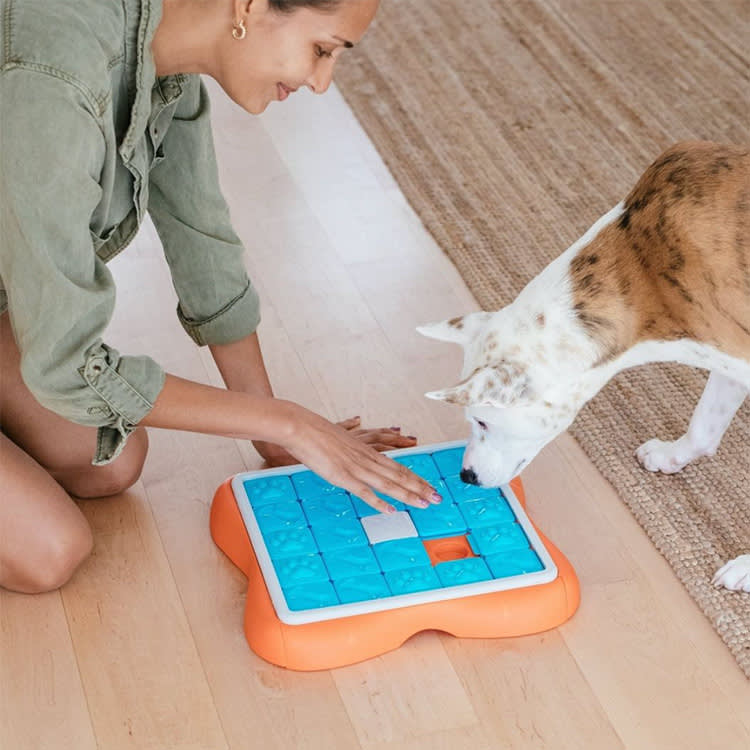
Most people buy their dog a treat puzzle, watch the dog solve it in ninety seconds or fail at it entirely, and put it in the closet. Then they conclude their dog isn’t a puzzle dog.
The dog is fine. The purchase was wrong, because it was made on the wrong axis. Nearly every one of these toys is sold by difficulty level — Level 1, Level 2, Level 3 — and the level tells you almost nothing about whether your specific dog will engage with the thing.
There’s a better question. How does your dog quit?
Some dogs quit by chewing: they stop solving and start destroying, because destruction is a solution too. Some quit by flipping the board over, because gravity is faster than thinking. Some quit by walking away after eleven seconds. Some can’t quit because they physically can’t reach the treat — a flat-faced dog trying to get their muzzle into a deep, narrow well is not being defeated by the puzzle, they’re being defeated by their own skull.
Match the puzzle to the failure, and the toy stays out of the closet. Here are eight, organized that way.
First, the standard everything here meets
These are all from Nina Ottosson’s line, which is the reference point in this category for a reason. She began building them out of pure necessity: she’d competed with her Bouvier des Flandres, and when her two kids arrived a year and a half apart, the hours she used to spend working her dogs disappeared. What she needed was a way to give a dog a real job indoors, quickly, without a training field.
That origin is visible in the products. She calls them games rather than toys, and the distinction is deliberate — the design assumes a person is playing alongside the dog, not handing something over and leaving the room. Every product in the range is non-toxic, free of BPA, PVC, and phthalates, and FDA-tested.
Prices below move around; check before you buy.
For the dog who quits by flipping the board
Dog Brick
Three different kinds of hiding place in one board, which is why it’s the first one I’d hand most people. Flip-open lids conceal two of the compartments, and removable bone-shaped bricks hide the third — so a dog can’t run a single strategy and clear the whole thing. They have to switch tactics halfway through.
That matters for the board-flipper specifically. A dog who has learned that grabbing an edge and heaving is faster than thinking gets nothing out of that here: two of the three mechanisms don’t come loose, and the one that does still has to be lifted deliberately. Flipping stops paying.
Right for: flingers, dogs who solve one mechanism and then stall out. Wrong for: dogs who need every win handed to them early.
Dog Hide N’ Slide
Sliding covers rather than removable pegs, and that’s the entire point: there is nothing here for a dog to pick up, fling, or carry off under the couch. For a dog whose approach to any puzzle is “take the loose bit and leave,” a board with zero loose bits is a completely different experience.
Sliding also demands a different motor pattern than lifting. Dogs who have gotten mechanical about pawing pegs upward suddenly have to think again.
Right for: thieves, dogs who’ve plateaued on lift-out boards. Wrong for: a dog who hasn’t yet grasped that the board contains food at all.
Dog Tornado
Three stacked, rotating tiers with twelve compartments between them, plus removable white blocks that lock over the wells and make it meaningfully harder. Spinning the layers is a satisfying, obvious mechanic — dogs grasp the idea fast, which keeps them in the game, and the blocks give you somewhere to escalate to later.
This is what I’d hand a dog with a short fuse for frustration, because the first success arrives quickly and quitting never becomes the habit. Ottosson’s own tip for the blocks: run a bit of durable string through them at first so the dog can hook a paw and lift, and remove it once the penny drops. Only do that while you’re watching. String is a choking hazard, and if swallowed it can cause a gastrointestinal obstruction.
Right for: short attention spans, dogs who need a fast first win with headroom above it. Wrong for: dogs who body-slam their toys — spinning tiers and a ninety-pound shoulder don’t mix.
Challenge Slider
The big flat one. The advanced sliding boards in this range are the sit-down-and-stay-a-while option — some hold close to a full cup of kibble spread across roughly two dozen compartments — which makes them the right pick when what you actually need isn’t “a puzzle” but “forty-five quiet minutes.”
There’s a particular use worth knowing about. A board like this is the single most valuable object you can own during crate rest. A dog on post-surgical restriction, or one with worn-out hips who can’t walk far anymore, is going quietly out of their mind, and no amount of physical exercise is coming to rescue them. Ottosson’s trick for exactly this situation: put the board up on a chair or in your lap, so the dog has to work it with nose and mouth alone and the injured leg stays out of it entirely. A senior who hasn’t had a proper walk in a year can still have a hard, satisfying, completely stationary job.
Right for: crate rest, seniors, mobility-limited dogs, long sessions. Wrong for: the dog who needs the game over in four minutes.
Treat Tumble
The only rolling toy on this list, and the answer for a dog who physically cannot hold still long enough to work a flat board — which is often the same dog who ends up chewing one out of sheer restlessness. It’s a ball with an internal maze; the dog noses and paws it around, and food falls out at intervals.
Its second, better use: slow feeding. Load it with a whole meal instead of treats and a dog who inhales dinner in forty seconds now spends ten minutes on it. That’s genuinely useful for a dog on a vet-supervised weight-management plan, since every calorie now has to be earned rather than vacuumed, and, surprisingly, for underweight dogs too — a lot of picky eaters get dramatically more enthusiastic about food they have to hunt for than food sitting in a bowl.
When your dog gets too good at it, drop a folded piece of paper inside to slow the flow.
Right for: pacers, inhalers, weight-management dogs, dogs who’d rather be hand-fed. Wrong for: a downstairs neighbor.
Dog Smart, in composite
Nine wells, each capped with a bone-shaped peg the dog lifts out. It’s the simplest board in the line, and if you have a serious chewer or a puppy, it’s where you start — a beginner board doesn’t mean a beginner dog, it means a dog who hasn’t been taught the rules yet.
Get the composite version specifically. That’s a wood-and-plastic blend: heavier, denser, and far harder to gnaw through than standard plastic. It also doesn’t skate across a hardwood floor when a determined dog shoves at it, which is half of what drives a chewer to abandon problem-solving and just start biting the thing.
Right for: first-timers, hard-mouthed dogs, puppies (no small removable parts). Wrong for: the dog who’s already fluent and needs a real problem.
Dog Twister
The endgame. Compartments hidden behind pieces that must be swivelled, scooted, and spun, in the right order, before anything opens. Nothing about it yields to brute force, which is exactly why it works for the dog who has been solving other puzzles by simply being strong.
It’s a good senior toy for the same reason as the Challenge Slider: it demands an enormous amount of thinking and almost no movement.
Right for: the dog who cleared everything else in a week. Wrong for: your first purchase, ever, under any circumstances.
Dog Casino
Six drawers, each held shut by a twisting bone-shaped lock. The dog has to work out that the lock and the drawer are two separate problems, in sequence, and that solving the first is worthless without the second.
It’s also the most physically busy toy here — sniff, swivel, pull, repeat — which is why it’s my pick for the hyperactive dog who is also clever, a combination that will otherwise be redecorating your hallway by Thursday. If they can’t get the drawers open, tie string to the orange handles to give them something to grab. Same warning as before: supervise, and take the string off when you’re done.
Right for: smart, high-arousal dogs. Wrong for: a dog who frustrates easily.
How to actually introduce one
The single biggest mistake is starting too hard. A frustrated dog doesn’t solve a puzzle, they chew it, and then you’ve bought them an expensive plastic snack.
- Load it while they watch. Fill every compartment where they can see you doing it, and leave several treats sitting in plain sight for an easy first win.
- Show them the rules. In the first sessions you are allowed to help them cheat. Nudge a lid. Push a peg halfway. You’re teaching the game, not testing them.
- Keep it short and end early. Stop while they’re still winning.
- Start at the level they’re ready for. If they’ve never done anything like this, start at Level 1 — even if they’re a smart dog, even if you’re impatient.
- Never leave them alone with it. A dog who can’t solve it will chew through it.
Once they’re fluent, the difficulty knobs are free:
- Freeze it. Blend some wet food with water, or use plain yogurt and mix in treats, then freeze the whole loaded board. A five-minute puzzle becomes a forty-minute one.
- Elevate it. On a stool or a chair, so they can only use their nose and mouth.
- Run a race. Line up several loaded puzzles and let them work down the row.
- Hide the puzzle itself. Stash loaded boards in different rooms, behind doors, under a blanket, and make finding the puzzle the first stage of the puzzle.
What to buy for a specific dog
- Puppy: Dog Smart, composite. No small removable parts, and it survives needle teeth.
- Flat-faced dog (Frenchie, Pug, Boston): choose boards with large or shallow compartments. A deep, narrow well is anatomically unwinnable for them, and they’ll disengage from a game they never had a chance at.
- Small dog: the composite boards are heavy, which is good — nothing slides. Attach string to any part that has to be lifted.
- Rough, powerful chewer: composite, always. The wood-plastic blend is the sturdiest material in the range.
- Senior or injured dog: Challenge Slider or Dog Twister, elevated onto a chair.
- Easily bored, low-persistence dog: something with immediate payoff — Dog Smart or Treat Tumble. Do not start them on the Casino.
What newer research adds
The case for this stuff has gotten stronger, and more specific, in the last few years. The clearest finding is about the nose, not the paws: in a study by Charlotte Duranton and Alexandra Horowitz, pet dogs who spent two weeks doing daily nose-based searching games became measurably quicker to approach an ambiguous object afterward — a standard indicator that an animal’s mood has shifted toward optimism. Dogs doing two weeks of heelwork showed no such change.
The practical translation is that the food-finding part is doing more work than the mechanical part. So load these boards in a way that makes your dog smell for it, not just paw at it: bury the treats deeper, use something aromatic, close the lids before they start. And on the days you can’t face a puzzle at all, scatter their dinner in the grass and let them hunt it. Same mechanism, no plastic.
“Owners think of enrichment as a treat, something extra you do for a lucky dog,” says Dr. Nina Kohl. “It isn’t extra. A dog with no outlet for foraging will invent one, and you will not like the one they pick.”
References
- Duranton, C., & Horowitz, A. (2019). Let me sniff! Nosework induces positive judgment bias in pet dogs. Applied Animal Behaviour Science, 211, 61–66.
- American Veterinary Medical Association. Obesity in pets and weight management.
- American Animal Hospital Association. 2021 AAHA Nutrition and Weight Management Guidelines for Dogs and Cats.
- American College of Veterinary Surgeons. Gastrointestinal foreign bodies.
- Nina Ottosson by Outward Hound. Product range and difficulty levels.
Common questions
What treats should I put in a dog puzzle?
When you're starting out, use something excellent — the good stuff, not a piece of kibble. A dog needs a real reason to work, and a food-motivated dog will happily earn their dinner once they understand the game. You can move to plain kibble later, when the puzzle itself has become rewarding.
Will my dog get bored of the same puzzle?
Less than you'd expect. Knowing how a game works doesn't make it unfun — people replay games they've mastered constantly. What kills a puzzle is difficulty mismatch, not familiarity.
Are these safe to leave my dog alone with?
No. Supervise every session. Dogs who can't solve a puzzle will try to chew their way into it, and that's how you get swallowed plastic. Put the puzzle away between sessions.
Is it safe to tie string to the pieces?
It's a common trick for helping a dog lift a lid or pull a peg, and it works. But string is a genuine choking hazard and can cause a gastrointestinal obstruction if swallowed. Only use it while you are watching, and take it off when the session ends.
Tom Hadley writes about training and behavior, helping owners understand what their pets are trying to tell them. His work covers everyday manners, decoding common behaviors, and the small changes at home that make dogs and cats easier to live with.
Meet our experts ↗Keep reading
 Product PicksSmart Pet Gear, Sorted by the Problem It Actually SolvesMarcus Webb · 8 min
 FoodHome-Cooked Dog Food Can Run $3 a Day. The Real Price Is Your Sundays.Dr. Amara Solis · 9 min
 FoodAn MIT Engineer Fed Her Seizing Dog Raw Meat. Then She Engineered the Safety Problem Out of It.Dr. Ravi Mehta · 6 min
 Product PicksThe Best Dog Food Container Isn't the Prettiest. It's the One That's Actually Airtight.Marcus Webb · 5 min
 FoodRaw Feeding Just Got a New Rulebook. Ask Every Brand This One Question.Dr. Priya Nair · 11 min
 Product PicksEveryone Knows Maxbone for the Feathered Dog Jumper. Its Biggest Seller Is Food.Leila Torres · 6 min