


Home-Cooked Dog Food Can Run $3 a Day. The Real Price Is Your Sundays.
Cooking for your dog genuinely can beat premium kibble on cost. What it costs instead is time, freezer space, a scale, and the discipline to follow a formulated recipe. Here's the honest accounting.

Affiliate disclosure. This article contains affiliate links. We may earn a small commission if you buy through a link, at no extra cost to you. How we handle recommendations.
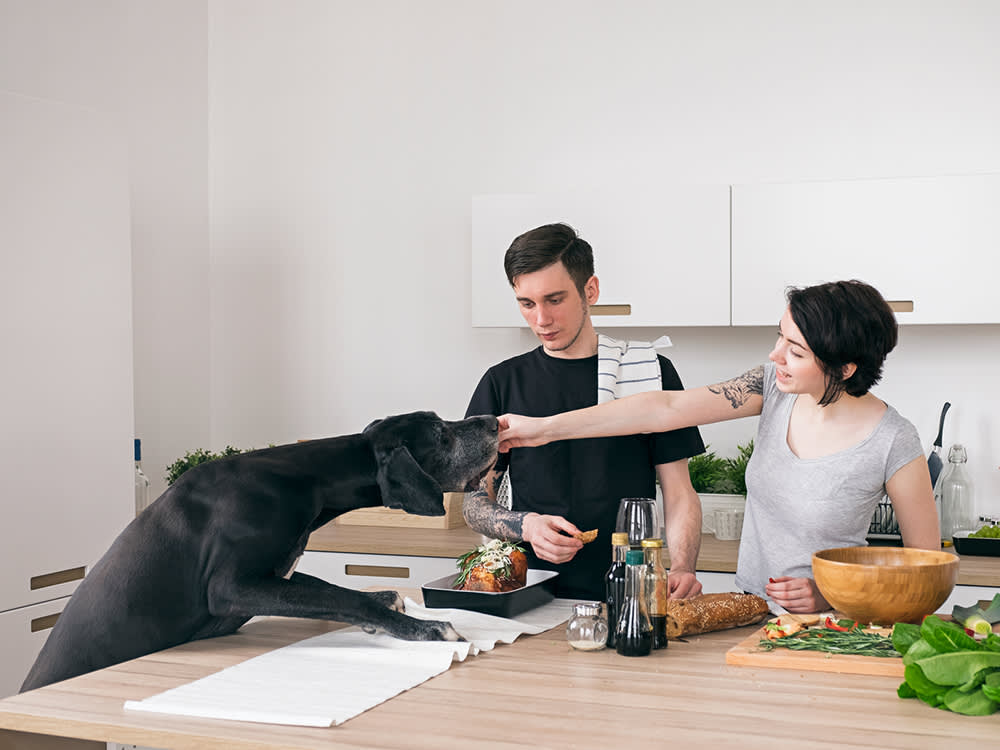
The pitch for cooking your dog’s food usually leads with money, and the money is real. Once you factor in a vitamin and mineral supplement and a calcium source, a home-cooked diet can land somewhere around $3 a day for a medium-sized dog. That is competitive with, and often cheaper than, a bag of premium food.
Here is the thing nobody puts in the pitch: you do not pay for this in dollars. You pay for it in Sunday afternoons, freezer real estate, and a level of precision that most people abandon by week five.
That is not a reason to avoid it. It is a reason to walk in with your eyes open, because the failure mode of home cooking is not “expensive.” It is “I got bored of weighing things and started eyeballing it,” and eyeballing it is how dogs end up nutrient-deficient.
Let’s do the whole accounting.
Line item one: your dog is not a small person
Start here, because everything downstream depends on it.
Dogs came up alongside us as both hunters and scavengers, and they eat well on an omnivorous mix of protein, carbohydrate, and fat. A healthy dog handles dietary fat more efficiently than we do, burning it for energy and clearing it from the bloodstream quickly. So far, so much like cooking for a person.
The divergence is in the details, and the details are where diets fail. Protein quality has to be high. And pound for pound, a dog’s mineral requirements, calcium above all, run well above ours.
Calcium is the headline. It is the single most important supplement in a successful home-cooked diet, and the one people most reliably skip, because unlike protein you cannot see it in the bowl. Even a varied, generous, beautifully cooked diet needs a deliberate extra calcium source. A moderately active adult dog of about 35 to 40 pounds needs roughly 1,800 mg of calcium daily. Smaller or larger dog? Roughly 600 mg per 12.5 pounds of body weight.
The exception is the one most people should take: if you are mixing homemade food with commercial food, you do not need to supplement heavily. Commercial food already contains adequate, sometimes more than adequate, calcium and phosphorus. A topper on top of a complete diet is a different, much more forgiving project than a full diet replacement.
Line item two: the recipe you found online is probably wrong
This is not a snide remark. It is a research finding.
When researchers evaluated 200 recipes for home-prepared maintenance diets for dogs, 129 of which were written by veterinarians, 95 percent of the recipes came up short on at least one essential nutrient relative to established minimums, and 84 percent had multiple imbalances. Only nine of the 200 met the standard. The nutrients that came up short over and over were zinc, choline, vitamin D, vitamin E, and vitamin B12.
If veterinarians writing recipes get this wrong most of the time, the recipe on a blog with a nice photo is not going to save you. Get a diet formulated by a board-certified veterinary nutritionist, or use a formulation service built for it. That is the cost line most people leave out, and it is the one that makes the rest of the plan legitimate.
The dogs I worry about are not the ones eating home-cooked food. They are the ones eating home-cooked food from a recipe nobody checked, for two years straight. Get the recipe formulated once, and then you can cook with confidence for the rest of your dog’s life. It is the cheapest insurance in this entire project.
Line item three: what actually goes in the pot
A workable homemade recipe has four components:
- Protein, and good protein. Eggs, fish, muscle meat, or organ meat like liver.
- Fat. Olive, canola, or safflower oil, or a marine oil such as cod or salmon.
- A carbohydrate that carries fiber. Oats, barley, brown rice, or sweet potato.
- Plant matter for phytochemicals. Vegetables, fruit, and herbs.
Swapping within a category is usually fine. Barley bores your dog and whole-grain pasta does not? Use the pasta. Vegetables are a non-starter but fruit disappears in seconds? Use the fruit.
Protein can occasionally come from tofu, beans, cottage cheese, or yogurt. Two warnings on that: dairy defeats a lot of dogs, and legumes or soy will make some of them noisily, memorably gassy. Try a small amount before a whole meal rides on it.
Line item four: the foods that are simply off the table
No amount of home-cooking enthusiasm makes these safe:
- Macadamia nuts
- Chocolate
- Tea and coffee
- Raisins and grapes
- Onions
- Excessive garlic
Beyond the list, three rules govern the transition:
Check with your vet before a big diet change, particularly if your dog has any preexisting condition. Make the change gradually, substituting a small proportion of new food for old over several days, so you do not trigger digestive upset. Watch the calories, because carrying extra weight does the same damage to a dog that it does to a person, and a generous home-cooked portion is very easy to over-serve. Your vet can tell you how much your dog should actually be eating.
Food safety is a real line item too. Dogs have defenses against bacteria, parasites, and food-borne pathogens, but they are not immune to them. Keep utensils clean, keep perishables refrigerated, and cook ingredients to appropriate internal temperatures. This matters most for puppies, older dogs, and dogs whose health makes them vulnerable.
Line item five: storage, which is where the time cost lives
Cooking in bulk is what makes the economics work, and bulk cooking is a logistics problem.
Cool the food after cooking. Portion it into reusable, washable containers, ideally in meal or multi-meal sizes. Three days is the refrigerator limit. Past that, you are gambling with spoilage, so anything you will not use by then goes into the freezer. Glass and plastic both work, but choose BPA-free plastic.
Jars
Heads up. are wide-mouth, which makes scooping food in and out far easier than a narrow jar, and they double for freezing stock or bone broth. If you are freezing in them, use the plastic lids, sold separately, rather than the glass ones.
Freezer containers
Heads up. hold 28 ounces, stack cleanly on a refrigerator or freezer shelf, and are microwavable, so you can warm a meal for a few seconds to bring it to room temperature, which most dogs find considerably more appetizing. Serve from a ceramic or stainless bowl rather than feeding straight from the container.
Vacuum sealer
If freezer space is the constraint, a
Heads up. compresses a week of meals into a fraction of the volume.
Line item six: the tools, and the one that actually saves money
Electric pressure cooker
Genuinely the workhorse. It handles stock, bone broth, and batch protein quickly. The
Heads up. is the size worth buying if you are cooking for a dog rather than a person.
Slow cooker
Good for long, low cooking and for softening vegetables and grains before you blend them with the protein. The
Heads up. does both jobs in one pot.
Sous vide, the money-saver. This is the tool most people skip and the one with a real return. Cooking method determines shrinkage, and shrinkage determines how much meat you have to buy. Cook a chicken breast in a pressure cooker on low pressure and it loses about 32 percent of its weight. In a slow cooker, about 24 percent. In a sous vide, 10 percent or less.
Run the math. A recipe calling for 7 pounds of cooked chicken might require you to buy more than 12 pounds of raw chicken depending on the method. That difference lands directly on your cost per serving, every single batch, forever. The Instant Accu Slim Sous Vide pays for itself over a year of batch cooking. It also cooks at lower heat over a longer time, which retains more vitamins and nutrients.
Silicone sous vide bags. The environmental catch with sous vide is that you cook inside an airtight plastic bag, and you burn through a lot of them. Reusable silicone bags fix that. Check it on Amazon ↗ are the well-known option; Platinum Pure large reusable sous vide bags are sized for batch work.
So is it worth it?
Honestly: yes, if you are the kind of person who will still be weighing the rice in month six.
Plenty of veterinarians remain wary of an exclusively homemade diet, and they are not being precious about it. Recalls happen. Some commercial food genuinely is low quality. Both things can be true while it is also true that an unformulated home diet, fed for years, produces the exact imbalances and vitamin and mineral shortfalls that damage a dog over time. The concern is well-founded. It is also fixable, but only on purpose.
What it costs you depends on how big your dog is, how hard they work, and what shape their health is in. Puppies still growing, dogs who are pregnant or nursing, and dogs doing real endurance work all need considerably more calories, protein, and fatty acids, plus other requirements layered on top.
The honest summary: home cooking buys you fresher food, ingredient control, palatability, and often a lower grocery bill. It costs you time, precision, and one up-front consultation you should not skip. If that trade sounds good to you, it is a genuinely good trade. If it sounds like a chore, cook a topper instead and let a complete commercial food do the heavy lifting. Both are legitimate. Only one of them requires your Sundays.
This article shares information and is not medical advice. Individual dogs react differently to any food or ingredient. Consult your veterinarian before changing your dog’s diet.
References
- Stockman, J., Fascetti, A. J., Kass, P. H., & Larsen, J. A. (2013). Evaluation of recipes of home-prepared maintenance diets for dogs. Journal of the American Veterinary Medical Association, 242(11), 1500–1505.
- University of California, Davis. Homemade dog food recipes can be risky business, study finds.
- American College of Veterinary Nutrition. Find a board-certified veterinary nutritionist.
- ASPCA Animal Poison Control Center. People Foods to Avoid Feeding Your Pets.
- U.S. Food and Drug Administration. Safe Minimum Internal Temperature Chart.
Common questions
How much calcium does my dog need?
A healthy, moderately active adult dog of roughly 35 to 40 pounds needs about 1,800 mg of calcium a day. Scale it at roughly 600 mg per 12.5 pounds of body weight. If you are mixing homemade food with commercial food, you need far less supplementation, because commercial food already contains adequate calcium and phosphorus.
How long does home-cooked dog food keep?
Three days in the refrigerator. After that, freeze it. Cool it before it goes into containers, portion it into meal or multi-meal sizes, and defrost as needed.
What has to be in a homemade recipe?
A high-quality protein source, a fat source, a fiber-containing carbohydrate, and a phytochemical source from fruits, vegetables, or herbs. Substitutions within those categories are usually fine. What is not optional is the supplementation that closes the nutrient gaps.
Not a substitute for your vet. Our guidance is educational. For urgent symptoms, contact a vet or emergency clinic right away. Editorial standards
Dr. Solis is a board-certified veterinary dermatologist with over twelve years of clinical experience. She advises on skin conditions, allergies, and grooming practices that affect coat and skin health. All dermatology and allergy content at The Pet Times is reviewed by her team before publication.
Meet our experts ↗Keep reading
 FoodRaw Feeding Just Got a New Rulebook. Ask Every Brand This One Question.Dr. Priya Nair · 11 min
 FoodSweet Potato Is a Real Dog Superfood. One Rule Makes It Safe.Dr. Priya Nair · 5 min
 FoodRaw Dog Food's Real Danger Isn't the Meat. It's What You Skip.Dr. Priya Nair · 6 min
 Food5 Reasons to Cook for Your Dog. Just Don't Cook All of It.Dr. Priya Nair · 6 min
 FoodA Beef-and-Veggie Dog Topper That Follows the 10% RuleDr. Lena Park · 5 min
 FoodCooking for Your Dog Is the Easy Part. Balancing It Is Where People Fail.Dr. Priya Nair · 7 min