


Your Cat Picks the Foot of the Bed on Purpose. Here's the Logic
It feels like a lukewarm compromise, close, but not on the pillow. In fact your cat's choice of the foot of the bed is a tidy piece of feline reasoning about warmth, safety, and scent. And there's a kind way to move them if it's wrecking your sleep.

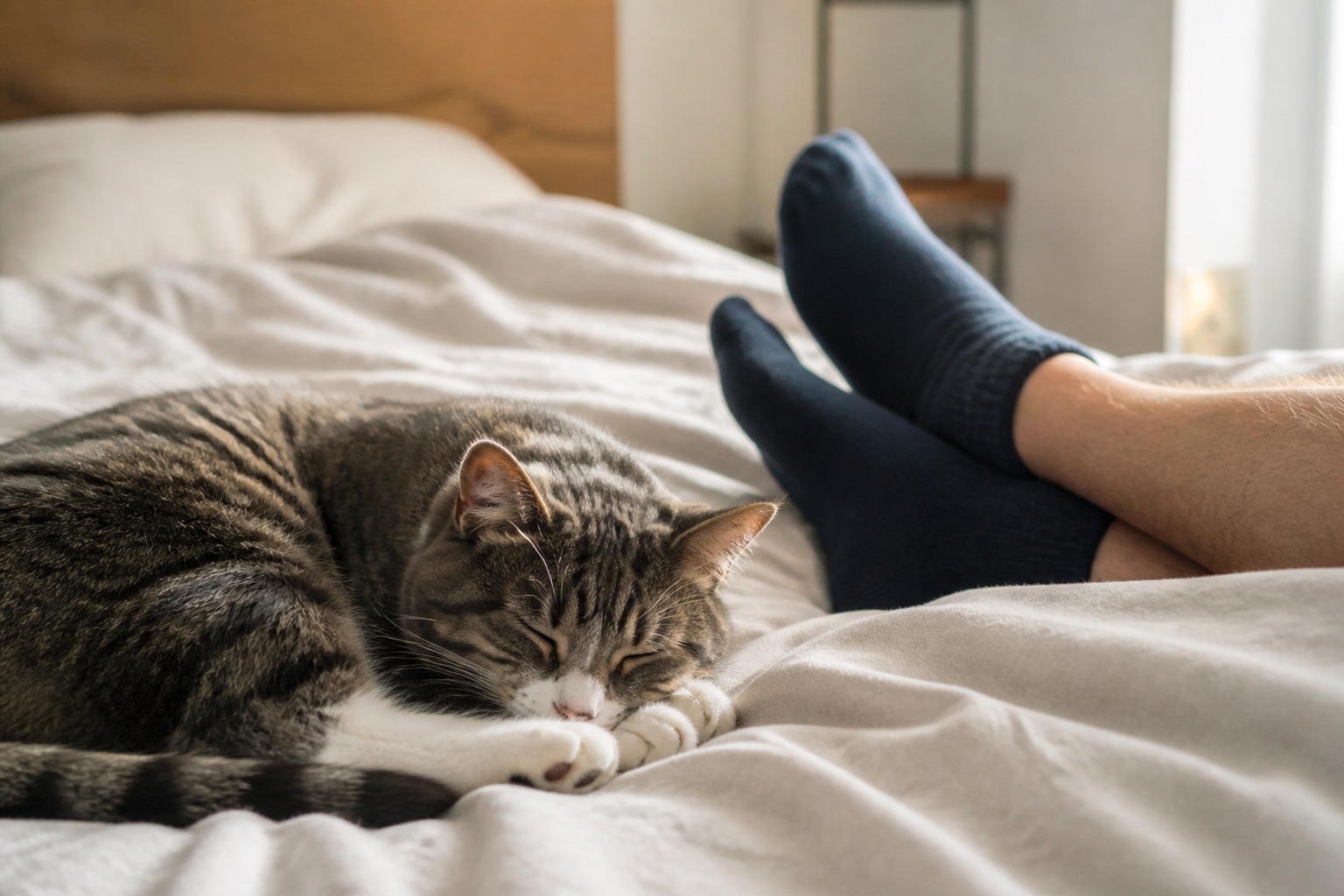
You’d think, after all the food and the vet bills and the devotion, your cat might reward you with the pillow. Instead it curls up down by your ankles, night after night, close but conspicuously not close. It’s easy to read that as a lukewarm verdict on the relationship. It isn’t. The foot of the bed is a considered choice, and once you understand the reasoning behind it, it turns out to be one of the more flattering things your cat does.
The reasons your cat sleeps where it does aren’t so different from yours. Here’s the logic, and, if the arrangement is costing you sleep, a gentle way to renegotiate it.
The case for the foot of the bed
Several threads usually braid together into that spot at the end of the mattress.
Warmth. A cat’s comfortable temperature runs hotter than ours. Their thermoneutral zone, the range where they don’t have to spend energy heating up or cooling down, sits roughly between 86 and 97 degrees Fahrenheit, while ours lands somewhere around 65 to 86. Since most of us nudge the thermostat down at night and burrow under the covers, and cats usually sleep on top of them, they drift toward us for the extra warmth. Even the sheets and blankets they’re resting on hold a little of that heat.
A sense of safety. Sleeping near us helps cats feel secure, and the instinct traces straight back to kittenhood, when they slept in a heap of littermates, tiny feet poking out in every direction, safety in numbers. That upbringing also means they’re used to a lot of jostling and rearranging in their sleep, so your rolling over isn’t nearly as disruptive to them as you might fear. The foot of the bed threads the needle: close enough to feel the safety, far enough to dodge the worst of your movement.
Trust and affection. This ties directly to feeling safe. A cat that trusts you and enjoys your company feels secure enough to sleep in contact with you, and plenty of cats simply like the closeness.
Scent, and a little territory. Wherever a cat spends time, it leaves its scent behind, and this isn’t the keep-out kind of marking. Being surrounded by their own smell makes cats feel more secure, and it quietly communicates to other pets that a spot is spoken for. The first few nights your cat sleeps by your feet, it deposits its scent there naturally, which then nudges it to return to the same claimed patch.
Plain comfort. Sometimes the answer is the obvious one: your bed is comfortable. Many cats also like to lean against something as they sleep, which is why yours may shuffle as close as possible and prop itself against your legs before settling.
”Does my cat like me best?”
Nobody enjoys feeling passed over when a cat favors one person’s bed over another’s. Sometimes it genuinely is a preference and a closer bond. But some of the deciding factors have nothing to do with love, and it’s worth knowing them before you gloat or sulk:
- You may simply move less in your sleep, making you the more restful pillow.
- Your bed might be more comfortable.
- Your room might sit at a temperature that suits the cat better.
- Your cat may be angling to be nearer, or farther from, other pets who sleep elsewhere.
If the arrangement is ruining your sleep
Loving your cat and needing a full night’s rest aren’t in conflict, and you shouldn’t feel guilty for wanting your bed back. You’ll be a better cat parent well-rested. The catch is that if you simply move a determined cat, it tends to reappear. The way through is encouragement, not punishment.
Start by learning what your cat actually likes, because cats are individuals about sleep. Use their current favorite spot as your reference and try to recreate it somewhere you’d prefer, then improve on it. Some cats want a squishy, plush bed; others prefer something firm and supportive. Many like a heated bed in winter and a cooling mat in summer. Some love to burrow into blankets or hidey-holes, while others want to sprawl and feel a breeze. Test a few options and watch what wins.
Then reward the new spot relentlessly. The best way to shift a cat’s behavior is to reward the choice you want, day or night, with treats, praise, petting, whatever your cat loves. When your cat lands in the unwanted spot, don’t shove it out dramatically, that just becomes attention. Neutrally lift it away without a fuss, steer it toward the spot you’d rather it use, warmly, and pay out a reward there.
For senior cats, factor in their joints. Older cats are very prone to osteoarthritis, which brings aches and mobility trouble, and you may notice a cat struggling to get comfortable or to climb into a favorite spot. Orthopedic beds offer more support; some sit low so there’s no jumping involved, and others have bolstered edges for a cat to lean on. A cat-specific heated pad can add comfort, but never use a human heating pad, which isn’t safe for pets. And think about the approach, too: senior or mobility-limited cats may need steps or a ramp to reach the bed at all.
Where a cat chooses to sleep tells you a lot, but it’s not a popularity contest you’re doomed to lose. If you’d rather they slept elsewhere, don’t fight them for the mattress. Build them something better than your feet, a warm, propped-up, safe little nest, and pay them handsomely for using it. Cats are ruthlessly practical. Make the new spot the best deal in the house and they’ll take it.
When a change is worth noticing
Cats revise their sleeping preferences the way we do, and it shows up most when the weather turns. Your cat might suddenly crave more room, or less, between the two of you, migrate to a different part of the bed, or decamp to another room entirely for part or all of the night. On its own, none of that is cause for concern.
It’s only worth a second look when the shift travels with other changes, a cat that abruptly can’t get comfortable, seems stiff, or is off its normal behavior in other ways. In an older cat especially, difficulty settling can be a quiet sign of pain, and that’s a conversation to have with your vet.
What newer research adds
There’s a nice footnote for anyone who lets the cat stay: co-sleeping with a pet may be good for you, too. A growing body of sleep research has looked at people who share a bed or bedroom with their animals and found many report feeling more secure and settled, with some studies pointing to genuine comfort benefits from the arrangement. It isn’t universal, light sleepers and allergy sufferers may do better with the cat in its own bed, but for plenty of households, the warm weight at the foot of the bed is a two-way comfort. Your cat picked the spot for its own good reasons. You might be getting something out of it as well.
References
- Hoffman, C. L., et al. “An Examination of Adult Women’s Sleep Quality and Sleep Routines in Relation to Pet Ownership and Bedsharing.” Anthrozoös, 2018. https://doi.org/10.1080/08927936.2018.1529354
- International Cat Care. “Understanding Your Cat’s Behaviour.” https://icatcare.org/advice/
- Cornell Feline Health Center. “Osteoarthritis in Cats.” Cornell University College of Veterinary Medicine. https://www.vet.cornell.edu/departments-centers-and-institutes/cornell-feline-health-center
Common questions
Why does my cat sleep at my feet instead of next to me?
The foot of the bed is often the sweet spot: close enough for warmth and security, far enough to avoid your tossing and turning. Cats also like the mild heat your body throws off and the fact that their scent is already there from previous nights.
Does my cat sleep by me because it loves me?
Often, yes, sleeping near you signals trust and affection. But not always. Sometimes it's just that you move less, your bed is comfier, or your room is the right temperature. Where a cat sleeps is a mix of bond and logistics.
How do I get my cat to stop sleeping on my bed?
Reward, don't punish. Recreate their favorite sleeping setup in a spot you prefer, then pile on treats and praise when they use it. If they climb onto the bed, calmly move them without fuss and coax them back to the rewarded spot.
Is it a problem if my cat suddenly changes where it sleeps?
Usually not, cats shift sleeping spots with the seasons and their moods. It's only worth a closer look if the change comes with other differences, like trouble getting comfortable, which can hint at pain in an older cat.
Claire Sutton writes about life with pets, from the first days home to the small daily routines that make a household work. Her reporting spans people-and-pet relationships, training basics, and the practical side of bringing a new animal into the family.
Meet our experts ↗Keep reading
 LivingWhy Agathe Singer Paints Every Cat as a Person, Never a PatternNina Vasquez · 6 min
 LivingAnimal Communicators Aren't Reading Your Cat. They're Reading You.Leila Torres · 8 min
 TrainingYour Cat Doesn't Care About the Bathroom. They Care That You Finally Sat Down.Dr. Priya Nair · 8 min
 LivingThe Cat Burglar of Mairangi Bay Has 150 Victims and Zero RemorseSasha Ford · 4 min
 LivingShe's Cut Her Cat Into 37 Surreal Portraits. He Couldn't Care Less.Claire Sutton · 5 min
 LivingThe 8 Cat Breeds Most Likely to Actually Love You BackLeila Torres · 7 min