


She's Cut Her Cat Into 37 Surreal Portraits. He Couldn't Care Less.
Scottish collage artist Lola Dupré turns a warped mirror on Prince, Aristotle, and Vogue covers with nothing but paper and scissors. Her most enduring muse is a formerly feral rescue named Charlie, who ignores every one.
Ask most people to name something artistic that came out of Scotland and you will get scotch, maybe Ewan McGregor, and then a long pause. So when Glasgow’s Lola Dupré started producing her strange, beautifully grotesque portraits, the art world noticed precisely because nobody expected it. Her subjects, Prince, Aristotle, Jean Harlow, arrive stretched and multiplied, wearing distorted proportions built from little more than magazine clippings, paper, and a pair of scissors. The results are intricate, precise, and unsettling, and they have earned her commissions from Nike, Burton, Vogue, Flaunt, New York Magazine, and the New York Times.
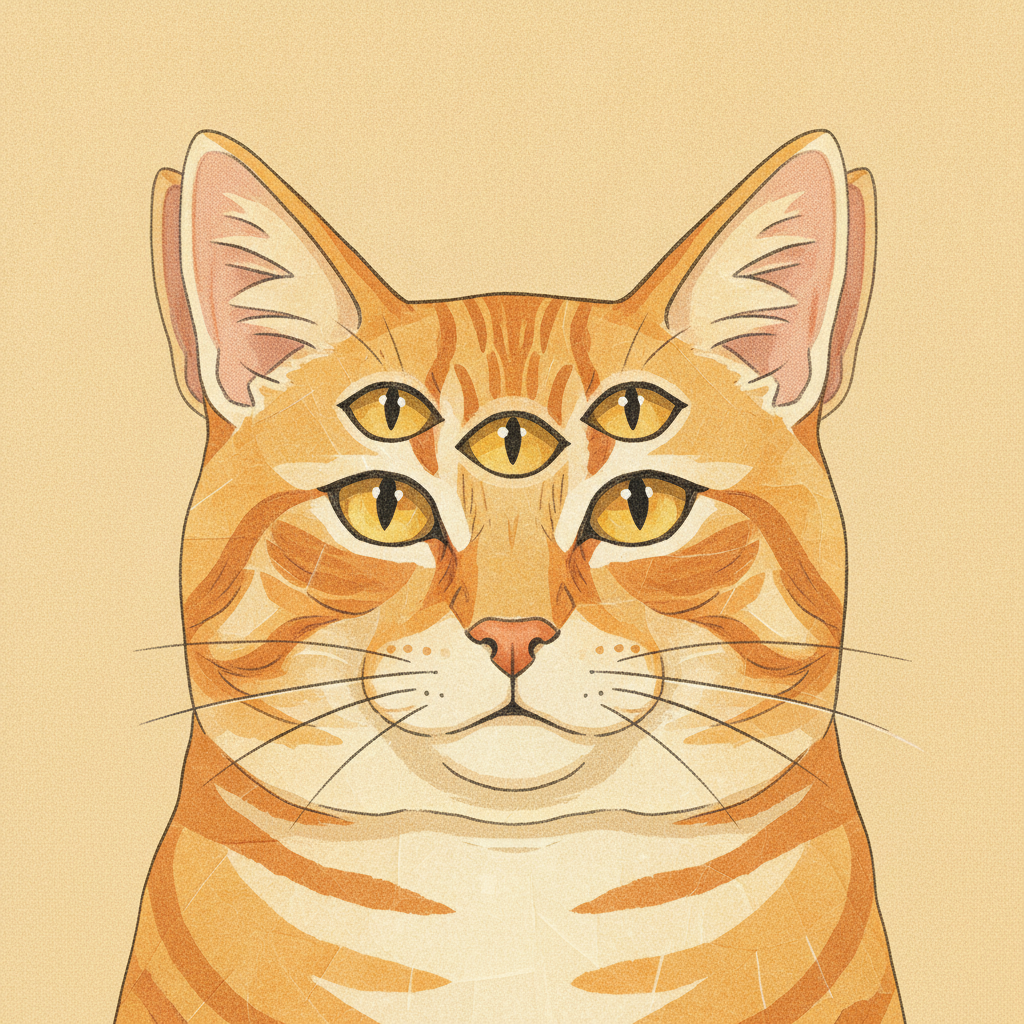
But her most persistent muse is not a celebrity or a philosopher. It is a formerly feral cat named Charlie, and she has made 37 portraits of him and counting.
Turning a warped mirror on the famous
Whether she gives a subject a dozen legs, a spiky tongue, or a face full of extra eyes, Dupré brings the same flair and obsessive detail to each piece. She reaches into art history, Surrealism, Cubism, Dadaism, to rebuild the faces of the famous and powerful, and her aim is pointed. She wants viewers to reconsider who, exactly, they have decided is worthy of attention and admiration. In her own words, she likes holding a distorted mirror up to pop culture, and working with instantly recognizable images is what gives that mirror its strange, almost primal jolt.
Her path to collage was slow and self-directed. She dabbled in it as a child, then committed to it full time around 2009, drawing early inspiration from Jean-Paul Goude, David Hockney, and Hannah Höch, and from the wilder corners of art history: Hieronymus Bosch, Leigh Bowery, Moebius, Bridget Riley, Otto Dix, Louise Dahl-Wolfe. The process itself has become more refined over the years. She works on wood panels, a solid surface that never curls or buckles, and where she once relied on cut-up magazines, she now prints her own source material, cutting and rearranging the pieces, following a plan in her head or letting the collage veer somewhere new when the shift feels right.
The cat who became her steadiest subject
Animals have always run through Dupré’s work, a natural fit for someone who grew up in the countryside surrounded by sheep, donkeys, cats, and dogs. But Charlie is the one she keeps returning to, and it started almost by accident. She made a single portrait of him, found the process so absorbing and satisfying that she could not stop, and simply kept going. He is, she says, endlessly inspiring, full of attitude and blessed with expressive features, though he does not always cooperate. Lately the sittings have gotten harder, partly because winter means less good light and Charlie spends more of the day curled up asleep.
His backstory is the kind that explains the attitude. Dupré and her partner adopted him at eight years old, and he is twelve now. They could never learn anything about his life before them, though she suspects it was rough. For his first year he was antisocial and grumpy, tolerating a gentle touch only on the forehead before he would swipe with his claws. He has softened considerably since; now he will let you rub his belly while he waits for food. He relaxes in sunny windows, prowls the local area on his own terms, and keeps no feline friends whatsoever, every other cat in the neighborhood is an enemy.
The funniest part of their creative partnership is how supremely unbothered Charlie is by the art he inspires. Asked whether a collage of a many-eyed creature has ever startled him, Dupré is blunt: not really. He is too cool to notice. He will occasionally regard a finished piece calmly and solemnly, then look right through it, entirely unimpressed, as though he has weightier matters to consider. The muse, it turns out, is the one member of the studio least interested in the output.
Life at the edge of the work
These days Dupré lives a quieter life than she used to. She and her partner once traveled widely across Europe but have been rooted in the Scottish countryside for a few years, filling their time with long walks through mountains, forests, and coastline. Nature feeds the work directly; she loves crouching over patches of moss and slime mold on the forest floor, turning over the relationship between the tiny and the massive, their odd similarities and differences. A change of scenery may be coming, they have been hoping to move, but wherever she lands, it is safe to assume Charlie will be there, ignoring the portraits, waiting for his dinner.
References
Claire Sutton writes about life with pets, from the first days home to the small daily routines that make a household work. Her reporting spans people-and-pet relationships, training basics, and the practical side of bringing a new animal into the family.
Meet our experts ↗Keep reading
 LivingYour Cat Picks the Foot of the Bed on Purpose. Here's the LogicClaire Sutton · 6 min
 LivingYour Cat Isn't Trying to Cuddle. They're Doing Math.Dr. Nina Kohl · 6 min
 LivingShe Built Her Cat a Sparkly Palace. The Cat Wanted the Cardboard.Nina Vasquez · 5 min
 LivingAnimal Communicators Aren't Reading Your Cat. They're Reading You.Leila Torres · 8 min
 LivingThe Cat Burglar of Mairangi Bay Has 150 Victims and Zero RemorseSasha Ford · 4 min
 LivingAn Amazon Driver Took Their Cat on Camera. The Microchip Couldn't Bring Her BackMarcus Webb · 5 min