


Animal Communicators Aren't Reading Your Cat. They're Reading You.
There is no evidence anyone can telepathically talk to your cat. There is also a reason people walk out of these sessions crying, and calmer, and getting along with their pets better. Both things are true, and the second one is more interesting than the debunking.

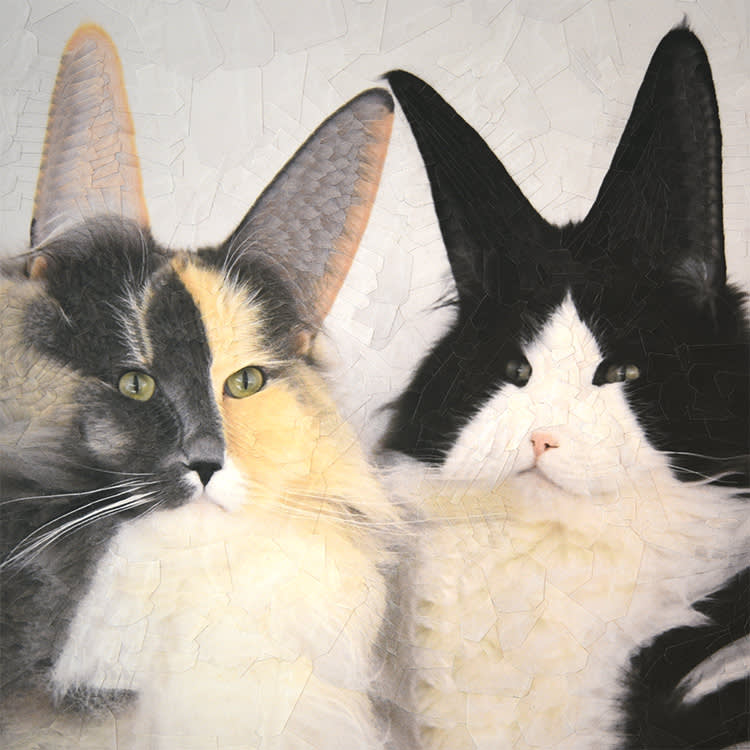
A cat parent books an hour with an animal communicator because two cats who were forced to become roommates cannot stand each other. Grumbling, hissing, chasing, the works. The session happens over Zoom. Nobody cries during the intake form. Everybody cries by the end.
The communicator reports that the resident cat is smart, always watching, and furious that nobody consulted her before a second cat moved in. That the newcomer is a shameless attention hog with an anxious streak who flops onto chests until the room looks at him. That both cats already know about the upcoming move, because they have heard their humans discussing it for weeks. That the resident cat does not want a friend so much as a subordinate, and would like, in future, to be checked in with.
The tension in the apartment drops for the rest of the day.
Now: none of that is telepathy. All of it is worth taking seriously. Those two sentences are not in conflict, and the space between them is the most useful thing anyone can tell you about pet psychics.
What actually happens in the room
Strip away the framing and a session is a structured, hour-long, professionally facilitated conversation about your animal.
You fill out a form. You state an intention, which forces you to name the problem in one sentence, possibly for the first time. You are asked to sit somewhere quiet, without distractions, with a notebook. A good practitioner asks the animals for consent before beginning, works gently, does not judge, and does not tell you that you have ruined your pet. Many offer Reiki as an add-on, and finish with ten minutes of it.
Then, for sixty minutes, a calm outsider asks you focused questions about your animal’s behavior, history, environment, and future, and reflects an interpretation back to you.
Consider what that hour contains, independent of any psychic claim. Uninterrupted attention on a problem you have been avoiding. A vocabulary for your pet’s inner life. Permission to feel something about it. A partner in the room, in this case, hearing all of it out loud at the same time you do. And an explicit, sympathetic model of your animal as a being with preferences that were not consulted.
That is a therapy session with a cat as the presenting issue. And people are transformed by therapy sessions all the time.
The evidence problem, stated plainly
There is no controlled, peer-reviewed evidence that anyone can telepathically receive specific information from an animal. The claims have not survived rigorous testing, and there is a very well-documented mechanism that explains why sessions feel so uncannily accurate without any of it being paranormal.
It is the same mechanism that fooled a generation of scientists about a horse.
Clever Hans was a horse in early-1900s Berlin who appeared to do arithmetic, tapping out answers with his hoof. He was genuinely getting them right. He was also, it turned out, reading the involuntary micro-changes in posture and breathing of the humans watching him, and stopping when they relaxed. Hans was not doing math. Hans was doing something arguably more impressive: reading people, with extraordinary precision, from cues the people did not know they were giving.
A skilled animal communicator, sitting across from an owner who is desperate to be told their cat forgives them, is in exactly that position. You told them the cats fight. You sent a photo where one cat is glaring at the other. You described the situation on the intake form in careful, hedging, guilt-soaked language, because that is how people describe a problem they feel responsible for. Your face moves when they get warm. This is not necessarily fraud. Many practitioners are sincere. It is simply that the information is flowing in the direction opposite to the one advertised.
The tell is in the content. Notice how much of what comes back is affirming, emotionally satisfying, and unfalsifiable. She appreciated that you tried to communicate with her. You cannot check that. You can only be moved by it.
Why the cats calmed down anyway
Here is where the easy debunking runs out of road, because the apartment did get quieter.
Two boring, entirely material things happen after a session like that.
The humans change their behavior. You have just spent an hour being told that your resident cat feels displaced and wants agency, and that the new cat is anxious and attention-starved. Whether or not a cat said that, you now go home and give the resident cat more separate, uncontested space and a little ceremony of her own, and you give the new cat more structured attention so he stops flopping for it. Those are exactly the interventions a feline behaviorist would prescribe for two-cat conflict. You did them because a session made you care enough to.
The humans calm down. Cats are relentless readers of household tension, and a stressed owner is a stressor. Two people who have just cried, had a nice hour, and feel hopeful about their cats are simply less agitating to live with.
You do not need telepathy to explain a good afternoon. You need a household where the humans changed what they were doing.
Where this turns dangerous
There is one line, and it is bright.
A communicator who tells you your animal says they are not in pain, or that a lump is nothing, or that they want to keep fighting a disease, or that they are ready to go, is now practicing medicine and end-of-life decision-making with no diagnostic capability whatsoever. Real animals have died waiting while their owners took reassurance from someone with no ability to examine them.
“The harm I see is almost never the session itself, it is the delay,” says Dr. Nina Kohl. “By the time a cat gets to me, the owner has spent three weeks being told the cat is at peace. The cat was not at peace. The cat had a treatable problem and now it is a much bigger one.”
If a communicator makes any medical claim, positive or negative, treat it as noise and go to a vet. A responsible practitioner will tell you the same thing without being asked, and the good ones do.
The other, smaller risk is financial. Sessions are not cheap, and open-ended packages of follow-ups can quietly become a subscription to being reassured.
So what should you actually do?
If your pets are in genuine conflict, the interventions that reliably work are unglamorous and well-established. Separate resources, so that food, water, litter, and resting spots are never contested. Vertical space. Scent swapping and a slow reintroduction rather than forced proximity. Structured, separate one-on-one time with each animal. Play that drains the tank. And if the fighting is serious or escalating, a certified feline behavior consultant or a veterinary behaviorist, who can watch what is happening and change it.
If you want the session anyway, you are allowed to. Go in clear-eyed. Take it as what it is: a facilitated hour of thinking hard and tenderly about an animal you love, run by someone whose job is to help you find the words. Take the insights that lead to concrete changes in your home. Discard anything medical. Do not book it instead of a vet.
And if you cry, that is not evidence of anything supernatural. It is evidence that nobody had asked you, until that hour, what you thought your cat was feeling. That question was always available to you. It just took someone charging for it to make you sit still and answer.
References
- Pfungst, O. Clever Hans (The Horse of Mr. von Osten): A Contribution to Experimental Animal and Human Psychology. Project Gutenberg.
- Samhita, L., and Gross, H.J. The “Clever Hans Phenomenon” Revisited. Communicative and Integrative Biology.
- American Association of Feline Practitioners. Feline Environmental Needs Guidelines.
- American Veterinary Medical Association. Complementary, Alternative, and Integrative Veterinary Medicine.
Leila Torres leads our Living coverage, from home life and travel to the products and rescue stories that come with sharing a life with animals. She edits and writes across the section, with a soft spot for pieces about the bond between people and their pets.
Meet our experts ↗Keep reading
 LivingI Spent $6,064 on My Cat in One Month. Only $94 of It Was Actually Cat Stuff.Nina Vasquez · 7 min
 LivingCan Cats Sense When Death Is Near? Inside the Mystery of Oscar the CatTom Hadley · 7 min
 LivingHer Cat Has a Meow for Everything. It Rewired How She Makes Music.Jordan Ellis · 4 min
 LivingA Video Game Studied Cats Harder Than Most Cat Owners DoSasha Ford · 6 min
 LivingThe 8 Cat Breeds Most Likely to Actually Love You BackLeila Torres · 7 min
 LivingMy Cat Has Never Once Felt Awkward. I'm Taking Notes.Sasha Ford · 5 min