


Can Cats Sense When Death Is Near? Inside the Mystery of Oscar the Cat
A nursing-home cat named Oscar seemed to know when residents were about to die. We asked a feline behaviorist what's really going on when cats appear to sense the end.

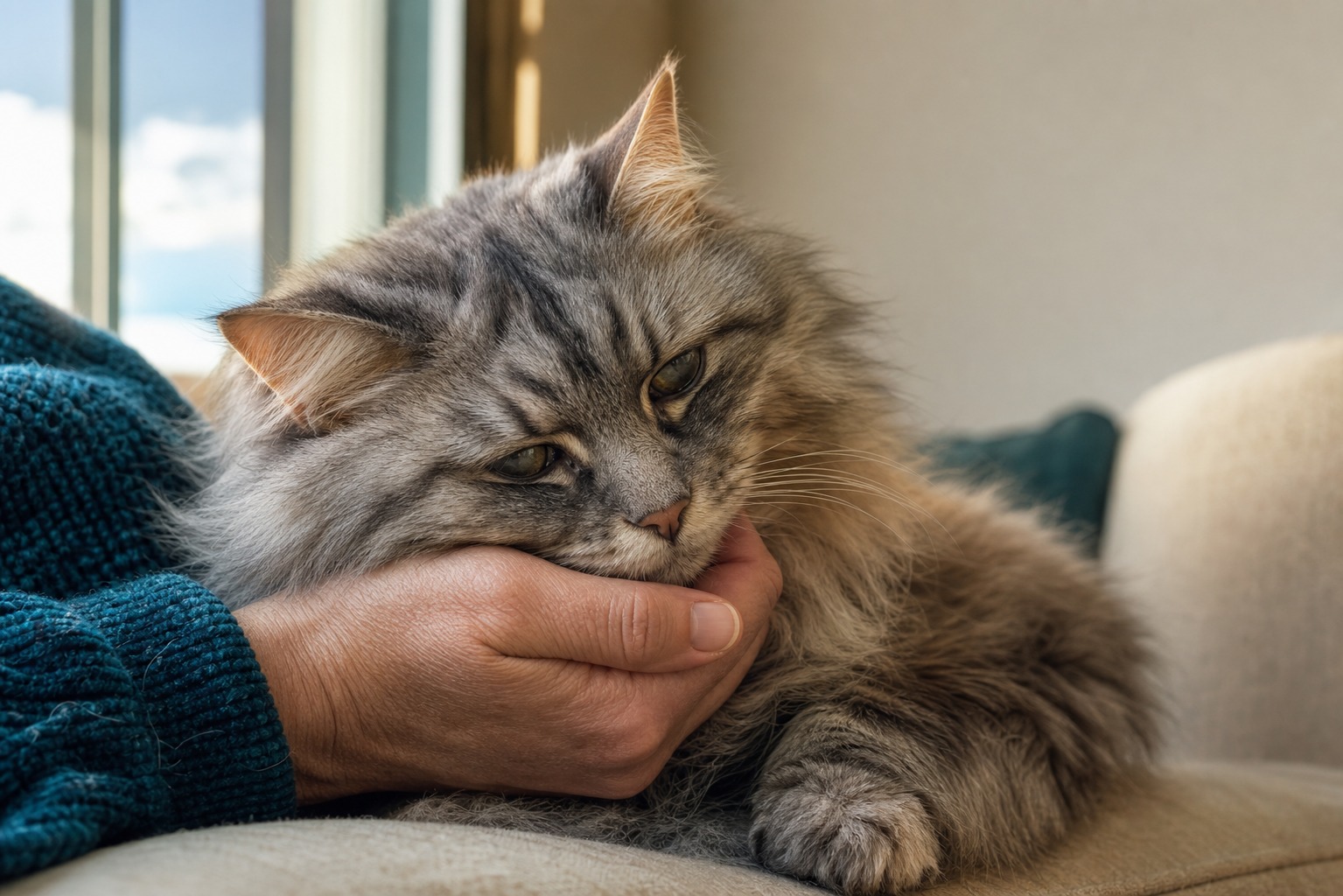
In 2007, the New England Journal of Medicine ran an essay that sounds like the opening of a horror novel: a cat who seemed to know, hours in advance, which nursing-home resident would die next. The cat’s name was Oscar. He lived at the Steere House Nursing and Rehabilitation Center in Providence, Rhode Island, where he’d been adopted to be a gentle, purring presence for residents in their final years. What the staff didn’t expect was the very particular kind of comfort he’d end up offering.
Over and over, Oscar would curl up in bed beside a specific resident in the hours before they passed. This wasn’t a tabloid rumor or a grieving family member reading meaning into a coincidence. The essay, “A Day in the Life of Oscar the Cat,” was written by Dr. David Dosa, a geriatrician at Steere House and a health-services researcher at Brown University.
The cat who made the rounds
The clearest picture of Oscar’s gift comes from a resident Dr. Dosa called Mrs. K. When a nurse noticed Oscar settle into bed with her, she phoned the family right away. They understood what his presence meant and arrived within the hour. In Dr. Dosa’s telling, a young grandson asks his mother why the cat is there. Fighting back tears, she tells him the cat has come to help Grandma get to heaven. Thirty minutes later, Mrs. K took her last breath.
If this is giving you Stephen King energy, you’re not imagining it. While promoting Doctor Sleep, King confirmed that Oscar’s story helped inspire it. Dr. Dosa’s essay struck such a chord with cat lovers and clinicians that he expanded it into a 2010 New York Times best seller, and echoes of Oscar turned up in episodes of both House and The Simpsons.
Oscar died in 2022 at the age of 17, having reportedly kept vigil for more than 100 residents over his lifetime. So is any of this actually possible? After talking it through with a feline behavior expert, the answer is more grounded — and more reassuring — than you might guess.
Could a cat genuinely sense the end?
It sounds like magical thinking, but there’s real behavioral logic underneath the story. Tom Hadley, a certified feline behavior consultant, says we can’t claim a cat like Oscar understood that someone was dying — our line of communication with cats only goes so far. But that’s a long way from impossible.
“Nothing about that requires magic — pick up enough repeated patterns around dying patients and an observant cat will connect them,” Hadley says. “Cats are remarkable observers. They just aren’t reading the situation the way a human would.”
Cats are exceptionally good at noticing human behavior, especially when that behavior leads to something they want. In a care setting, a dying resident — and the staff around them — may give a therapy cat more attention than usual. Oscar might also have been drawn to the changes that come with the end of life: slower breathing, reduced mobility, a shift in body temperature.
Hadley points out that a cat could even be cueing off the humans. “Nurses shift their routines around a declining patient, and a cat notices the traffic change. Where the people keep going is where the attention is, and the cat follows,” he says.
Then there’s scent. As the body begins to shut down, it releases chemicals into the bloodstream, including ketones — acids the body produces when it breaks down fat for fuel in the absence of glucose.
“A cat’s nose operates on a level ours can’t approach. A shift in what the body is releasing as it breaks down fat for fuel would be well within what a cat can register,” Hadley says.
Dr. Dosa hinted at exactly this in his essay, describing Oscar jumping onto Mrs. K’s bed, sniffing the air, pausing as if to weigh the situation, then turning twice and curling up beside her.
The less mysterious explanations
For decades, pet parents have shared stories of a cat suddenly shadowing or clinging to someone shortly before they died. Oscar lends those stories a little credibility, but it’s worth resisting the urge to assume every cat has a built-in sense for the Grim Reaper. More often, they’re simply responding to a change in that person’s own behavior.
When someone is seriously ill or nearing the end of life, their daily habits shift — including how they care for their pet. Those changes ripple straight into a cat’s world. “Cats thrive on predictable routines, and any disruption can leave them feeling anxious,” Hadley says. “A clingy or watchful cat may just be seeking reassurance from a person they love.”
It’s also true that cats go through their own grief. After losing a companion — human or feline — a cat may seem withdrawn, low on energy, or restless, as though searching for someone. “Grief in a cat is real, and it makes sense once you take their relationships seriously,” Hadley says. “These are animals with genuine attachments, and an absence registers.”
If your cat is mourning
Hadley cautions against rushing to adopt a new pet the moment your cat starts grieving a fellow cat. “A cat’s shortlist of tolerable feline roommates is short and non-negotiable,” he says. “Dropping a stranger into the home during a vulnerable stretch can make things worse, not better.” Instead, he recommends leaning into gentle, positive experiences — extra play, favorite spots, calm one-on-one time — that help a grieving cat heal without piling on stress.
As for whether Oscar truly knew, Hadley keeps coming back to the same point. There were simply too many accurate vigils for pure chance. “From the accounts, it’s clear the cat could distinguish among many unresponsive patients and choose to sit with the one whose death was imminent,” he says. But the part he finds most moving isn’t the prediction — it’s the response. “What’s behaviorally fascinating isn’t that Oscar could sense death approaching,” he says. “It’s that he met it with tenderness, choosing to spend those hours offering comfort.”
So if you ever wake to find a soft, purring shape that looks a little like an angel of death curled against you, take heart. They’re almost certainly there out of love.
What’s new since this was written
Researchers keep finding evidence that a cat’s nose is even more capable than we assumed. In 2025, a team at Tokyo University of Agriculture published a study in PLOS One showing that cats can distinguish their owner’s scent from a stranger’s using smell alone — and that they spend noticeably longer investigating unfamiliar odors. It’s a reminder that scent-based “reading” of the humans around them is well within a cat’s wheelhouse.
That work builds on a 2023 study in Scientific Reports finding that cats respond differently to human body odors tied to specific emotions, showing the most stress in response to the scent of fear. None of this proves a cat can predict death, but it does support the central idea behind Oscar’s story: cats are constantly gathering chemical information about us that we can’t even perceive.
References
- Dosa, David M. “A Day in the Life of Oscar the Cat.” New England Journal of Medicine, vol. 357, no. 4, 26 July 2007, pp. 328–329. https://www.nejm.org/doi/full/10.1056/NEJMp078108
- Dosa, David. Making Rounds with Oscar: The Extraordinary Gift of an Ordinary Cat. Hyperion, 2010.
- “Oscar (therapy cat).” Wikipedia. https://en.wikipedia.org/wiki/Oscar_(therapy_cat)
- Concha, A., et al. “Behavioral responses of domestic cats to human odor.” PLOS One, 28 May 2025. https://journals.plos.org/plosone/article?id=10.1371/journal.pone.0324016
- d’Ingeo, Serenella, et al. “Relationship between asymmetric nostril use and human emotional odours in cats.” Scientific Reports, 2023. https://www.nature.com/articles/s41598-023-38167-w
Common questions
Can cats really predict death?
There's no proof a cat understands death the way we do, but it's plausible they learn to recognize the subtle physical and chemical changes that come with the end of life, from shifting breathing patterns and body temperature to scent changes in the blood.
How might a cat 'know' someone is dying?
Cats are excellent at reading human behavior and have a remarkable sense of smell. They may pick up on a person's slowing movements, changing odor (including ketones produced as the body shuts down), or even subtle shifts in how caregivers behave around that person.
Do cats grieve when a companion dies?
Yes. Grieving cats may play less, seem low on energy, or appear to search for a missing companion. It's a normal response to losing a strong social bond with a person or another animal.
Tom Hadley writes about training and behavior, helping owners understand what their pets are trying to tell them. His work covers everyday manners, decoding common behaviors, and the small changes at home that make dogs and cats easier to live with.
Meet our experts ↗Keep reading
 LivingI Spent $6,064 on My Cat in One Month. Only $94 of It Was Actually Cat Stuff.Nina Vasquez · 7 min
 LivingHow Many Cats Is Too Many? Vets Say You're Asking the Wrong Question.Nina Vasquez · 7 min
 LivingWhy Agathe Singer Paints Every Cat as a Person, Never a PatternNina Vasquez · 6 min
 LivingYour Cat Picks the Foot of the Bed on Purpose. Here's the LogicClaire Sutton · 6 min
 LivingA Video Game Studied Cats Harder Than Most Cat Owners DoSasha Ford · 6 min
 LivingAn Amazon Driver Took Their Cat on Camera. The Microchip Couldn't Bring Her BackMarcus Webb · 5 min