


Why Agathe Singer Paints Every Cat as a Person, Never a Pattern
The Parisian artist behind those bold, botanical cat portraits has worked with Gucci and Sephora. Her real subject, though, is individuality: the conviction that no two cats are alike, and neither are her paintings of them.

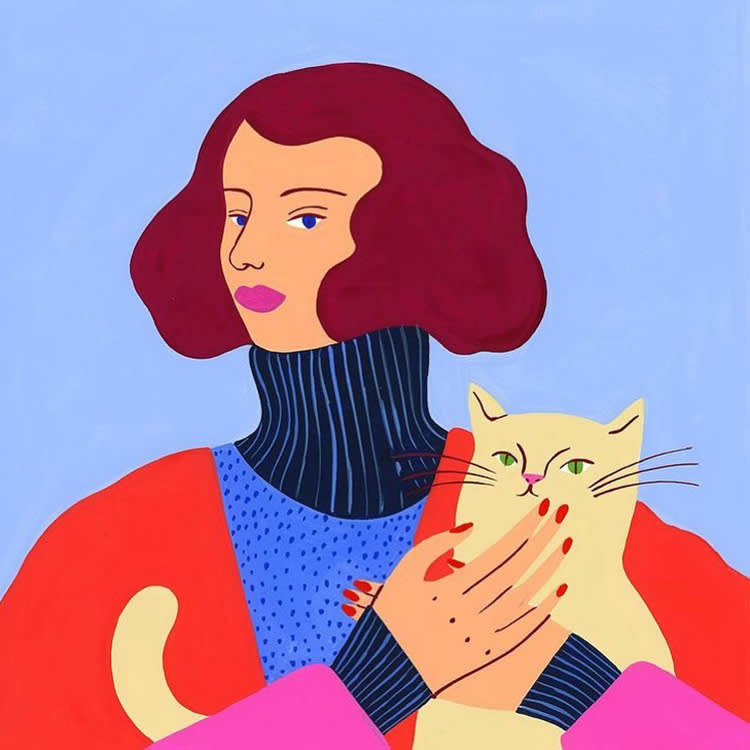
There is a quiet thesis running underneath all of Agathe Singer’s work, and once you spot it you cannot unsee it: she refuses to paint a generic cat. A leopard prowling an invented jungle and a slightly chubby house cat curled on a chair get the same treatment in her hands, which is to say each is rendered as a specific individual with its own look, its own attitude, its own slightly imperious personality. For an artist whose client list includes Gucci, Sephora, and Atelier Cologne, that insistence on particularity is not a small stylistic quirk. It is the whole point, and it is also, as it happens, the single most useful thing an artist can teach a cat owner.
We talked with the Paris-based painter about her influences, her studio, the strange affinity between women and felines in her work, and the childhood that made cats her first and most enduring subject.
The jungle came first, and the cats came with it
Singer did not set out to become a cat painter. She backed into it through landscape.
When she returned to painting about a decade ago, her earliest subjects were big cats, leopards, panthers, and tigers, chosen because they belonged inside the dense jungle scenes she loved to build. Those animals carried something she wanted on the canvas: a sense of the mysterious and the magical, a combination of elegance and raw strength. As she puts it, they are dangerous and also, fundamentally, just bigger cats. Sometimes fuzzy, sometimes furry, occasionally a little chubby. The house cats arrived later, and with them a project that doubled as wish fulfillment.
“When I started painting house cats, I wanted to build an imaginary feline family for myself, each one with a particular look and a personality of their own,” Singer says. “The best part is when people write to tell me they recognized their own cat in a painting. That is exactly what I was after, the sense that each animal is somebody, not a type.”
Human subjects came later still. She admits she was not comfortable drawing people at first and only began painting women well after the cats had taken over her canvases.
Where the look comes from
Singer’s palette is instantly recognizable, bright, joyful, a little theatrical, and she is generous about naming where it comes from.
Her influences run wide. She loves the work of botanical illustrators, and she looks to artists like Alex Katz and David Hockney for their bright palettes and the buoyant energy of their portraits. She cites the painter Paula Modersohn-Becker for the strange, arresting look of her female models. And in a tell that explains a lot about the staged, story-driven quality of her compositions, she draws heavily on couture houses, Gucci, Schiaparelli, Patou, for their use of color, and on younger designers like Ester Manas whose inclusive work celebrates all kinds of bodies. Fashion editorials are a constant reference point: the clothes, the styling, the poses, the way bodies and garments together tell a story.
Her homages to the post-impressionist Henri Rousseau are a fan favorite, especially the dense, almost textile-like foliage of her jungle scenes, with Matisse hovering nearby as another touchstone.
Women, cats, and the spaces between them
Ask Singer why women and cats appear so often together in her work and she resists the obvious answer.
She does not see female and feline bodies as especially similar. The visual rhyme she actually feels is between the way she paints flowers and the way she paints women. What draws her to pairing women with cats is something less anatomical and more emotional: the genuinely complicated relationship between the two, which she likes to play with on the canvas. In her telling, the cat is the companion, the comforter, the totem, the shadow, a role rather than a shape. It is a more interesting idea than the usual one, and it is why her women-and-cats paintings read as portraits of a bond rather than a matched set.
That same instinct for strength shows up even in her most delicate figures. One of her illustrations of a woman with bandaged hands, looking ready to step into a boxing ring, was inspired by the French boxer Sarah Ourahmoune. It was made for The New Parisienne by Lindsey Tramuta, a book of portraits of inspiring Parisian women, and it opened the chapter on “The Disruptors.” The woman, Singer notes, is definitely ready to fight.
The studio, and the cats that started it all
After nearly ten years working from home, Singer recently moved into a studio, and what she chose to bring first says something about her.
Not equipment, but objects with a history: handmade pieces from a Parisian ceramic artisan she loves, Laurette Broll, including her water jug, her palette, and a few dishes and pots. These things are inspiring and comforting to her, and she is looking forward to building a tiny jungle of plants on the studio balcony, life imitating canvas.
Her own history with cats is the kind that makes the individuality in her work feel earned. Growing up in the countryside, her family kept cats in the garden, allowed inside only on the stormiest days, yet entirely “theirs.” They had names and home-cooked meals: Pink Nose and Grey Nose, Alphonse, Moufle et Pantoufle (Mitten and Slipper). At one point about six lived with the family, a riot of personalities for the kids. When the family went on holiday the cats would revert to the wild, and once the children watched one dispatch a rabbit for dinner. Innately fierce hunters, Singer says, and also the clumsiest, sweetest furry things alive. That double nature is exactly what her paintings keep insisting on.
What an artist’s eye can teach a cat owner
Here is the practical takeaway tucked inside an interview about art, and it is worth pulling out.
Singer’s working method, treating every cat as an individual to be observed rather than a category to be filled in, is a useful corrective for how owners often see their own animals. We default to “cats are aloof” or “tabbies are friendly,” the way a lazy painter would default to a generic outline. If you want to genuinely understand the cat you live with, do what she does on the canvas: look at this one. Notice the specific way they sit, the exact set of the ears when they are annoyed, the particular tail flick that means enough now. The individuality she paints is not artistic license. It is accurate, and cats reward owners who see it.
And if you ever want a portrait of your own cat that captures that, her advice is implicit in her process: choose an artist whose work already treats animals as individuals, and bring them a sense of your cat’s personality, not just a clear photo. A good pet portrait, like a good Singer painting, is a likeness of a character, not a coat pattern.
You can see more of Agathe Singer’s work on her Instagram.
Nina Vasquez writes about life at home with pets and the relationships at the heart of it. Her work covers day-to-day living, people-and-pet stories, and the products that fit into a real household, with a warm, grounded take on everyday pet ownership.
Meet our experts ↗Keep reading
 LivingThe 'Stray' Movie Has One Job: Don't Let the Cat TalkSasha Ford · 6 min
 LivingShe's Cut Her Cat Into 37 Surreal Portraits. He Couldn't Care Less.Claire Sutton · 5 min
 LivingYour Cat Isn't Trying to Cuddle. They're Doing Math.Dr. Nina Kohl · 6 min
 LivingAn Amazon Driver Took Their Cat on Camera. The Microchip Couldn't Bring Her BackMarcus Webb · 5 min
 LivingHow Many Cats Is Too Many? Vets Say You're Asking the Wrong Question.Nina Vasquez · 7 min
 LivingThe Cats in Her Art Aren't Decoration. They're the Coping Mechanism.Sasha Ford · 6 min