


The Cats in Her Art Aren't Decoration. They're the Coping Mechanism.
Livia Fălcaru's work is candy-bright and full of cats. The reason why is considerably darker, and it explains why the cats keep showing up whether she plans them or not.
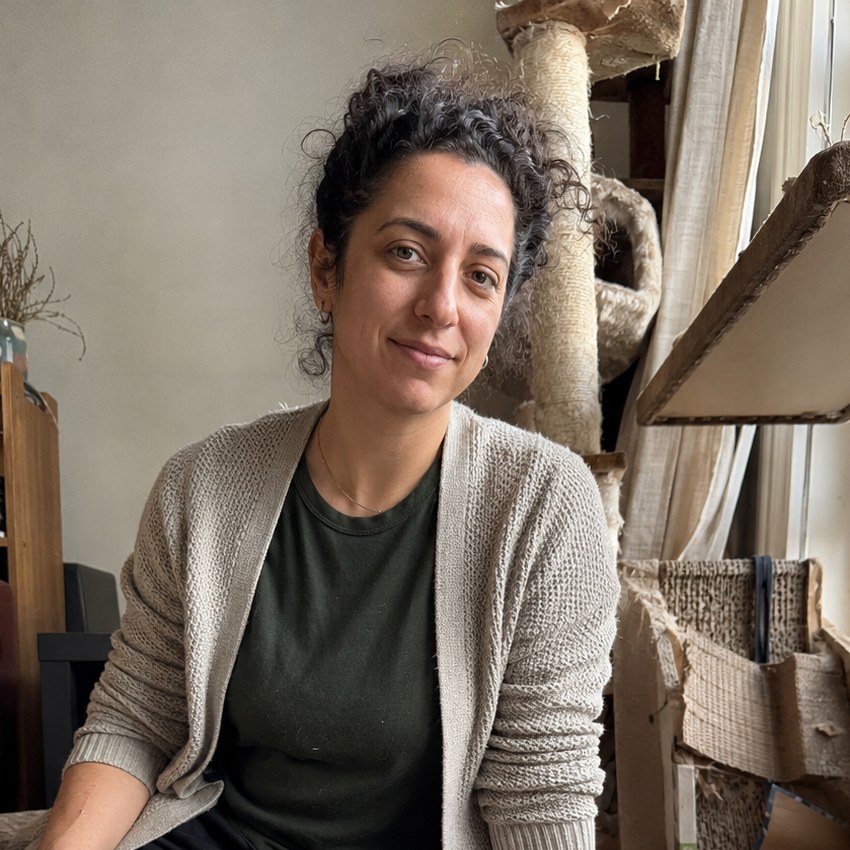
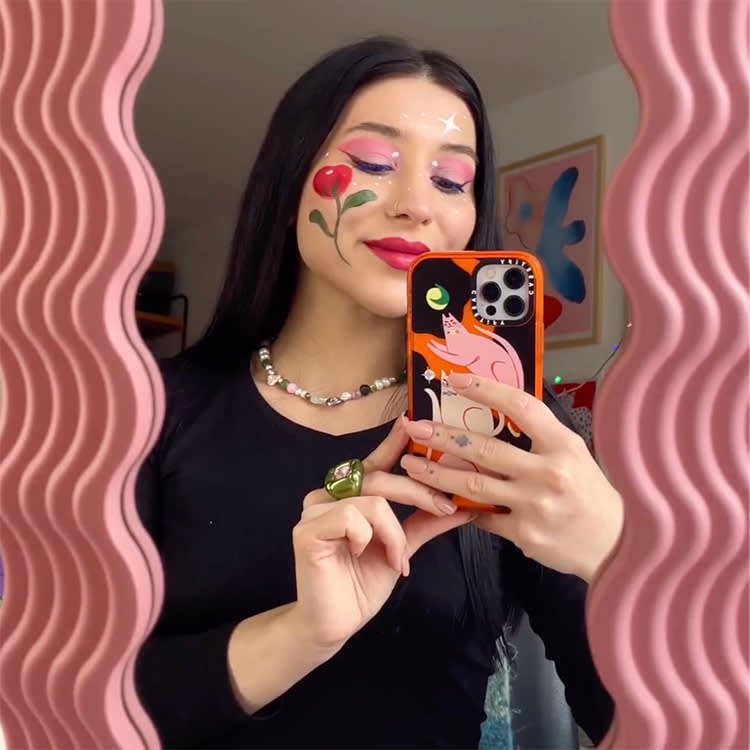
There is a particular kind of artwork that looks like nothing bad has ever happened to the person who made it. Bright pinks, soft coral, a cat lounging somewhere in the corner with an expression of total indifference. Cheerful. Weightless.
Livia Fălcaru’s work looks like that. It is not that.
The Bucharest-based illustrator has built a career on candy-colored, cat-strewn images that have carried her into collaborations with Refinery29, Vans, the World Wildlife Fund, Absolut, and, in 2023, a Casetify collection of phone cases, laptop shells, AirPods covers, and wireless chargers rendered in her signature palette. She described it at the time as a set of bold, colorful accessories built around the illustrations she loved most, and a large share of them were, unavoidably, cats.
The cheerfulness is real. It is also, by her own account, deliberate construction over something else entirely.
What the brightness is holding up
Fălcaru has written openly about a childhood spent poor in Romania after communism, and about what school was. From the age of six, by her account, teachers beat and humiliated her daily. It was routine, and parents sometimes encouraged it. Hair pulled, books used as weapons, chalk thrown.
She struggled emotionally and academically in that environment. What survived it was the drawing. Teachers held up her work as an example to the class even as they were hitting her, which is the kind of contradiction a child has to file somewhere. By fourth grade she was taking pocket money from classmates in return for doing their art assignments.
As a teenager she got her first tablet and a pirated copy of Photoshop, and taught herself on it. The paid work she found was retouching photographs of the dead for her family’s funeral business. She has said she has never held a conventional job in her life, only what she does now.
Read her art with that behind it and the color starts doing something different. She has described making art as a way of getting the bad stuff out, but constructively. The brightness is not naivety. It is a decision, made repeatedly, by someone with a lot to metabolize.
Why it’s always a cat
Fălcaru is not, she has said, especially a cat person. She loves all animals, and her long-standing dream, from childhood, has been to become wealthy enough to open shelters in a country where animals still have no legal rights and are routinely treated badly.
But she lives with three rescues: Lily and Igor, both white, and Ida, black. And the cats have colonized the work.
She has described it as automatic at this point, something that simply arrives when she makes an illustration. She likes the idea of cats. She likes the specific things that come with them.
This is worth sitting with, because it is a thing a lot of people with animals will recognize without ever having named it. The cat is not the subject of the drawing. The cat is what makes the drawing bearable to make. It shows up in the corner of the frame the way it shows up in the corner of the room, and its presence is what tells you the scene is safe.
Ask any illustrator who works through difficult material what keeps recurring in their work without permission, and you will hear something like this. It is rarely the thing they are trying to say. It is the thing they are standing on while they say it.
“People describe their cat as a comfort object and then apologize for it, as if that were embarrassing,” says Dr. Lena Park. “It isn’t. A steady, undemanding presence in the room is a genuine regulator of the human nervous system. If your work or your recovery has a cat sitting in the middle of it, that is the cat doing a job.”
The phone as a place to put the joy
Fălcaru’s read on the Casetify collaboration was that it made her work into small art objects, which is a more interesting idea than it first sounds.
Her argument: technology is the most present thing in most of our lives now, and our devices have quietly become statement pieces, surfaces on which we announce who we are and what we like. So it makes sense to make them as pretty as we possibly can. She hoped a splash of color would make people’s ordinary days slightly better.
That is a modest ambition, deliberately. It is also, given where she came from, a coherent one. Someone who learned to survive by putting bright color on top of a hard day is going to be interested in doing that on the object you look at four hundred times a day.
The 2023 Casetify capsule has since cycled out, as brand collaborations do, but her artist page on Casetify remains, and her own shop and portfolio are the better place to start anyway.
Livia Fălcaru’s portfolio and shop — prints and originals, direct from the artist
Her Casetify artist page — for whatever cases are currently in rotation
Where the cats end up
The point of her story is not that hard childhoods make good artists. That idea is lazy and mostly false.
The point is narrower and more useful. Fălcaru had a very specific problem, which was too much to feel and no acceptable place to put it, and she assembled a very specific solution out of what was available: color, work, and eventually three rescued cats in a Bucharest apartment. The cats did not fix anything. They just kept showing up, in the room and then on the page, until they became part of the structure holding everything else in place.
Anyone who has come home to a cat on a genuinely terrible day understands the mechanism exactly. Fălcaru just drew it.
References
- Casetify, “Livia Falcaru — Artist Collection.” https://www.casetify.com/artist/liviafalcaru
- Livia Fălcaru, official portfolio and blog. https://liviafalcaru.com/
- Behance, “Livia Fălcaru — Illustrator and Visual Artist, Bucharest.” https://www.behance.net/liviafalcaru
- Beetz, A., et al. “Psychosocial and psychophysiological effects of human-animal interactions: the possible role of oxytocin.” Frontiers in Psychology, 2012. https://www.frontiersin.org/articles/10.3389/fpsyg.2012.00234/full
Sasha Ford is a certified cat behaviour consultant who has worked with shelters, catteries, and private clients across the country. They review all feline behaviour content at The Pet Times, with expertise in multi-cat households, indoor enrichment, and stress-related disorders.
Meet our experts ↗Keep reading
 LivingWhy Agathe Singer Paints Every Cat as a Person, Never a PatternNina Vasquez · 6 min
 LivingAnimal Communicators Aren't Reading Your Cat. They're Reading You.Leila Torres · 8 min
 LivingShe's Cut Her Cat Into 37 Surreal Portraits. He Couldn't Care Less.Claire Sutton · 5 min
 LivingShe Built Her Cat a Sparkly Palace. The Cat Wanted the Cardboard.Nina Vasquez · 5 min
 LivingDo Cats Know When You're Sad? Inside Your Cat's Emotional RadarLeila Torres · 6 min
 LivingThe 'Stray' Movie Has One Job: Don't Let the Cat TalkSasha Ford · 6 min