


Her Cat Has a Meow for Everything. It Rewired How She Makes Music.
Composer Kaitlyn Aurelia Smith builds wordless music on a Buchla synthesizer. Her talkative rescue cat, Clover, taught her how much can be said without a single word.
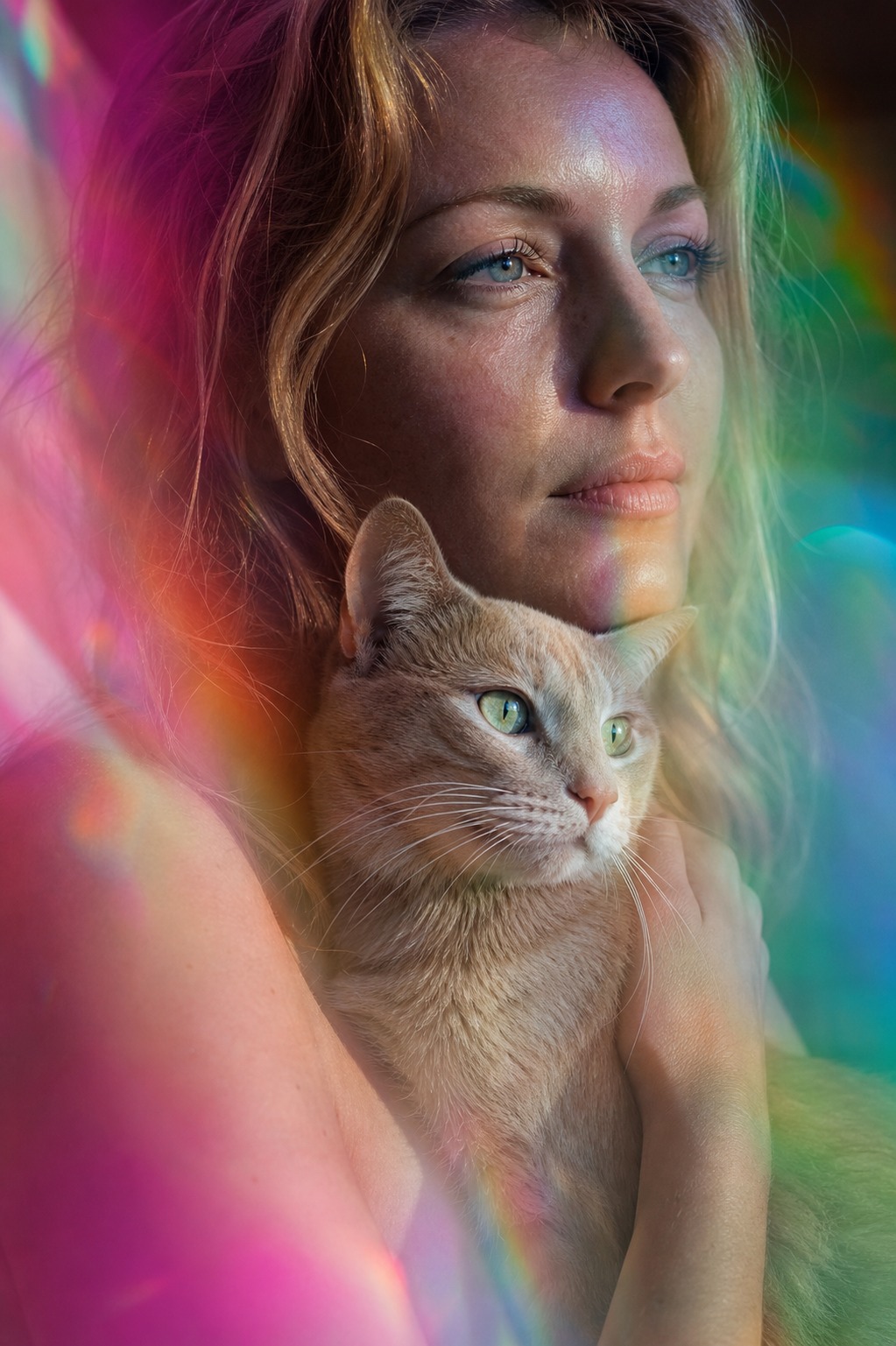
Some people choose their cat. Kaitlyn Aurelia Smith says her cat was more or less handed to her by the universe.
The composer, known for the shimmering, largely wordless music she coaxes out of a Buchla synthesizer, tells a story about the day she met Clover that sounds a little like one of her own songs. She felt a sudden, unexplained pull to head outside and run errands, followed it without knowing why, and ran into a woman carrying a tiny kitten on her shoulder. She stopped to ask if she could pet the cat. The woman asked if she wanted to keep her. That was that.
If you know Smith’s work, the coincidence lands as almost too on-the-nose. Her music trades in feelings that live just underneath language, the things you cannot quite name. So of course her muse turned out to be an animal who communicates entirely without words.
A cat with a vocabulary
Clover, who Smith believes is a Bengal or part-Bengal, is not a quiet cat. Smith describes her as having an unusually wide range of sounds, a different meow for a different meaning, each one landing exactly the way it sounds like it should. For a composer whose whole practice is about conveying emotion through tone rather than lyrics, living with a cat who does the same thing all day turned into a kind of ongoing lesson.
That influence is not abstract. Smith dedicated one of her recent albums to Clover, and she talks about the cat the way other artists talk about a collaborator, as a creature who keeps surprising her and reshaping how she pays attention.
Clover, for her part, is a tougher critic than most. Smith says the cat actively dislikes her singing and will deliver a pointed meow before leaving the room, though she is entirely unbothered by the synthesizers.
From leash-cat to wildcat
Smith grew up surrounded by animals. There was a beloved parakeet that rode on her shoulder and slept under the covers with her, plus a household that at one point ran to four cats and two dogs. So she is not new to the negotiation of living with an opinionated animal.
She did try, briefly, to make Clover a leash cat. There are, by her account, some genuinely ridiculous photos of the attempt from Clover’s kitten days. It did not take. Clover grew into what Smith affectionately calls a wildcat, the kind who has firm opinions about how she wants to spend her time, and the leash was quietly retired.
What the cat taught the composer
Smith’s music often circles the idea that the most important things are the ones that resist being put into words, and she connects that directly to her relationship with Clover. Living closely with an animal who is clearly communicating, clearly feeling, without any shared spoken language nudges you toward listening differently, toward tone and body and timing rather than vocabulary. It is not a huge leap from there to an album built around wordless voices.
What newer research adds
There is a nice piece of science underneath Clover’s chattiness. Researchers who study cat vocalizations have found that adult cats meow mostly at people, not at other cats, and that they seem to develop and refine their meows specifically to get their humans to respond. In other words, a cat with a big vocabulary is not just noisy; she is running a communication system aimed squarely at you. Smith’s instinct that Clover is genuinely trying to tell her things is closer to the evidence than it might sound.
References
- Nicastro, N., & Owren, M. J. (2003). “Classification of domestic cat (Felis catus) vocalizations by naive and experienced human listeners.” Journal of Comparative Psychology. https://pubmed.ncbi.nlm.nih.gov/12856781/
- Kaitlyn Aurelia Smith, official site. https://www.kaitlynaureliasmith.com/
Jordan Ellis is a certified professional dog trainer with a decade of experience working with rescue organisations and private clients. They specialise in anxiety, reactivity, and positive reinforcement methods, and review all training and behaviour content at The Pet Times.
Meet our experts ↗Keep reading
 TrainingYour Cat Doesn't Care About the Bathroom. They Care That You Finally Sat Down.Dr. Priya Nair · 8 min
 LivingYour Cat Picks the Foot of the Bed on Purpose. Here's the LogicClaire Sutton · 6 min
 LivingYour Cat Isn't Trying to Cuddle. They're Doing Math.Dr. Nina Kohl · 6 min
 LivingThe 'Stray' Movie Has One Job: Don't Let the Cat TalkSasha Ford · 6 min
 LivingDo Cats Know When You're Sad? Inside Your Cat's Emotional RadarLeila Torres · 6 min
 LivingCan Cats Sense When Death Is Near? Inside the Mystery of Oscar the CatTom Hadley · 7 min