


The Cat Burglar of Mairangi Bay Has 150 Victims and Zero Remorse
A young cat in a quiet New Zealand suburb keeps swiping his neighbors' socks, boxers, and one very expensive sweater. The strange part isn't the stealing. It's that everyone forgives him.

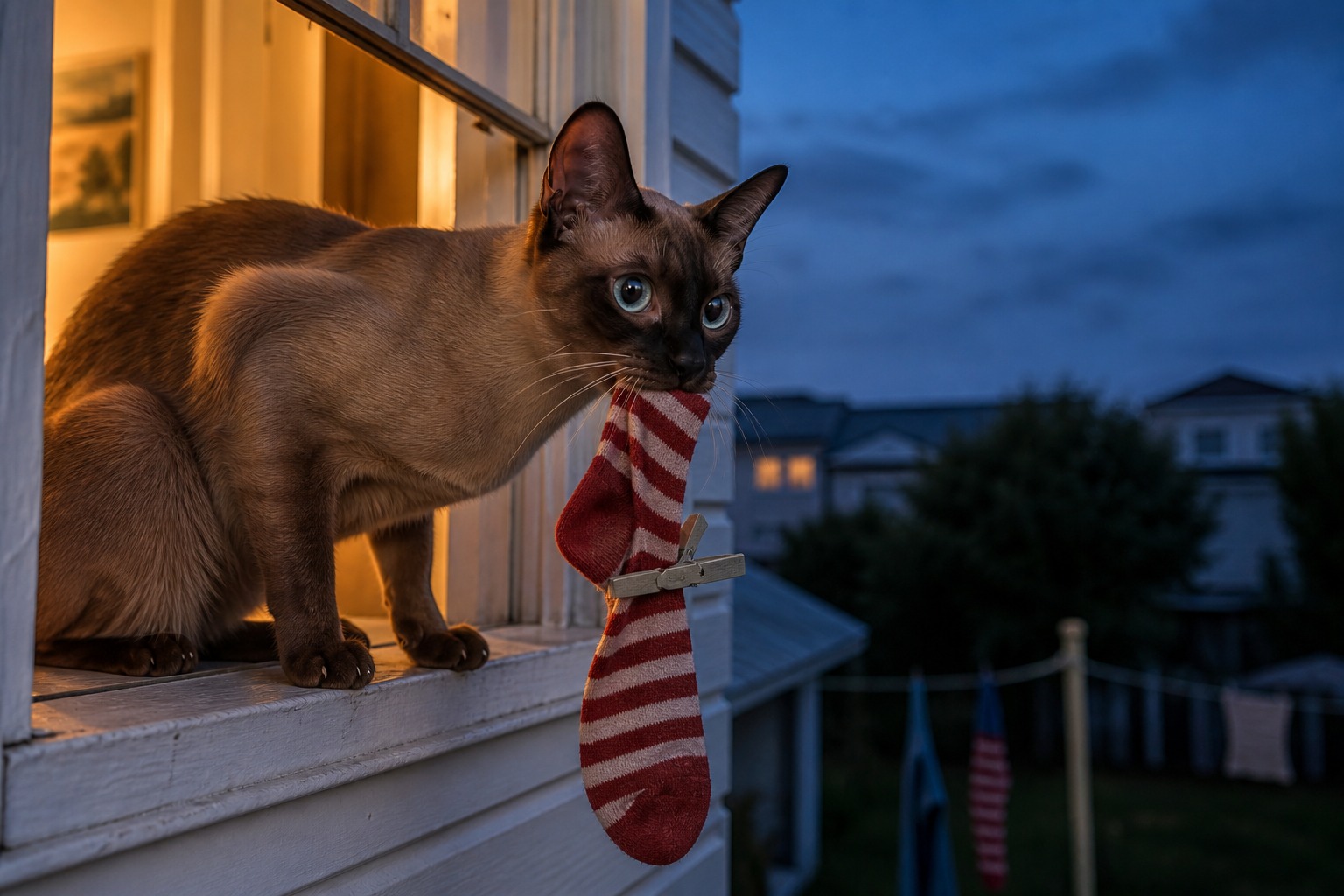
Somewhere in Mairangi Bay, a leafy seaside suburb on Auckland’s North Shore, there is a family who wakes up most mornings to a fresh pile of stolen goods on the floor. Not their goods. Somebody else’s underwear, socks, a stranger’s work gloves, once an entire outfit’s worth of clothing ranging from baby clothes to menswear. The culprit is not a person. He is a small, wide-eyed cat with a criminal streak and a very good name: Leonardo da Pinchy.
Leo, as his family calls him, has turned petty theft into a full-time occupation. And the most surprising thing about his crime spree isn’t the haul. It’s the reaction of the people he robs.
What we actually know about the thief
Leo is a Tonkinese, about 14 months old, which in cat terms is a teenager with too much energy and no supervision. Over roughly nine months, he has dragged home an estimated 150 pilfered items. His loot list reads like the contents of a laundromat lost-and-found: piles of socks (some with the clothespins still attached), silk boxer shorts, thick work socks, a sports jersey, and, memorably, a five-foot stuffed toy snake that is nearly triple his own length.
His crowning theft was a cashmere sweater worth around 300 New Zealand dollars, or roughly 181 US dollars. When it turned up, his owner Helen North said the whole family went on high alert, because the thing was genuinely beautiful and briefly very tempting to keep. They didn’t. Leo, as North has learned, only ever wants the things he isn’t supposed to have.
Why a well-fed house cat turns into a thief
Here is the part that gets left out of the “look at this funny cat” headlines: Leo isn’t malfunctioning. He’s doing something cats are quietly wired to do.
The instinct to carry objects back to a home base is an old one. In the wild, a cat that has caught prey often hauls it to a safe, familiar spot to eat or stash it. Domestic cats keep the machinery even when the hunting is gone. A soft, human-scented sock hits several of the same notes as a small caught animal: it is grabbable, it holds a scent, and it can be carried in the mouth. Kittens and young adults like Leo are especially prone to it, because they have the drive of a hunter and none of the real work to burn it on. The behavior tends to spike in the same adolescent window Leo is in right now.
Human scent almost certainly makes it worse. Freshly worn clothes and just-dried laundry are saturated with the smell of the people nearby, which for a social, people-oriented breed like the Tonkinese is roughly the most interesting smell in the neighborhood. Leo isn’t collecting clothes. He’s collecting his neighbors.
The neighbors are the real story
Most people would be furious to find a cat systematically raiding their bedrooms and clotheslines. Leo’s neighbors are the opposite. North started by posting recovered items in the local group chat with captions along the lines of “are these your undies,” then graduated to a neighborhood Facebook page as the volume outgrew the group. One woman recognized her own purple-and-pink underwear in a post and claimed it. A boy got his favorite jersey back.
Instead of complaints, North says she mostly fields a kind of gentle envy: several neighbors have told her they think Leo is wonderful, and a few are quietly put out that he hasn’t stolen anything of theirs yet. In a stretch of suburb where most people never learn each other’s names, a thieving teenage cat has accidentally become the thing that introduces everyone.
If your own cat is a sock thief
Leo is an extreme case, but the low-grade version, the cat who drags one particular sock around the house, is common. You can’t really train the instinct out, but you can take the pressure off it. Give a carry-prone cat something legal to haul and hunt: a few small soft toys they’re allowed to claim, a daily play session with a wand toy that lets them chase, catch, and “kill” something, and a puzzle feeder so some of that predatory drive goes toward dinner. The goal isn’t to stop the carrying. It’s to give it a target that doesn’t belong to the people two houses down.
As for Leo, there’s no sign he’s planning to retire. His family has tried keeping him in and leaving decoy clothing at home, and none of it has slowed him down. The socks of Mairangi Bay remain, for now, unguarded.
Sasha Ford is a certified cat behaviour consultant who has worked with shelters, catteries, and private clients across the country. They review all feline behaviour content at The Pet Times, with expertise in multi-cat households, indoor enrichment, and stress-related disorders.
Meet our experts ↗Keep reading
 LivingAn Amazon Driver Took Their Cat on Camera. The Microchip Couldn't Bring Her BackMarcus Webb · 5 min
 LivingThe Bewitching History of Black Cats and HalloweenLeila Torres · 7 min
 LivingShe Says 'Meow' Instead of 'Hello.' Meet Fashion's Most Committed Cat Lady.Claire Sutton · 4 min
 LivingYour Cat Picks the Foot of the Bed on Purpose. Here's the LogicClaire Sutton · 6 min
 LivingA Video Game Studied Cats Harder Than Most Cat Owners DoSasha Ford · 6 min
 LivingThe 'Stray' Movie Has One Job: Don't Let the Cat TalkSasha Ford · 6 min