


Two Years, Two Best in Show Winners, Two Sets of Cut-Off Ears. That's Not a Coincidence.
Westminster's top dog has now had cropped ears and a docked tail two years running. The AKC says it's optional. The results say something else, and a vet who has done the procedure explains what it actually involves.

In February 2026, at the 150th Westminster Kennel Club Dog Show, a Doberman Pinscher named Penny won Best in Show. It was the first time a Doberman had taken the title since 1989, and there is a lovely wrinkle to it: the owner of the 1989 winner, Andy Linton, also owns Penny.
Penny has cropped ears and a docked tail.
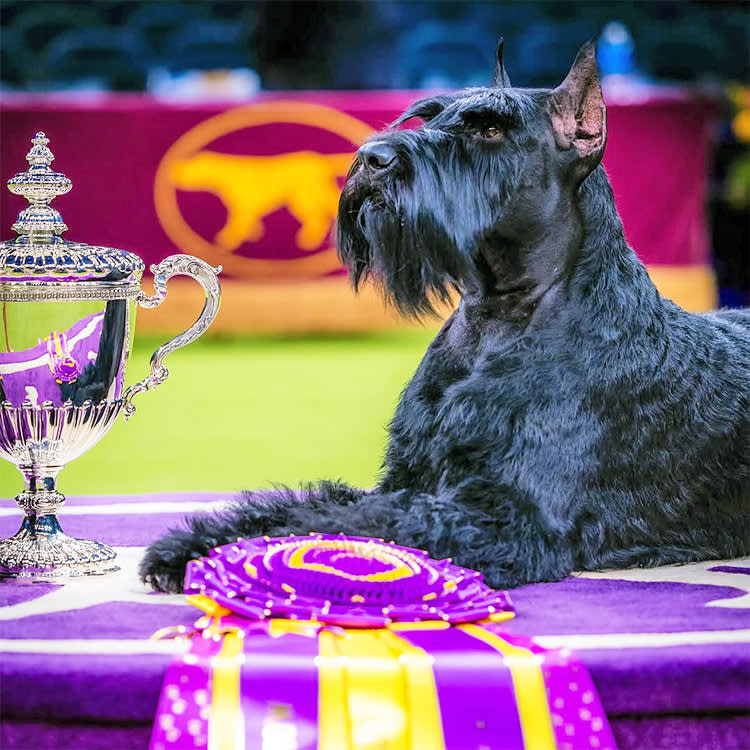
A year earlier, in February 2025, a Giant Schnauzer called Monty had taken the same title, and made his own history doing it: no Giant Schnauzer had ever won Best in Show at Westminster before.
Monty had cropped ears and a docked tail.
Two consecutive years. Two Best in Show winners. Two dogs who had parts of their bodies surgically removed for looks. And every year, the same argument runs in the comments under the same photographs. “Please stop the cropping of ears and tails of all dog breeds!” “Stop cutting ears!! It’s archaic, unnecessary and cruel.” “Seems strange that a dog that would be banned for docking ears at Crufts wins in USA.”
The American Kennel Club’s position is that ear cropping is entirely optional and has nothing to do with whether a dog wins. That claim is now carrying a very heavy load.
The claim, and the record
Here is the AKC’s stated position, in its own words on its FAQ page: “Ear cropping is a decision made by a dog’s breeder or owner. While it is true that some breeds are shown with their ears cropped, there is nothing in AKC rules and in fact nothing in any breed standard that compels an owner to have this procedure performed as a prerequisite to entry at a dog show.”
Read narrowly, that is true. Nobody is required to crop.
Now read the Official Standard for the Giant Schnauzer, which describes the ears like this: “When cropped, [ears are] identical in shape and length with pointed tips. They are in balance with the head and are not exaggerated in length. They are set high on the skull and carried perpendicularly at the inner edges with as little bell as possible along the other edges. When un-cropped, the ears are V-shaped button ears of medium length and thickness, set high and carried rather high and close to the head.”
Cropped is described first. Uncropped is described second, as the alternative.
Does the ordering imply a preference? The AKC and the Westminster Kennel Club did not respond to emailed requests for comment. Chris Reed, president of the Giant Schnauzer Club of America, offered this: cropping and docking are legal practices throughout the United States, and accordingly, many breeders and owners view it as a choice they have the right to make.
Which is unarguable, and also not an answer to the question.
The question is this: if cropping genuinely makes no difference to the judging, why does the winner keep having cropped ears? Two years in a row, in two different breeds. Nobody at the AKC has offered an explanation, and Monty’s breeder, Cherlann Ambrose of Hearthmore Giant Schnauzers, did not respond to requests for comment about why she chose to crop him.
Tail docking, unlike cropping, is not optional at all. It is part of the standard for roughly 60 breeds competing at shows like Westminster. For the Giant Schnauzer, the AKC states that the tail “should be docked to the second or not more than the third joint (approximately one and one-half to about three inches long at maturity).” The AKC’s position is that the procedure does not hurt.
What cropping is, described by someone who watched it
The word “cropping” is doing a lot of concealing. Here is the procedure without the euphemism.
It is an amputation. There is no softer word for it, and the softer words are why people agree to it. You cut off a portion of the ear, then you suture the entire cut edge, which takes about two weeks to heal. Then the taping starts, and the taping is the part nobody sees.
The reconstruction is the long part. Once the cut edge has healed, stents go into the ears and the ears are taped upright, teaching them to grow vertically. Depending on how much tissue is left to train, that stenting phase can drag on for three to four months. And for as long as it lasts, the ear canal is sealed shut, which is an excellent way to grow a yeast infection.
Cropping is real surgery. It requires general anesthesia, and it is typically done at 12 to 14 weeks old, for a grimly practical reason: any younger and any smaller, and the puppy cannot be safely put under.
“Technically it is not a difficult operation, and that is exactly the trap,” Dr. Mehta says. “Matching one ear to the other is the hard part, and there is no undo. You are doing elective cosmetic surgery on a three-month-old who cannot consent, and when it goes wrong, the dog wears the mistake for the next twelve years.”
Docking is worse, and this is the part most people do not know
Cropping, for all of the above, is at least done under general anesthesia.
Docking frequently is not.
Docking, cutting a dog’s natural tail short, is usually performed when the puppy is only a few days old. A three-day-old puppy fits in a cupped hand, and an animal that small cannot be intubated to keep them breathing under anesthetic. So there is no general anesthesia. A hemostat clamps the tail, and it comes off.
A local anesthetic like lidocaine is technically possible. In practice it is often skipped: lidocaine burns going in, landing it precisely enough to be effective is difficult, and clamping and cutting is simply cheaper. Cheaper matters, because it protects the breeder’s margin on the puppy.
Sit with the sequence. The procedure done to a conscious three-day-old is the one the AKC describes as painless.
The AVMA has been documenting this history for decades, and its account undercuts the tradition it describes. Yes, the organization acknowledges, working dogs’ tails have long been docked on the theory that a tail might otherwise be injured in the field. But the oldest sources, it notes, recommended the procedure only in the narrow case of a tail so long for the animal’s frame that it was genuinely at risk. In other words, the historical justification was a targeted one, and it has since been stretched to cover every puppy of sixty breeds.
The AVMA also records how the requirement got locked in: American pedigree dog shows made docking mandatory in the 1950s. The AVMA first called for its removal in 1976. Fifty years later, it remains in AKC standards.
The “it helps them work” defense, examined
The AKC’s central justification is historical function, and its published materials work through two examples. The Boxer, it points out, has a working past: guard duty and courier work for soldiers, and service as a guide dog for the blind. Cropping, the argument runs, sharpens the Boxer’s hearing and therefore helps him do that job well. The Brussels Griffon gets a different rationale: a small dog kept in stables to kill rats, whose cropped ears were supposedly less likely to be torn by a cornered rodent fighting back.
There are two problems with this, and they are both fatal.
The first is factual. Cropping does not improve hearing.
“Dogs hear perfectly well with the ears they were born with,” Dr. Mehta says. “The hearing argument is a rationalization applied after the fact to a decision that was made on looks. And the bite-protection argument answers itself: if you are worried about a dog’s ears being torn by a cornered animal, the fix is not to remove the ears in advance.”
The second problem is that the dogs in question do not work. A Giant Schnauzer competing at Westminster is not going to spend a day guarding a courier route, and a Brussels Griffon in the ring is not clearing rats out of a barn. The historical function being preserved is not being performed by any of these animals.
The AKC goes further, arguing that its critics simply do not understand the procedures. The belief that cropping and docking are painful, cosmetic, and pointless is, in the organization’s telling, flatly wrong, and it stems from ignorance about why and how the surgeries are done. The AKC then reaches for a comparison it clearly considers decisive: that these procedures hurt a dog considerably less, and traumatize them far less physically, than routine spaying and neutering does.
That comparison collapses on contact. Nobody neuters a dog to improve its silhouette. That surgery exists to hold down the population of unwanted animals, and it brings documented benefits to the dog’s health and behavior along the way. Cropping, docking, and the amputation of a front dewclaw bring none. Setting a surgery that has a medical purpose beside one that has none, and then comparing how much each hurts, does not make them equivalent. It changes the subject.
The dewclaw footnote, where the AKC is partly right
Worth being fair about, because it is the one place the picture is genuinely more complicated.
Breed standards also address dewclaw removal, which is required on the hind legs and optional on the forelegs. Canine “declawing” is nothing like the feline version; it removes a single digit, the dewclaw, sitting higher up the leg than the other claws.
On the hind legs, the rear dewclaw is frequently just a flap of skin, often with no bone or nail in it at all, and many dogs are born without them entirely. It is usually removed at the same time as docking, comparable to taking off a skin tag. It serves no purpose and can catch on things and become a site of recurring injury.
On the front legs, the story is completely different. That dewclaw is functional. Dogs use it to grip, a little like a thumb. Removing a front dewclaw is a purely aesthetic decision that costs the dog a working digit.
So: hind dewclaw removal has a defensible rationale. Front dewclaw removal does not.
Everywhere else drew the line decades ago
The strangeness of the American position becomes obvious the moment you look up.
Crufts, which sits alongside Westminster among the biggest and most prestigious shows anywhere in the world, has refused entry to cropped-eared dogs for more than a hundred years. Its owner, The Kennel Club in the U.K., does not hedge: “Ear cropping is a barbaric practice. The Kennel Club has always been against ear cropping and banned dogs with cropped ears from our events over 100 years ago, so we are deeply concerned that this barbaric practice is becoming more widespread. We continue to work to support efforts to reduce the supply and demand for dogs with cropped ears in the U.K., educate owners about the health and welfare implications for these dogs, and support restrictions on the importing of dogs with cropped ears.”
The World Dog Show likewise bans dogs with cropped ears or docked tails. Cropping is outright illegal across much of Europe.
A dog who would be turned away at the door of Crufts can win Best in Show at Westminster. That is not a difference of opinion about animal welfare. That is one country’s show system being roughly a century behind the rest.
What’s new since this was written
The state-level picture in the U.S. is moving, slowly, and it is worth knowing where it actually stands, because both sides tend to overstate it.
There is no outright federal ban on ear cropping, and, contrary to a common belief, no U.S. state has passed a clean prohibition either. What exists instead is a patchwork of roughly nine states that regulate the procedure, typically by requiring that it be performed by a licensed veterinarian with anesthesia rather than by a breeder with a pair of scissors: Connecticut, Illinois, Maine, Maryland, Massachusetts, New Hampshire, New York, Pennsylvania, and Washington are among them.
That is a meaningfully lower bar than a ban. It does not stop cropping. It stops the worst-case version of cropping.
Legislative pushes for a genuine ban keep surfacing, most visibly in California, and the AKC has consistently and actively lobbied against them, issuing legislative alerts to its members urging opposition. That fact belongs in the record next to the AKC’s insistence that cropping is a neutral personal choice with no bearing on the sport. An organization with no stake in the outcome does not usually mobilize against a bill.
And then there is the show record, which keeps writing its own commentary. Two years, two Best in Show winners, two cropped-eared, docked-tailed dogs. The AKC says these procedures preserve a dog’s ability to perform its historic function. If that were the real reason, the obvious fix would be simple: add a working component to the judging.
Nobody has proposed it. The standards being used at Westminster are aesthetic ones, whatever anyone says to the contrary, and they are ultimately arbitrary. As long as the AKC and the organizations around it continue to reward dogs who have had pieces cut off them for looking the part, the pieces will keep getting cut off.
References
- American Kennel Club. “Official Standard of the Giant Schnauzer.” https://images.akc.org/pdf/breeds/standards/GiantSchnauzer.pdf
- American Veterinary Medical Association. “Canine Tail Docking FAQ.” https://www.avma.org/resources-tools/animal-health-and-welfare/animal-welfare/canine-tail-docking-faq
- American Veterinary Medical Association. “Ear cropping and tail docking of dogs (policy).” https://www.avma.org/resources-tools/avma-policies/ear-cropping-and-tail-docking-dogs
- The Kennel Club (U.K.). “Ear Cropping campaign.” https://www.thekennelclub.org.uk/about-us/campaigns/ear-cropping
- World Dog Show. “Regulations.” https://www.worlddogshow.ch/en/en-regulations/
- American Kennel Club. “Issue Analysis: Dispelling the Myths of Cropped Ears, Docked Tails, Dewclaws, and Debarking.” https://www.akc.org/expert-advice/news/issue-analysis-dispelling-myths/
- Westminster Kennel Club. “Best in Show.” https://www.westminsterkennelclub.org/best-in-show-26/
- Peltz, J. “Giant Schnauzer Named Monty Wins Westminster’s Best in Show.” AP News, 11 Feb. 2025. https://apnews.com/article/westminster-kennel-club-best-show-ec5dd7767afc63f1a658f2ec3040503a
Dr. Mehta is a board-certified veterinary nutritionist who evaluates pet food formulations, ingredient quality, and the science behind dietary trends. He writes and reviews all nutrition content at The Pet Times, including our food rankings and feeding guides.
Meet our experts ↗Keep reading
 LivingThe ADA Has No Breed List. Your Landlord's Insurance Does.Dr. Priya Nair · 6 min
 LivingWe Docked Their Tails for Looks. Other Dogs Literally Can't Read Them Anymore.Dr. Nina Kohl · 8 min
 LivingA Viral Dog Reunion Rewrote California LawMarcus Webb · 6 min
 Health & WellnessLeaving Your Dog Out in the Cold Isn't Just Cruel. In These States, It's a Felony.Dr. Priya Nair · 5 min
 Living43 Arrests at a Texas Dogfight. Nearly All of Them Bonded Out.Dr. Amara Solis · 7 min
 LivingYour Dog Slips the Yard. A Cop Shows Up. What the Data Says Happens Next.Marcus Webb · 6 min