


A Viral Dog Reunion Rewrote California Law
Oreo survived five days in the ashes of the Palisades fire. The video broke everyone's heart. Then it did something videos almost never do: it changed the rules.

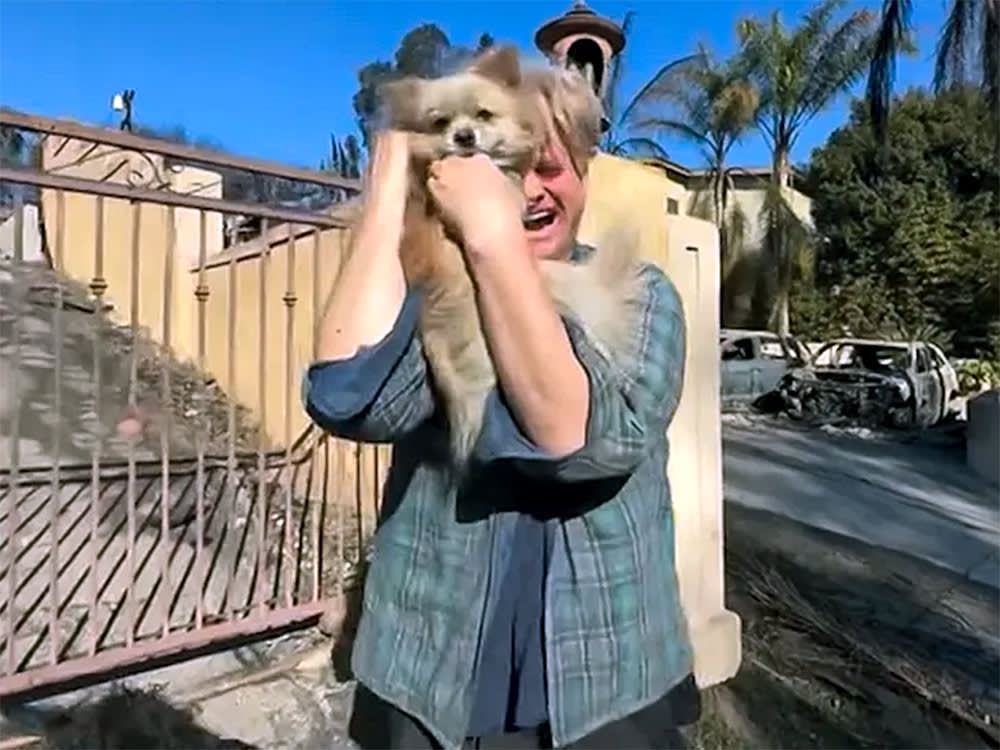
One year ago this week, a man in Pacific Palisades ran into the street holding a filthy, singed Pomeranian above his head and shouted that the dog was alive.
You have probably seen it. Casey Colvin’s reunion with Oreo, five days after the Palisades fire took his house, is the kind of clip that gets shared by people who do not normally share anything. It is thirty seconds of pure relief.
What almost nobody shares is the part that came afterward, which is the part that actually saved dogs. That video is now the reason California has a law on the books telling every city and county in the state what to do about the pets left behind when a neighborhood burns.
What happened
The Palisades fire ignited on Tuesday, January 7, 2025. Colvin was at work when the mandatory evacuation order went out for his neighborhood, and by the time he tried to get back to his two dogs, roadblocks were up and officials were turning residents away.
He met Liz Kreutz, an NBC reporter covering the evacuation, on the way in. He was in tears, asking how he was supposed to reach his own house.
A CalFire battalion chief, Brent Pascua, saw him and offered to go in himself. Pascua got one dog out. The other, Oreo, bolted from the house into the chaos.
Hours later the house burned to the ground.
What followed was five days of the least glamorous work in animal rescue. Kreutz posted Oreo’s photo and asked people to watch for him. He was sighted twice, once sleeping in the rubble of a neighbor’s home. Colvin left out food and water. Firefighters, who had told him to stay out of the zone, kept refilling the bowl for him. He brought in a professional dog trapper. The Animal Advocacy Network worked the sightings.
On Sunday, January 12, the call came: Oreo was hiding in a neighbor’s house. Colvin and Kreutz drove over. Oreo came out at a full sprint.
The unglamorous middle
Here is the thing worth sitting with. The reunion is the story everyone watched, but the reunion is not what got Oreo home.
What got Oreo home was a food and water station left in the same spot for five days. Firefighters willing to top it up. A neighbor who looked twice at a lump of dirty fur in the debris and made a phone call. A trapper who knew that a terrified dog in a burn zone does not want to be chased and will not come when called, because a dog in that state is running on a survival circuit that has switched his person off.
That is the operational lesson, and it is worth knowing before you need it:
- Do not chase. A frightened, displaced dog who is pursued runs further and faster, often for miles. Every chase makes the search area bigger.
- Feed the last known spot. Scent stations, food and water and something that smells like home, left in place, are how lost dogs get recovered. They anchor the animal instead of scattering it.
- Get a trapper, not a search party. Humane traps and a person who knows how to bait them beat a well-meaning crowd of volunteers calling the dog’s name every time.
- Post everywhere, immediately. Sightings are the raw material. Every hour a photo is not circulating is an hour of sightings that never get reported.
- Microchip, and update the number. A chip registered to a phone you cancelled in 2019 is a chip that does nothing.
What the video actually built
Two months after Oreo came home, in March 2025, Assemblymember Rick Chavez Zbur stood up and announced a bill he named after the dog: the Friends of Oreo Uniting During Disasters Act, the FOUND Act, sponsored by Social Compassion in Legislation. Pets, Zbur said, are family, and nobody should have to choose between their own safety and their animal’s survival.
Governor Gavin Newsom signed it on October 13, 2025. It took effect on January 1, 2026, eleven days ago.
What it actually does, in plain terms:
- Every city and county has to have a pet plan, in writing, in advance. Emergency response plans must now explicitly include pet rescue procedures, which means naming who is responsible instead of improvising it at 3 a.m. while a hillside burns.
- There has to be a way to report a missing or found animal. Dedicated hotlines, web portals, or registries, so that a sighting like the one that found Oreo has somewhere to go besides an Instagram comment section.
- Rescued animals get held for 90 days instead of 72 hours. This is the quiet giant of the bill. Under the old rule, an animal pulled from a disaster zone could be adopted out or worse within three days, while the person searching for them was living in a hotel with no phone charger and no address. Ninety days is enough time for a family who has lost everything to find their dog.
That last provision is the one that would have mattered most if Oreo’s story had gone slightly differently, and it is the reason this bill is more than a gesture.
“In a disaster, the animals that don’t make it home are usually the ones nobody had a system for,” says Dr. Lena Park. “The heartbreak isn’t that people stopped looking. It’s that the clock ran out while they were still looking.”
What newer research adds
California is not alone in learning this lesson, and it did not learn it first. The federal PETS Act, passed in 2006 after Hurricane Katrina, already requires state and local emergency plans to account for household pets and service animals in order to qualify for certain FEMA funding. The FOUND Act is the version with teeth at the city level: it pushes the requirement down to the jurisdictions that actually run evacuations, and it fixes the holding-period problem that federal law never addressed.
Practically, if you live anywhere with a wildfire, hurricane, or flood season, the useful takeaways are simple. Find out now whether your county has a published pet rescue plan and a reporting hotline. Confirm your microchip is registered to a phone number that rings. Keep a go-bag with a photo of your animal, their medical records, and a carrier or slip lead. And put the dog in the car on the first warning, not the second, because the roadblocks go up faster than anyone expects.
Colvin got extraordinarily lucky, and he knows it. What he told reporters afterward was that it was the community that did it, the strangers and the firefighters and the people who kept looking. The law is the version of that community that shows up for the next family automatically, whether the video goes viral or not.
References
- California Assemblymember Rick Chavez Zbur, “Governor Signs the FOUND Act to Strengthen Pet Rescue Efforts in Disasters,” October 13, 2025. https://zbur.asmdc.org/press-releases/20251013-governor-signs-found-act-strengthen-pet-rescue-efforts-disasters
- California Assemblymember Rick Chavez Zbur, “Zbur Announces the FOUND Act to Strengthen Pet Rescue Efforts in Disasters,” March 18, 2025. https://a51.asmdc.org/press-releases/20250318-zbur-announces-found-act-strengthen-pet-rescue-efforts-disasters
- CBS Los Angeles, “Viral video of fire victim reuniting with dog after Palisades Fire inspires new pet rescue bill,” March 18, 2025. https://www.cbsnews.com/losangeles/news/casey-colvin-oreo-palisades-fire-viral-video-reuniting-found-act-rick-zbur/
- FEMA, “Pets Evacuation and Transportation Standards Act of 2006 (PETS Act).” https://www.fema.gov/press-release/20230425/pets-evacuation-and-transportation-standards-act-2006
- American Veterinary Medical Association, “Disaster Preparedness for Pet Owners.” https://www.avma.org/resources-tools/pet-owners/emergencycare/pets-and-disasters
Marcus Webb writes about the gear, gadgets, and everyday choices that make life with a pet easier. His coverage runs from product picks to training and the causes worth paying attention to, always with an eye on what actually earns a place in your home.
Meet our experts ↗Keep reading
 LivingHe Lost 90% of His Business. Then He Groomed 1,461 Dogs for Free.Marcus Webb · 5 min
 LivingTwo Years, Two Best in Show Winners, Two Sets of Cut-Off Ears. That's Not a Coincidence.Dr. Ravi Mehta · 11 min
 Health & WellnessLeaving Your Dog Out in the Cold Isn't Just Cruel. In These States, It's a Felony.Dr. Priya Nair · 5 min
 Health & WellnessA Man Shot a Dog for Running at Him. He Was Never Charged.Marcus Webb · 8 min
 LivingYour Dog Slips the Yard. A Cop Shows Up. What the Data Says Happens Next.Marcus Webb · 6 min
 LivingHow the Animal-Rescue Network Beat Helene's FloodwatersNina Vasquez · 5 min