


Your Dog Slips the Yard. A Cop Shows Up. What the Data Says Happens Next.
A husky named Enzo became a hashtag after police killed him in 2023. His case is one visible dot in a pattern the government itself has called an epidemic, and one that better training is starting to address.


In January 2023, a husky named Enzo got out of a fenced yard in Lodi, California. What happened after that turned his name into a rallying cry. Officers tased and then killed the dog, and Enzo’s family launched a viral campaign, #JusticeForEnzo, arguing the response was wildly out of proportion and cited local animal-handling rules. A county prosecutor later reviewed the case and declined to file criminal charges. The family kept organizing anyway.
The reason Enzo’s story is worth revisiting is not that it was unique. It is that it was ordinary, and the pattern behind it is bigger and better documented than most people realize.
The number the government put on it
A Department of Justice community-policing specialist has estimated that officers kill somewhere between 25 and 30 dogs a day in the line of duty, on the order of 10,000 a year, and used the word “epidemic” to describe it. That figure is an estimate rather than a hard count for a telling reason: most law-enforcement agencies do not keep reliable records of the animals they kill. When a category of harm is not systematically tracked, the real total can only be larger than the visible one, and the visible one is already grim.
Enzo did not happen in isolation, either. Around the same stretch, a loose dog was killed by an off-duty SWAT commander in Novato after it got into his chickens, an officer in Brockton, Massachusetts shot a dog it wrongly believed was charging, and a Detroit family filed a federal civil-rights suit after officers entered a backyard without a warrant and fatally shot their dog. Different towns, same shape.
Why so many of these dogs weren’t actually a threat
Talk to people who study canine body language and a consistent theme emerges: a lot of what gets logged as “aggression” was fear.
“A dog that freezes, whips its head around, and shows you a hard, closed mouth is usually frightened, not hunting you,” says Dr. Amara Solis. “The tragedy is that the fearful dog and the dangerous dog can look similar for a split second to someone who was never taught the difference. That gap is exactly where training has to live.”
Animal-law advocates make a parallel point about tactics. The Animal Legal Defense Fund notes that even when an officer genuinely feels threatened, there are non-lethal options, and that a great deal of trouble starts when someone enters a property without first announcing themselves and giving a dog a beat to react as a dog. The recurring failure is not usually malice. It is a control-first approach applied to an animal that reads sudden control as danger.
What’s changed since Enzo
Here is the part the original wave of outrage could not include, because it hadn’t happened yet. Reform has started to move, unevenly, at the state level.
As of the mid-2020s, only a handful of states, California, Colorado, Illinois, Tennessee, and Texas, actually mandate dog-encounter training for law enforcement. But the list is growing. After an officer in Missouri shot and killed Teddy, a small blind and deaf dog, in 2024, legislators there pushed a bill to require canine-encounter training. California advanced a measure directing its police-standards commission to write canine-use guidelines and requiring agencies with canine units to adopt a compliant policy by mid-2027.
There is also an off-the-shelf curriculum for this. The Law Enforcement Dog Encounters Training program, developed with national sheriffs’ and community-policing groups, runs roughly eight hours across ten modules teaching officers to read a dog and de-escalate instead of defaulting to a weapon. Departments that adopt it are betting, reasonably, that a few hours in a classroom is cheaper than a dead family pet and the lawsuit and public backlash that follow.
What this means for you
You cannot fully insulate your dog from a bad encounter, but you can shrink the odds. Keep gates and fences genuinely secure, because most of these stories start with a dog that got loose. Keep your dog licensed, microchipped, and tagged so anyone who finds them has a fast, non-escalating way to get them home. If officers are ever on your property, get control of your dog yourself, physically and verbally, before anyone else has to make a snap judgment about it. And if you care about the systemic side, the concrete ask is narrow and winnable: your state can require the training that already exists.
Enzo’s family wanted his name to mean something. The most durable version of that is boring and bureaucratic, a line item in a training budget, repeated in enough places that the next loose dog gets read correctly.
References
- Newsweek. “Fact Check: Do US Police Kill Around 25 Dogs Each Day?” newsweek.com
- Animal Legal Defense Fund. “Requiring Dog-Encounter Training for Police Officers.” aldf.org
- National Sheriffs’ Association. “Law Enforcement Dog Encounters Training (LEDET) Curriculum.” sheriffs.org
- Courtney G. Lee. “More than Just Collateral Damage: Pet Shootings by Police,” University of New Hampshire Law Review. scholars.unh.edu
This piece touches on violence and loss involving animals. If it is a hard subject for you right now, it is okay to step away from it.
Marcus Webb writes about the gear, gadgets, and everyday choices that make life with a pet easier. His coverage runs from product picks to training and the causes worth paying attention to, always with an eye on what actually earns a place in your home.
Meet our experts ↗Keep reading
 LivingTwo Years, Two Best in Show Winners, Two Sets of Cut-Off Ears. That's Not a Coincidence.Dr. Ravi Mehta · 11 min
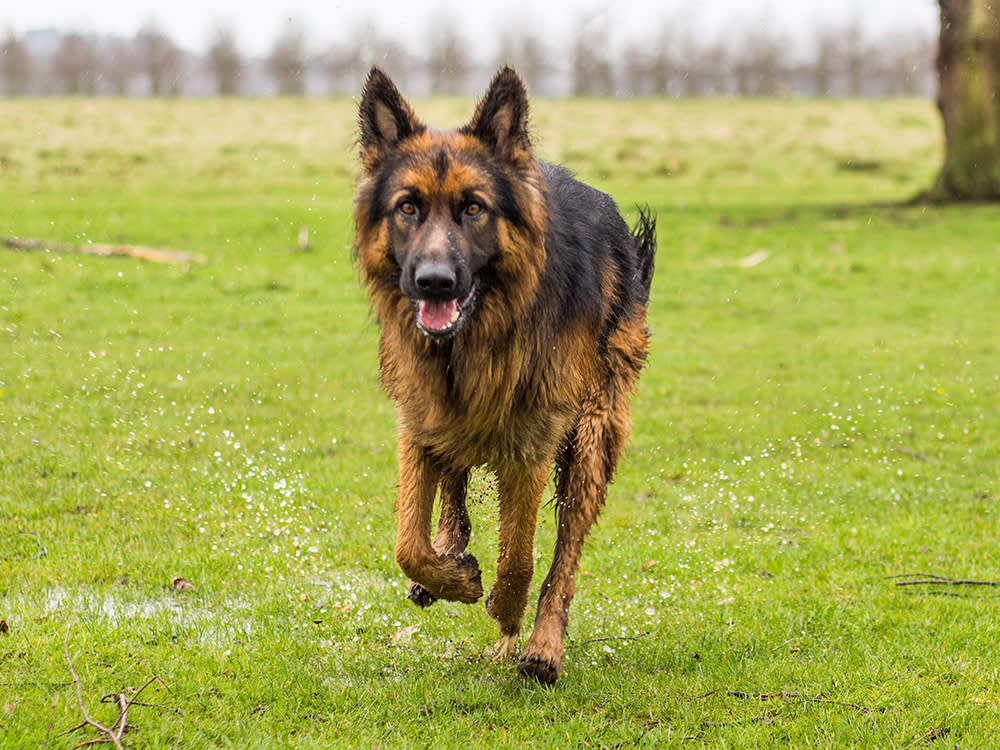 Health & WellnessA Man Shot a Dog for Running at Him. He Was Never Charged.Marcus Webb · 8 min
 LivingA Viral Dog Reunion Rewrote California LawMarcus Webb · 6 min
 Health & WellnessThe Cutest Thing About Your Flat-Faced Dog Is the Thing That's Suffocating ItDr. Ravi Mehta · 7 min
 Health & WellnessThe East Palestine Derailment's First Victims Had Four LegsDr. Amara Solis · 6 min
 Health & WellnessWashington's Senate Voted 48-0 to Let You Idle for Your Dog. The Bill Died Anyway.Sasha Ford · 6 min