


A Stranger Found Him Tied to a Bench in the Rain. A TikTok With 100 Followers Got Him Home.
Bishop was snatched off a downtown 1 train and abandoned in a West Village park. What brought him home wasn't his microchip, which had a dead phone number on it. It was two strangers who refused to give up.
We have all had our fill of stories about what social media is doing to us. So here is one going the other way.
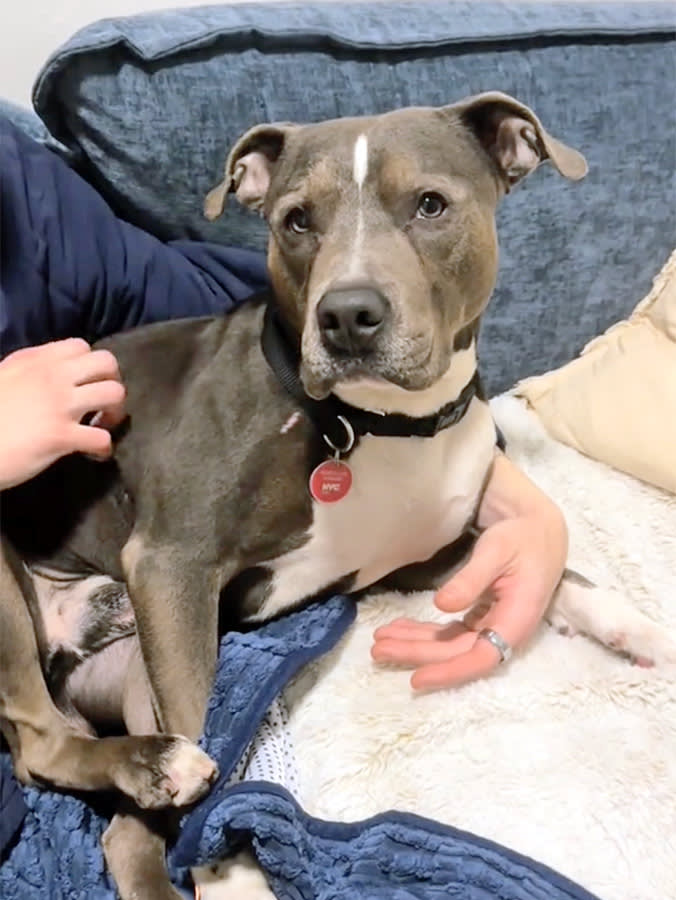
A Pit Bull named Bishop was stolen off a New York City subway car, abandoned tied to a bench in a West Village park in the rain, and reunited with his person 36 hours later because a woman with about a hundred TikTok followers decided to post a video anyway.
What happened
Will Zurier and Margaret Molloy had their own Pit Bull, Banks, out for a walk in the West Village, at the park by the AIDS Memorial, when they came across Bishop: alone, leashed to a bench, in the rain.
They stayed. For an hour they waited with him for a person who never came.
Then they made a decision that shaped everything that followed. Zurier has said the two of them are simply suckers for dogs, and that they know how routinely Pit Bulls get written off, and that this one struck him as deserving better than a call to animal control and a one-way ride to a shelter. So instead of handing the problem to the city, they took it on themselves.
They brought him to Small Door Vet, which gave them a free appointment, sensibly wanting a quick check before bringing an unknown dog into their home and near their own dog.
Then they went looking for his person, and the search was exhaustive: a call to the police station, where they were told no report had been filed, which they were also told is common with missing pets. A visit to the nearby hospital, on the theory that someone might have been admitted and left a dog behind. A call to 311. A digital flier. Their contact details left with local vets and hospitals. Requests to nearby buildings and restaurants to share Bishop’s story.
Nothing.
The last-ditch post
Molloy has been open about how little she expected from the video. She has roughly a hundred followers, most of them friends. She does not post often. She had just seen this sort of thing work on the app before, and figured she had nothing to lose by throwing it out there.
It took off. Thousands of views. And eventually a comment arrived from someone who recognized the dog from a Nextdoor post, where a person had written that a friend’s dog had been stolen during a subway ride: their friend had been riding a downtown 1 train at Chambers Street when a stranger scooped up his Pit Bull and bolted through the doors as they shut. Four photos were attached.
Bishop’s guardian had searched the area and found nothing.
Thirty-six hours after they first found him standing in the rain, Zurier and Molloy brought Bishop back to the vet’s office to meet his person. By Zurier’s account, the dog ran straight to him, the man was carrying Bishop’s toys, and everyone in the room, finders included, cried.
Had the search failed, the pair had already committed to fostering Bishop themselves, provided they could get into a rescue program that would help with the financial side.
The detail that should worry you
Bishop had a microchip. It did not help.
When the number registered to that chip was called, the line was disconnected.
That is the entire story of most microchip failures, and it is not a technology problem. The chip is a permanent, unloseable ID that a shelter or vet can scan in ten seconds. It is also completely inert unless the registry has a phone number someone still answers.
Zurier’s stated takeaway is the correct one and it is worth repeating as bluntly as he put it: update your dog’s microchip.
Do this today, it takes four minutes
Find out which registry your chip is with. If you have no idea, run the number through the American Animal Hospital Association’s Universal Pet Microchip Lookup, which searches across participating registries and tells you where it is registered.
Confirm the number is actually registered at all. A chip implanted by a shelter or a breeder is frequently registered to them, not to you. A scan then produces the shelter’s number, not yours. Implantation and registration are two different events, and plenty of people only ever did the first one.
Update the phone number, and add a second one. Add a backup contact, ideally someone who does not live with you, so a single lost phone does not sever the whole chain.
Do it again when you move. Then confirm at your next vet visit; most clinics will scan the chip for free and check that it reads.
Keep the collar tag current too. The tag is what a neighbor reads in the first ten minutes. The chip is what a vet reads on day three. You want both.
And a harder thing to hear
The reason Bishop needed rescuing at all is that a stranger picked him up on a subway and walked off with him. Dog theft is not a folk tale. It is common enough to have its own body of research, and stolen dogs are disproportionately the small, valuable, and, in this case, simply available ones.
The prevention is unglamorous. Do not tie a dog outside a shop. Keep a hand or a foot through the leash loop on transit and in crowds. And be a little more suspicious of the friendly stranger who wants to know your dog’s breed and whether they are worth much than feels polite.
What’s new since this was written
The microchip story has had a bureaucratic sequel that actually matters. Registries have continued to consolidate, and the AAHA universal lookup tool has become the reliable front door for finding out where an unknown chip lives, which is exactly the gap that stranded Bishop.
The wider lesson has not changed, and it is not really about technology at all. Bishop got home because two people stood in the rain for an hour, then spent a day and a half working a problem that was not theirs, and because a woman with a hundred followers made the video anyway.
The internet did not save this dog. It just gave the people who did somewhere to put their effort.
References
- People. “Dog Stolen off NYC Subway Found Tied to Park Bench, Reunited with Owner Thanks to TikTok.” https://people.com/
- American Animal Hospital Association. “Universal Pet Microchip Lookup.” https://www.petmicrochiplookup.org/
- American Veterinary Medical Association. “Microchipping of animals FAQ.” https://www.avma.org/resources-tools/pet-owners/petcare/microchipping-animals-faq
- Lord, L. K., et al. “Search methods that people use to find owners of lost pets.” Journal of the American Veterinary Medical Association, 2007. https://pubmed.ncbi.nlm.nih.gov/17696857/
Nina Vasquez writes about life at home with pets and the relationships at the heart of it. Her work covers day-to-day living, people-and-pet stories, and the products that fit into a real household, with a warm, grounded take on everyday pet ownership.
Meet our experts ↗Keep reading
 LivingA Viral Dog Reunion Rewrote California LawMarcus Webb · 6 min
 Living43 Arrests at a Texas Dogfight. Nearly All of Them Bonded Out.Dr. Amara Solis · 7 min
 LivingA Pink Poodle Fell Into an Icy River. The Dye Job Saved Her.Marcus Webb · 6 min
 Health & WellnessDog Saliva Doesn't Heal Wounds. It Delivers Bacteria.Dr. Priya Nair · 8 min
 Health & WellnessThe 'Beards Are Dirtier Than Dogs' Study Says No Such ThingDr. Priya Nair · 6 min
 LivingConan's Cohost Let Her Husband Cut the Dog's Hair. Once.Leila Torres · 8 min