


Conan's Cohost Let Her Husband Cut the Dog's Hair. Once.
Sona Movsesian's dog stories are funny: the lockdown haircut, the coyote patrol, the kid who turned out allergic. They are also the three dilemmas that make people give up a dog. Here is what each one should actually look like.

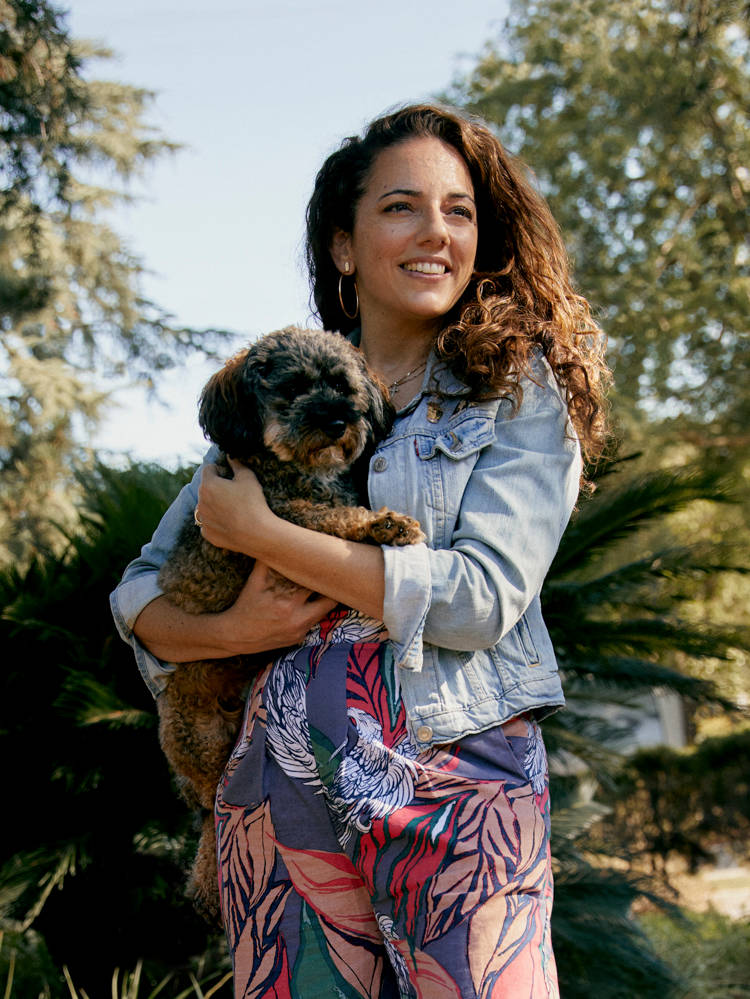
Every dog owner has a lockdown story, and most of them involve hair.
Sona Movsesian’s is better than yours. As Conan O’Brien’s longtime assistant and now the cohost of Conan O’Brien Needs a Friend, she has built a whole public persona on cheerfully failing at her job, to the point of writing a book about it called The World’s Worst Assistant. So when the groomers closed and her mostly-Poodle dog Oki’s coat kept growing, her husband bought a clipper set and had a go himself.
The result, by her account, was a catastrophe: far too short, faintly alarming, a dog who looked unwell rather than groomed. She felt terrible for her. The clippers, she says, are gone, and nobody but a professional touches that coat now.
It is a funny story. It is also the first of three genuinely common crises tucked into her dog’s life, and each one is a place where owners quietly conclude they are out of options. So here they are, with the answers she got the hard way.
Why the home haircut goes so wrong on a curly dog
The mistake was not confidence. It was coat type.
A Poodle-type coat is not fur that sheds and stops at a fixed length. It is hair that grows continuously, curls back on itself, and traps every shed strand inside the curl instead of dropping it on the floor. That is why these dogs are marketed as low-shedding, and it is exactly why they mat. Left alone, the coat felts into a dense mesh against the skin, which is painful, traps moisture, and hides everything underneath it.
Two things follow from that.
First, the clock is real. Curly and wavy coats generally need a professional groom every four to six weeks, plus brushing at home between visits, right down to the skin rather than skimming the top. Miss that window by a couple of months, which is precisely what happened to a great many dogs in 2020, and you no longer have a grooming appointment. You have a mat problem.
Second, once a coat mats, the humane fix looks drastic. A groomer cannot brush out a tight, felted coat without hurting the dog, so the answer is a short clip, and the dog comes home looking startled and half their previous size. That is not the groomer being lazy or unskilled. It is the only kind thing available. The way to never get that haircut again is to never let the coat get there.
If you are cutting a matted coat at home with a fresh set of clippers, the risks stack up fast: clipper burn on skin that has been suffocating under the mat, cuts where the skin tents up into the blade, and a dog who now finds grooming frightening for years afterward. Movsesian’s instinct was right. Hand it to someone who does this all day.
The allergy that nearly ended it
The harder story is her son.
When one of her twins, Charlie, was tested at an allergist, the result came back as a mild allergy to dogs. She has described the news as devastating, and anyone who has heard it will recognize the specific dread underneath: the assumption that this is the end of having a dog.
It was not. The family got an actual plan. The allergist advised keeping antihistamines on hand, prescribed an epinephrine auto-injector, and they set up separated zones in the house so the dog and the child were not in the same space by default. Then, slowly, they walked it back, reintroducing Oki into Charlie’s life in small doses so his tolerance could build. Today the two of them are, in her telling, inseparable. He chases her; she runs loops around the boys.
The reason this is worth spelling out is that “rehome the dog” is the default advice a family hears, and for a mild allergy it is usually not the first move. The mainstream allergy guidance is closer to what the Movsesian household ended up doing on its own:
- Make the bedroom a hard no. The allergic person’s bedroom stays pet-free, door closed, all the time. It gives them eight hours a night in a low-allergen room.
- Filter the air. A HEPA air cleaner running continuously in the bedroom and main living space measurably lowers airborne allergen over time.
- Wash the dog, and wash the fabric. Dander is the allergen, not hair. Frequent bathing of the dog, plus hot-washing bedding and soft furnishings, drops the household load.
- Ask about immunotherapy. Allergy shots or under-the-tongue drops gradually build tolerance to dog allergen over a course of several years, and they are the standard escalation when medication and environmental controls are not enough on their own.
“Almost every family I meet after a positive dog-allergy test has already decided they are going to lose the dog, and they have usually decided it in the car on the way home,” says Dr. Priya Nair. “For a mild allergy, that is skipping about four steps. Get an allergist to grade the severity, protect the bedroom, filter the air, and ask what immunotherapy would look like. Rehoming is the answer sometimes. It is almost never the first answer.”
Two caveats that matter. Severe allergy and allergic asthma are a different conversation, and an allergist grades that, not the internet. And if a child is prescribed an auto-injector, the plan is not “we will manage,” it is a written plan the whole household knows.
The coyote on the walk
Movsesian walks Oki in Los Angeles carrying a bat or a golf club, on the theory that the local coyotes are bold enough to try something and she would like a word.
The instinct is correct. The equipment is not.
Coyotes are established in essentially every major American city now, and a small dog is genuinely at risk, especially at dawn and dusk. But wildlife agencies and coexistence groups converge on a very specific set of behaviors, and swinging a bat is not among them, mostly because by the time you are close enough to swing, the situation has already gone badly wrong.
What is actually recommended:
- Keep the leash short. Six feet or less. A retractable leash puts your dog fifteen feet away from you at the moment you need them at your knee, and it is the single most common failure in these encounters.
- Do not let a small dog out in the yard alone, particularly at dawn and dusk. Most yard incidents happen in unattended minutes.
- Get big and loud. The recommended response is hazing: stand tall, wave your arms, shout, and advance on the coyote until it leaves. It has to be able to see that the threat is a human being. Hazing from inside a car, or from behind a bush, teaches it nothing.
- Carry noise, not a bat. An air horn, a whistle, a shaker can, a squirt bottle. Anything that makes you unpredictable and unpleasant to be near.
- Do not run, and do not turn your back.
- Never feed them, including indirectly. Fallen fruit, pet food left outside, and unsecured trash are what turn a wary coyote into a bold one. A coyote that has learned humans mean food is the dangerous one.
The goal is not to win a fight with a coyote. It is to be so obviously not worth the trouble that no fight starts.
Two more things buried in the funny parts
The pandemic made her dog antisocial, and that was normal. She was a social dog before; after six or so months of not seeing other dogs, she was done with them. This is not a personality defect and it is not permanent damage. Tolerance for other dogs is a skill that decays without practice, and a huge cohort of dogs came out of lockdown having lost it. What she does instead of fighting is worth noting too: at a friend’s house with a dog in it, Oki finds a room and poops in it, something she never does at home. That is not spite. Out-of-character indoor elimination in an unfamiliar, stressful house is a stress signal, and it is telling you the dog is not coping. The answer is fewer of those visits, not a scolding.
“Never yell at your dog” is not just kindness. It is the piece of her advice that happens to line up with the evidence. The research on training methods consistently finds that aversive handling, which includes yelling, is associated with more stress behaviors and a more pessimistic outlook in dogs, without any training advantage over reward-based methods. You can teach a dog everything they need to know without ever raising your voice, and the dogs trained that way tend to look better on every welfare measure we can take.
Her other rule, that you cannot spoil a dog too much, is a little more debatable at the margins. A dog does need structure, and there are dogs whose anxiety is made worse by never being allowed to be alone or to cope with anything. But as a corrective to the reflex to shame people for the stroller and the fancy collar, it is a fine place to land: nobody has ever damaged a dog by loving them visibly.
References
- Pet Allergies: symptoms, diagnosis, and management — American College of Allergy, Asthma & Immunology
- Pet allergy: diagnosis and treatment — Mayo Clinic
- Coyote Hazing Field Guide — Project Coyote
- Coyote hazing: how to scare off coyotes and keep them away — The Humane Society of the United States
- Vieira de Castro, A. C., et al. “Does training method matter? Evidence for the negative impact of aversive-based methods on companion dog welfare.” PLOS ONE, 2020.
Leila Torres leads our Living coverage, from home life and travel to the products and rescue stories that come with sharing a life with animals. She edits and writes across the section, with a soft spot for pieces about the bond between people and their pets.
Meet our experts ↗Keep reading
 Health & Wellness'Natural' Dog Shampoo Isn't a Safety Claim. Nobody Is Checking.Dr. Priya Nair · 7 min
 Health & WellnessNobody Licenses Your Dog's Groomer. Ask About the Dryer.Dr. Mara Chen · 7 min
 Health & WellnessThe Hardest Part of Dog Grooming Isn't the Clippers. It's Vetting the Groomer.Dr. Ravi Mehta · 8 min
 Health & WellnessSummer Grooming Isn't About the Haircut. It's a Health Check.Tom Hadley · 5 min
 Health & WellnessYour Dog's Cracked Paws Are Trying to Tell You SomethingDr. Lena Park · 8 min
 Health & WellnessRainbow Dogs Are Everywhere. Two Products Separate Art From an ER Visit.Dr. Priya Nair · 7 min