


'Natural' Dog Shampoo Isn't a Safety Claim. Nobody Is Checking.
Pet grooming products sit in a regulatory blind spot, which means the word natural on the bottle means whatever the brand wants. Here's what to actually avoid, what actually helps, and why the viral DIY shampoo recipe can hurt your dog.

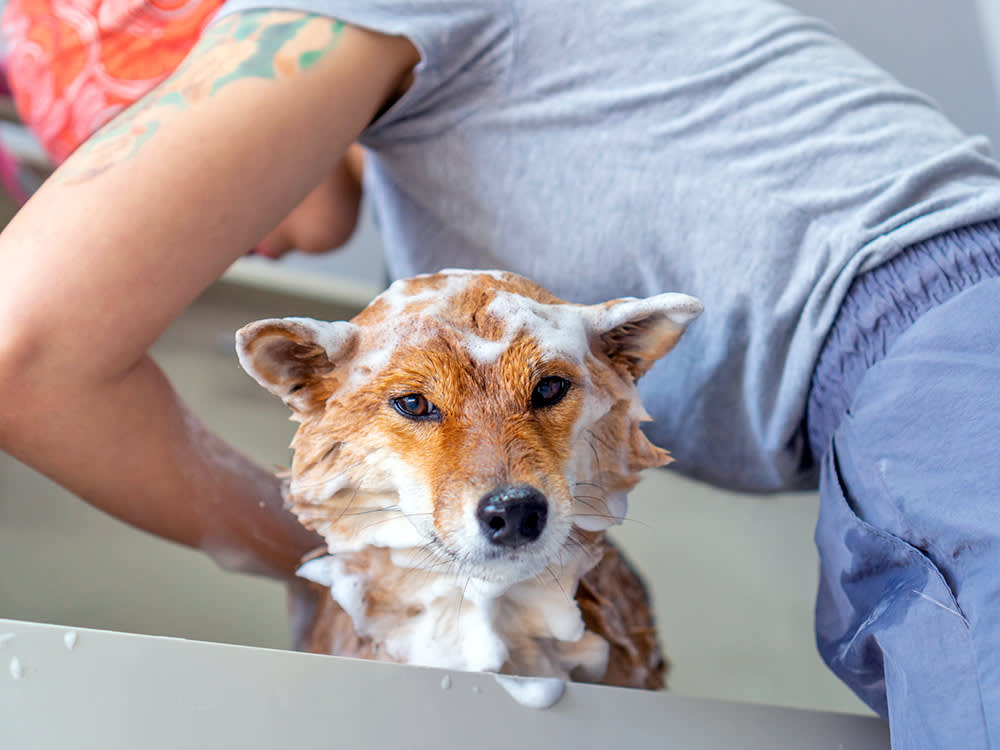
Here is the thing almost nobody tells you when they tell you to go natural: the word “natural” on a bottle of dog shampoo is not policed by anyone.
Products intended only to clean or beautify an animal are classified as grooming aids, and they sit outside the FDA’s authority under the Food, Drug, and Cosmetic Act. That is not a loophole someone is exploiting. It is the actual regulatory structure. The labeling rules that govern your own shampoo do not apply to your dog’s. Ingredients do not have to be listed in a set order, and vague catch-alls like “vegetable surfactants” or “odor-control blend” are perfectly legal. The EPA steps in only when a product claims to kill fleas or ticks, which makes it a pesticide.
So the natural-grooming aisle is not a lie. It is just unsupervised. Which means the burden of judgment lands on you, and the advice you find online is often worse than the products it is warning you about.
First, the part that is genuinely true
Your dog’s skin is not a tougher version of yours. It is more delicate in the ways that matter for bathing, and harsh detergents can strip it, dry it, and turn a mild itch into an angry one. If your dog already has an allergic or inflammatory skin condition, the wrong shampoo does not just fail to help. It can make the flare worse.
The ingredients to steer clear of are boring and specific:
- Sulfates, including sodium lauryl sulfate, the stripping agent doing most of the lather work in cheap formulas
- Parabens: ethylparaben, butylparaben, isobutylparaben
- Petrochemicals: paraffin, petrolatum, and their relatives
- Polyethylene glycols (PEGs)
The old rule of thumb, “if you can’t pronounce it, don’t put it on your dog,” is a bad rule (water is dihydrogen monoxide), but the list above is short enough to memorize, and it covers most of the offenders.
The ingredients that earn their spot
The gentler ingredient list is short, too, and it is not mystical. Each of these does one thing well:
- Aloe vera — moisturizing, and genuinely soothing on itchy skin
- Calendula (pot marigold) — helps calm minor cuts, rashes, abrasions, and eczema-type irritation, which makes it useful for dogs whose skin is already sore
- Sea kelp — rich in iodine, potassium, and iron; used to strengthen and smooth coat and skin
- Colloidal oatmeal — the workhorse for allergic, itchy dogs, especially ones who have scratched themselves raw
If a bottle leads with those and skips the list above, it is doing its job, regardless of whether the front label says “natural,” “botanical,” or nothing at all.
The ingredient panel is the only part of the bottle that is telling you the truth. I have seen beautifully branded ‘clean’ shampoos with a sulfate two lines down, and I have seen plain white drugstore bottles that were perfectly kind to a dog’s skin. Read the back, ignore the front.
The DIY recipe going around can poison your dog
This is the correction worth the whole article.
The internet’s standard homemade dog shampoo goes like this: warm water, a splash of apple cider vinegar, and a few drops of whatever essential oil you happen to have. That last ingredient is doing an enormous amount of damage.
Concentrated essential oils are toxic to dogs. Tea tree oil (melaleuca) is the clearest case: in concentrated form, as little as seven or eight drops can make a dog seriously ill. Signs of toxicity include weakness, tremors, difficulty walking, a dangerously low body temperature, a slowed heart rate, drooling, vomiting, and skin irritation. Symptoms can start within an hour or two of a topical application, but they can also take up to eight hours to show, which is exactly long enough for an owner to conclude everything is fine.
The nuance that gets lost: commercial products containing tea tree oil at low concentrations, roughly under 1 to 2 percent, are generally not considered toxic when used as directed. The danger is not the ingredient’s existence on a label. It is you, in your bathroom, adding drops from a bottle you bought for a diffuser.
If you want to bathe your dog at home with something you mixed yourself, make it an oatmeal soak. Blend plain, unflavored oats into a fine powder, stir into warm water, work it through the coat, let it sit a few minutes, rinse. No oils. If you suspect your dog has ingested or been dosed with concentrated essential oil, call your vet or the ASPCA Animal Poison Control Center at (888) 426-4435 right away.
And the standing rule holds: check with your vet before you put anything new on a dog with a skin condition.
Going green past the bottle
If sustainability is why you are here, the shampoo is only part of it.
Tools. Most combs, brushes, detanglers, and thinners are plastic. Wood and, better, bamboo do the same job. Bamboo is renewable, biodegradable, and grows without pesticides, and these tools tend to outlast their plastic counterparts, which is the actual environmental win.
Cruelty-free. The pet grooming market is crowded enough now that you do not have to compromise. Look for the Leaping Bunny logo or PETA’s certification; PETA keeps a running list of pet shampoos and conditioners made without animal testing. ADC Houndstone & Co., Good Girl Good Boy, and Organic Oscar are all built around that standard.
Water. Do not leave the tap or shower running while you lather. It is the single easiest change in the whole routine.
Wipes. If you rely on grooming wipes between baths, take a worn towel or a shirt headed for the bin, cut it into squares, soak the squares in plain water, and keep them in a sealed tub by the door. Reusable, free, and waiting for you after a muddy walk. (Skip the essential-oil soak here too.)
What’s new since this was written
The regulatory picture is the update. The FDA’s food-dye phase-out made headlines and prompted a wave of pet brands to advertise dye-free formulas, but that rule does not reach pet grooming products at all, because those products were never under the FDA’s cosmetic authority in the first place. A dye-free claim on a dog shampoo is a marketing decision, not compliance with anything.
Meanwhile, the veterinary toxicology guidance on essential oils has only gotten firmer. Poison control centers keep logging cases from home aromatherapy and homemade grooming mixes, and the advice has settled into something simple: diluted, properly formulated products used as directed are fine, and loose drops of concentrated oil have no place near your dog.
None of this means the natural aisle is a scam. It means the label is not the evidence. The ingredient list is.
References
- U.S. Food and Drug Administration. “Compliance Policy Guide Sec. 653.100 Animal Grooming Aids.” https://www.hhs.gov/guidance/sites/default/files/hhs-guidance-documents/FDA/CPG-Sec.-653.100-Animal-Grooming-Aids_0.pdf
- ASPCA Animal Poison Control Center. “The Essentials of Essential Oils Around Pets.” https://www.aspca.org/news/essentials-essential-oils-around-pets
- American College of Veterinary Pharmacists. “Tea Tree Oil.” Pet Poison Control List. https://vetmeds.org/pet-poison-control-list/tea-tree-oil/
- U.S. Environmental Protection Agency. “Pesticide Registration: Pet Products.” https://www.epa.gov/pesticide-registration
- Cruelty Free International. “Leaping Bunny Program.” https://www.leapingbunny.org/
Common questions
Can I make my own dog shampoo with essential oils?
This is the most common piece of DIY grooming advice online and the riskiest. Concentrated essential oils are toxic to dogs. Tea tree (melaleuca) oil in concentrated form can cause serious illness in a dog from as little as seven or eight drops. Skip the essential oils and use a plain oatmeal soak instead.
Which ingredients should I avoid in dog shampoo?
Sulfates (including sodium lauryl sulfate), parabens (ethylparaben, butylparaben, isobutylparaben), petrochemicals like paraffin and petrolatum, and polyethylene glycols (PEGs). These are the usual suspects behind drying, itching, and aggravated skin conditions.
Are bamboo brushes actually better?
For the planet, yes. Bamboo is renewable, biodegradable, and grows without pesticides, and the tools tend to be more durable than plastic. For your dog's skin, the brush material matters far less than the shampoo you use and how well you rinse it out.
Not a substitute for your vet. Our guidance is educational. For urgent symptoms, contact a vet or emergency clinic right away. Editorial standards
Dr. Nair is a veterinarian focused on diet and feeding. She covers everyday nutrition, treats, and the many "can they eat this?" questions owners ask, grounding each answer in what is actually safe and sensible for dogs and cats.
Meet our experts ↗Keep reading
 Health & WellnessYour Puppy's Coat Is Going to Change. Here's When to Shrug and When to WorryDr. Mara Chen · 6 min
 Health & WellnessYour Dog's Skin Is a Third as Thick as Yours. Wash Accordingly.Dr. Priya Nair · 9 min
 Health & WellnessThe Bath Mistake That Ends in a Vet Bill: Letting Your Dog Stay DampDr. Lena Park · 6 min
 Health & WellnessFifteen Seconds Is Grooming. A Minute Is a Symptom.Dr. Mara Chen · 7 min
 Health & WellnessThose Flakes on Your Dog Aren't Dry Skin. They're a Readout.Dr. Amara Solis · 7 min
 Health & WellnessBathing Your Dog More Won't Fix the Smell. Finding It Will.Dr. Priya Nair · 8 min