


Your Dog's Skin Is a Third as Thick as Yours. Wash Accordingly.
Every 'can I use this on my dog' answer comes down to one question: is this a rescue, or a routine? Get that right and the whole shelf sorts itself out, including the vinegar.

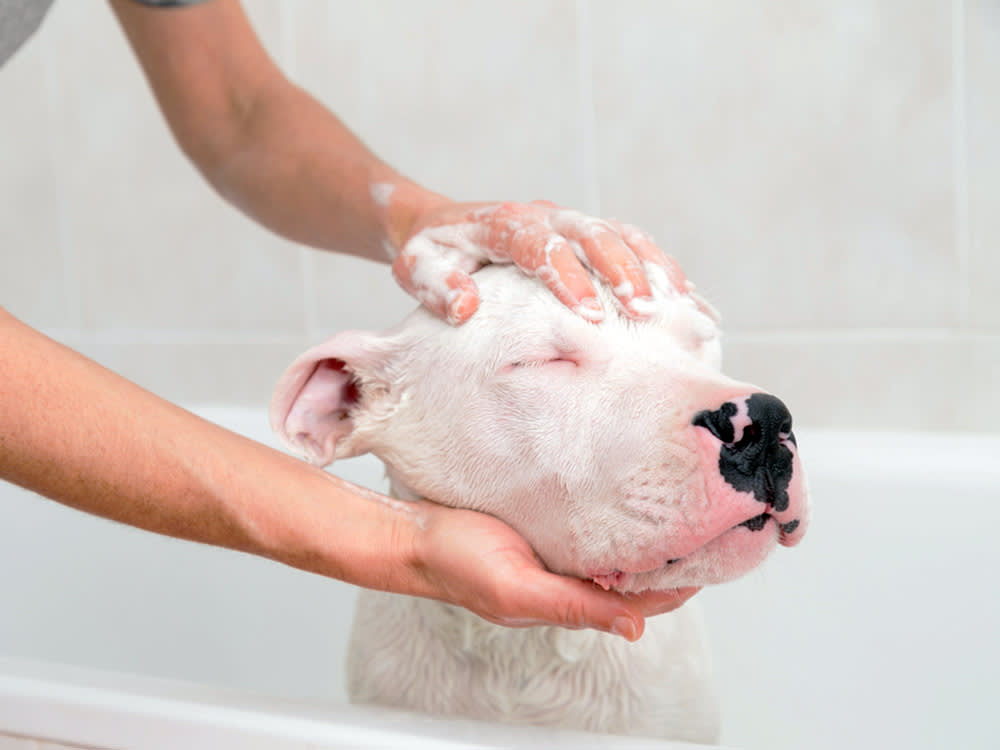
Search “what can I wash my dog with” and you get a shelf: dog shampoo, baby shampoo, apple cider vinegar, dish soap, some DIY oatmeal thing from a blog. Each gets a paragraph. None of them gets a rule.
Here is the rule, and it comes from one physical fact about your dog that changes everything downstream.
The outer layer of your dog’s skin is about three times thinner than yours. The epidermis, the barrier layer that holds moisture in and keeps the world out, is genuinely, structurally slighter on a dog than on a person. Dog skin is also less acidic than human skin, so a product balanced for you is chemically mismatched to them from the first drop.
That is why “can I use this on my dog” is not a question about ingredients. It is a question about how much barrier your dog can afford to lose. And that gives you one clean test to apply to everything on the shelf:
Is this a rescue, or is this a routine?
A rescue is a one-off. Your dog found something dead and rolled in it, it is Sunday, and you have no dog shampoo. In that situation, a slightly wrong product used once is almost always fine. A routine is what happens to your dog’s skin every week for years. There, “slightly wrong” is not slightly wrong at all. Repetition is what turns a mismatch into a damaged barrier, a dry coat, an itchy dog, and eventually an overgrowth of organisms that were meant to be kept in check.
Every answer below is just this test, applied.
The shelf, sorted by the test
Dog shampoo: the routine
This is the only thing on the list built for the routine, and that is the whole reason to use it. It is formulated for canine skin, which means the pH is correct and it is far less likely to irritate.
It is also the only category with real problem-solving in it. There are formulations for itching, for antibacterial needs, for sensitive skin, and prescription options when the situation calls for one. If your dog has an actual skin condition, this is not a preference, it is treatment, and the product your vet names is the product to use, at the frequency they specify.
Baby shampoo: a decent rescue, a bad routine
Baby shampoo is gentle and it is designed to be safe if it gets in eyes, which is genuinely useful on a squirming dog. Plenty of dogs tolerate it perfectly well.
The catch is who it was formulated for. A human infant’s skin sits at a more acidic pH than a dog’s does. One bath, no harm done. A bath every week is a small chemical mismatch, applied over and over, to the thinnest barrier in the house.
Verdict: keep a bottle for emergencies. Do not build your dog’s grooming around it.
Apple cider vinegar: mostly an anecdote
This is the one that deserves a harder look, because it is recommended constantly and the evidence is not where people think it is.
In research settings, apple cider vinegar does show antimicrobial and antifungal activity. That is true, and it is where the reputation comes from. What is much less clear is whether any of that translates to a dog’s skin. Anecdotally, people report success with ACV diluted 1:1 with water for itchy skin and yeasty ears, and that is a real pattern of reports.
But when researchers actually tested it, soaking dogs with atopic dermatitis in apple cider vinegar did not meaningfully alter the bacterial microbiome of their skin. The mechanism people assume is doing the work did not show up when it was measured.
And there is a real downside. If your dog has been scratching, their skin is already broken, and applying vinegar to abraded skin burns. You will have taken an itchy dog and made them an itchy dog who is now also frightened of you and the bathroom.
Verdict: not a treatment. If your dog is itchy enough that you’re reaching for the pantry, that is your signal to find out why, not to improvise.
DIY shampoo: understandable, and the wrong move
Itchiness drives people to their wits’ end, and a homemade shampoo for an itchy dog feels like taking action. The problem is that bathing genuinely does provide relief, so DIY seems to work, and that masks the real issue.
DIY shampoos are not as stable or as effective as properly formulated ones, and more importantly, an itchy dog needs a diagnosis, not a recipe. Parasites, infection, and allergies all present as an itchy dog, and they are all treated differently. Use a veterinary-recommended shampoo for a dog with skin issues, and rule out what is actually causing it.
Dish soap: not a shampoo, but a legitimate tool
Dish soap strips protective oils out of the skin and coat, which is precisely what makes it bad as a shampoo and useful in exactly two rescues, both below.
The two real emergencies
Fleas
Start with the honest framing: washing fleas off a dog is not flea control. Bathing gives temporary relief and does nothing to stop fleas hopping back on an hour later. Monthly preventives are a vastly better strategy, and if you find yourself bathing for fleas repeatedly, the bath is not the problem you should be solving.
Flea-killing shampoos do exist, and they work. But they are not universally tolerated, and on a very small or very young puppy they can be too aggressive.
Which is where the exception lives. On a tiny puppy overrun with fleas, dish soap in the bath will strip the live fleas off, provided your vet has cleared it. This is not folklore, it is a genuine technique, and it carries genuine caveats. A serious flea load can make a very small puppy anemic, and the bath itself may be more stress than the puppy can take. Get the plan from your vet rather than inventing one.
Skunk
Know this part before it ever happens: if the spray catches your dog in the face, it can make them properly ill. Damage to the eyes, vomiting, trouble breathing, anemia. A face hit is a phone call to the vet, not a trip to the bathroom.
For a body spray, bathing is the answer. And skip the tomato juice entirely. It is a myth and it does nothing. Commercial de-skunking shampoos are real and they work. If you do not happen to own one at 2am, which is invariably when this happens, mix this:
De-skunk mix
- One quart of 3 percent hydrogen peroxide
- 1/4 cup baking soda
- One to two teaspoons of dishwashing liquid
How to use it: Combine it in a bowl or bottle. Work it through the coat, keeping well clear of the eyes. Leave it on for roughly five minutes. Then rinse it all out with warm water, and go again if the smell is still there.
Two warnings that matter. The peroxide will lift the color out of a dark coat, and it will take the color out of any towel or shirt it touches, so grab the ones you were going to throw away anyway. And whatever is left in the bowl goes down the drain immediately. Sealed up in a bottle, the mixture carries on reacting, and the pressure has to go somewhere. Mix it fresh each time.
Then there’s the skin itself
Skin complaints fill more veterinary appointment slots than almost anything else. Dogs itch. Dogs pick up parasites. Dogs develop a smell you can identify from another room.
Most skin problems need some amount of home management, and bathing is usually part of it. The distinction that matters is that a bath is a component of a plan, not a substitute for one. When your vet recommends a product and a schedule, that is the fastest route to a comfortable dog. Improvising around it, with the best intentions, is the slowest.
By the time someone is standing in the kitchen mixing vinegar into a bowl, we’ve usually skipped the only step that would have fixed it. An itchy dog is a diagnosis waiting to happen. It is almost never a shampoo problem.
Bathing technique, which is where half the damage happens
You can pick the right product and still irritate the skin, mostly by rushing the rinse.
- Get everything out first. A shampoo that suits the coat and whatever is going on with the skin, more towels than you expect to need, and a brush if that coat is one that gets brushed.
- Build a safe space. The sink for a little dog, the tub for a big one. What you are preventing is a dog whose feet skid out from under them and who hurts themselves in the process, so put down a rubber mat or a towel for grip.
- Use warm water. You may love a scalding bath or an ice-cold shower. Your dog does not. Warm and tepid.
- Lather up. Wet from neck to tail, apply enough shampoo to actually lather, and work it in. Do not shampoo the face, so nothing runs into their eyes.
- Rinse thoroughly. This is the step people cut short, and it is the one that causes irritation, because dried shampoo left in the coat irritates skin. Keep water out of the eyes, ears, and nose, and rinse until there is genuinely nothing left.
- Dry your dog. The shake gets rid of an impressive amount of water and is not enough. Towel or dryer, and if you use a blow dryer, keep it cool and several inches off the coat.
- Give lots of praise. Treats, fuss, and a good ending. For a frightened dog this is not sentimentality, it is what determines whether next month’s bath is a fight.
What newer research adds
The most useful recent finding is a negative one, and it is the sort of thing that rarely makes it into a grooming article: when researchers tested apple cider vinegar soaks in dogs with atopic dermatitis, the vinegar did not change the skin’s bacterial microbiome. The lab activity that made ACV famous did not deliver on an actual dog.
That does not mean an ACV rinse has never made anyone’s dog feel better. Bathing itself is soothing, and plenty of what people credit to the vinegar is probably the water. But it does mean the mechanism people believe in has been looked for and not found, and that a burning rinse on broken skin is a real cost for an unproven benefit.
The broader point holds. The skin your dog is wearing is thinner than yours and chemically different from yours, and it is not a place to run experiments. Pick the product built for it, rinse it all out, and if your dog is itchy enough that you’re improvising, book the appointment instead.
References
- Rodrigues Hoffmann, A., et al. “The skin microbiome in healthy and allergic dogs.” PLOS ONE, vol. 9, no. 1, 2014. https://doi.org/10.1371/journal.pone.0083197
- “Apple cider vinegar soaks [0.5%] as a treatment for atopic dermatitis do not alter the skin bacterial microbiome in normal or atopic dogs.” PLOS ONE, 2019. https://doi.org/10.1371/journal.pone.0223559
- Yagnik, D., et al. “Antimicrobial activity of apple cider vinegar against Escherichia coli, Staphylococcus aureus and Candida albicans; downregulating cytokine and microbial protein expression.” Scientific Reports, vol. 8, 2018. https://doi.org/10.1038/s41598-017-18618-x
- Humane Society of the United States. “What to do if your pet is sprayed by a skunk.” https://www.humanesociety.org/resources/what-do-if-your-pet-sprayed-skunk
- American Kennel Club Canine Health Foundation. “Skin barrier function in dogs.” https://www.akcchf.org/
Common questions
Can I use human shampoo on my dog?
Avoid it where you can. Ours is the more acidic skin, and theirs has an outer layer roughly a third the thickness of ours, which is why our shampoo leaves a dog dry, irritated, and with a compromised barrier, and can unsettle the bacterial community that normally lives up there. Caught out with no dog shampoo and a filthy dog? Rinse hard with plain water instead. If you genuinely need suds, baby shampoo is the least objectionable substitute.
How often should I wash my dog?
There is no universal schedule. It moves with the coat they have, the life they lead, and the state of their skin. A dog at either extreme of coat, very long or entirely hairless, a dog who lives outdoors, or a dog with a diagnosed skin problem, will all need the bath more often than a short-coated house dog.
Can I use dish soap on my dog in an emergency?
It makes a poor shampoo, because pulling the oils out of skin and coat is precisely what it is designed to do. There are exactly two jobs it is right for: it goes into the de-skunking mix, and, with your vet's say-so, it will strip live fleas off a puppy too young for any real flea product.
Does apple cider vinegar help an itchy dog?
Not in the way it is sold to you. In a dish it does kill microbes and fungi, which is where the reputation comes from. But when researchers soaked atopic dogs in it and then measured, the bacterial population on the skin had not meaningfully shifted. On skin already raw from scratching, it also stings viciously. File it under anecdote, not treatment.
Not a substitute for your vet. Our guidance is educational. For urgent symptoms, contact a vet or emergency clinic right away. Editorial standards
Dr. Nair is a veterinarian focused on diet and feeding. She covers everyday nutrition, treats, and the many "can they eat this?" questions owners ask, grounding each answer in what is actually safe and sensible for dogs and cats.
Meet our experts ↗Keep reading
 Health & WellnessMost Dog Hair-Loss 'Remedies' Treat the Wrong ThingDr. Mara Chen · 9 min
 Health & WellnessNothing in Your Pantry Will Cure Your Dog's Itch. 11 Things Will Make Tonight Bearable.Dr. Nina Kohl · 8 min
 Health & WellnessThe Bath Mistake That Ends in a Vet Bill: Letting Your Dog Stay DampDr. Lena Park · 6 min
 Health & WellnessBathing Your Dog More Won't Fix the Smell. Finding It Will.Dr. Priya Nair · 8 min
 Health & Wellness'Natural' Dog Shampoo Isn't a Safety Claim. Nobody Is Checking.Dr. Priya Nair · 7 min
 Health & WellnessFifteen Seconds Is Grooming. A Minute Is a Symptom.Dr. Mara Chen · 7 min