


Rainbow Dogs Are Everywhere. Two Products Separate Art From an ER Visit.
Creative grooming turned a Standard Poodle named Snow into a celebrity. The technique is legitimate. The failure mode, human hair dye on a dog who licks, is a poisoning, and the line between them is thinner than Instagram suggests.

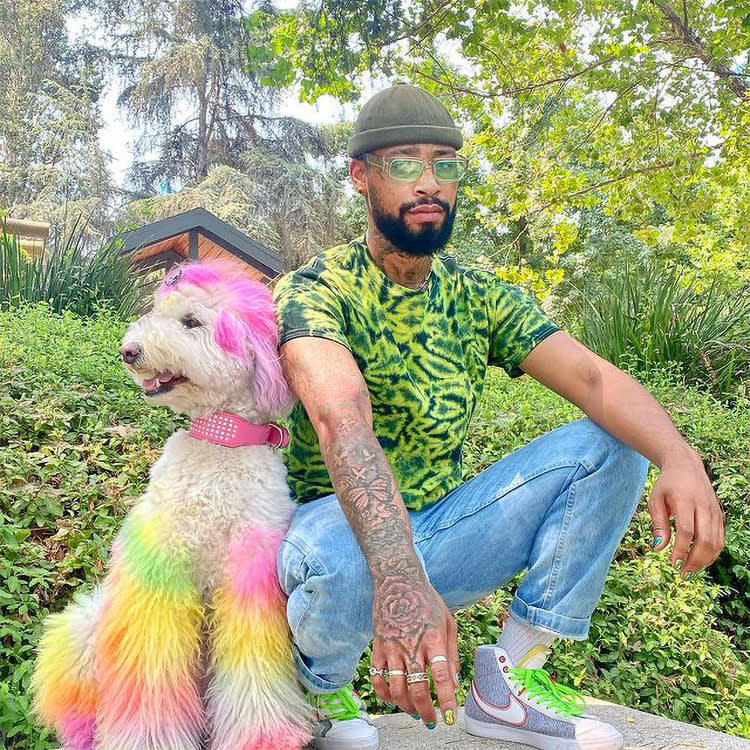
Josh White and his Standard Poodle, Snow, turn heads on purpose. He is the West Hollywood groomer behind Dogue Spa, a star of Amazon’s The Pack, and the person Cardi B, Awkwafina, and Usher call about their dogs. Snow is his canvas and his business card: cotton candy swirls, leopard spots, a rainbow that he coordinates his own outfits around. If he dyes her blue, he wears denim.
The work is real and the craft is real. What almost never makes it into the caption is the part that determines whether a dyed dog is a piece of art or a case at the emergency vet, and it comes down to what is in the bottle and whether the dog wants to be there at all.
Start with the dog, not the color
White has been direct about the one rule that governs the whole practice: if Snow were shy, or disliked being groomed or dyed, he would not do it. She is, in his description, a ham who loves being handled and loves meeting clients. That is not a throwaway line, it is the entire qualifying test.
Creative grooming is a long appointment. It is bathing, drying, sectioning, applying product, waiting, rinsing, and drying again, with a lot of standing still. A dog who finds a routine bath stressful is going to find this significantly worse, and there is no aesthetic payoff worth a dog who learns that the salon is where bad things happen.
The dog does not know they are beautiful and does not care. So the only question that matters is whether they enjoyed the two hours it took. If the honest answer is no, the color is not a treat you gave them. It is a thing you did to them.
The chemistry is where people get hurt
This is the hard line, and it is not a matter of taste.
Human hair dye does not go on a dog. It is engineered for a species that does not lick itself. The oxidative dyes most people have under the sink rely on ammonia or an alkalizing agent plus hydrogen peroxide to lift the cuticle, and they carry aromatic amines that are common contact sensitizers. Dogs groom. Dogs lick their legs, their flanks, and each other. Whatever you put on that coat is going in that mouth, and the skin under the coat will absorb some of it regardless.
Pet-formulated dye is a different risk profile, not the absence of risk. Dogue Spa’s product of choice is OPAWZ. It is a pet-specific shampoo dye line, marketed as vegan, cruelty-free, and non-toxic, built on ingredients that also appear in cosmetics and food. That is the right category of product. It is still a chemical sitting against skin for a period of time, and veterinary guidance on pet dye is consistent: contact irritation, sensitization, and even chemical burns are possible with products marketed as safe, and anything on the skin can be absorbed systemically.
Food coloring is the conservative option. Groomers reach for it on light coats because it is genuinely low-toxicity, sourced from the same fruit, vegetable, and plant pigments in your kitchen. It also fades quickly and does almost nothing on a dark or coarse coat, which is why the professional work uses purpose-built products.
“Non-toxic” is not a regulated promise. There is no pre-market federal approval process for pet grooming cosmetics the way there is for a drug. A pet dye can be entirely reasonable and still be sold on the strength of a claim nobody audited. Read the ingredient list, not the adjective on the front.
The safety checklist before any color goes on
- Skip it entirely if the dog has skin disease. Allergies, hot spots, an active flare of atopic dermatitis, broken skin anywhere: no dye. You are putting a sensitizer on a barrier that is already failing.
- Patch test. A small area, 24 to 48 hours, watch for redness, heat, itching, or a dog who will not stop licking the spot.
- Keep it off mucous membranes. No color near the eyes, the muzzle, the genitals, or the anus, no matter how good the design would look.
- Watch the licking. A dog who will not leave a dyed area alone is telling you it is uncomfortable. Rinse it out.
- Never on a cat. Cats groom compulsively and metabolize a lot of things badly. This is a dog practice.
- Use a groomer for anything ambitious. Ask what product they use and whether it is formulated for dogs. If they cannot name it, walk out.
The upkeep is boring, which is the point
After a color, there is no exotic maintenance regimen. Brush and comb regularly. That is it, and it is exactly what every dog with a coat like that needs anyway.
Dogue Spa’s busiest stretches are summer and the run-up to the holidays, especially Halloween and Christmas, when some clients book a year ahead. The most requested services are creative grooms, dyes, and the Asian Fusion styling that makes dogs look almost animated. White’s own pitch is not really about hair, it is about pushing an industry that has always been treated as maintenance into being treated as design work, with the inclusivity and visibility that come along with that.
None of that changes the chemistry. A colored dog can be a genuinely happy dog with a coat that fades out over a few weeks. A colored dog can also be a dog with a chemical burn under a swirl, because someone reached for the box on the bathroom shelf. The distance between those two outcomes is one bottle.
What newer guidance adds
Veterinary advice has converged on a simple frame: dye a dog only with a product made for dogs, only on healthy skin, and only if the dog tolerates a long groom without stress. Even then, watch for contact reactions, because “non-toxic” describes ingestion risk, not skin sensitivity.
The practical upshot is that the Instagram version of creative grooming, a relaxed poodle in a park with pastel legs, is achievable and defensible. The version that lands in a clinic is almost always a home job with a human product on a dog who did not want to stand still.
References
- Trupanion Veterinary Team. “Is it Okay to Dye Your Pet?” https://www.trupanion.com/pet-blog/article/pet-fur-dye-safety
- Hill’s Pet Nutrition. “Is Hair Dye Safe for Dogs?” https://www.hillspet.com/dog-care/resources/is-hair-dye-safe-for-dogs
- Parade Pets. “Is Dog Hair Dyeing Safe? A Veterinarian Weighs In.” https://paradepets.com/dogs/is-dog-hair-dyeing-safe
- ASPCA Animal Poison Control Center. “People Foods and Household Items to Avoid.” https://www.aspca.org/pet-care/animal-poison-control
Common questions
Is pet-safe dye actually safe?
Safer, not risk-free. Even dyes formulated for pets can cause contact irritation or sensitization, and anything sitting on skin can be absorbed. Patch test, keep it off broken skin, and skip it entirely on a dog with existing skin disease.
Can I dye a cat?
Don't. Cats groom compulsively and metabolize many compounds poorly. Creative color is a dog practice for a reason.
What about food coloring?
It is the low-risk option many groomers reach for on light coats, though it fades fast and takes poorly to dark or coarse hair. Low risk is not zero risk if a dog ingests a large amount.
Not a substitute for your vet. Our guidance is educational. For urgent symptoms, contact a vet or emergency clinic right away. Editorial standards
Dr. Nair is a veterinarian focused on diet and feeding. She covers everyday nutrition, treats, and the many "can they eat this?" questions owners ask, grounding each answer in what is actually safe and sensible for dogs and cats.
Meet our experts ↗Keep reading
 Health & WellnessMud Won't Hurt Your Dog. What's Living In It Might.Dr. Priya Nair · 6 min
 Health & WellnessStop Shaving Your Dog for Summer. Here's What It Actually Does.Dr. Nina Kohl · 5 min
 Health & WellnessNobody Licenses Your Dog's Groomer. Ask About the Dryer.Dr. Mara Chen · 7 min
 Health & WellnessThe Hardest Part of Dog Grooming Isn't the Clippers. It's Vetting the Groomer.Dr. Ravi Mehta · 8 min
 Health & WellnessBaby Shampoo on a Dog: Fine for the Rescue Bath, Wrong for the RoutineDr. Lena Park · 6 min
 Health & WellnessSummer Grooming Isn't About the Haircut. It's a Health Check.Tom Hadley · 5 min