


Rescuers Saw the Starving Dogs and Left. Four Times.
Investigators visited the Polk County property four times over 60 days before 27 dogs were finally removed. That delay wasn't indifference. It was the only thing that made the rescue stick.

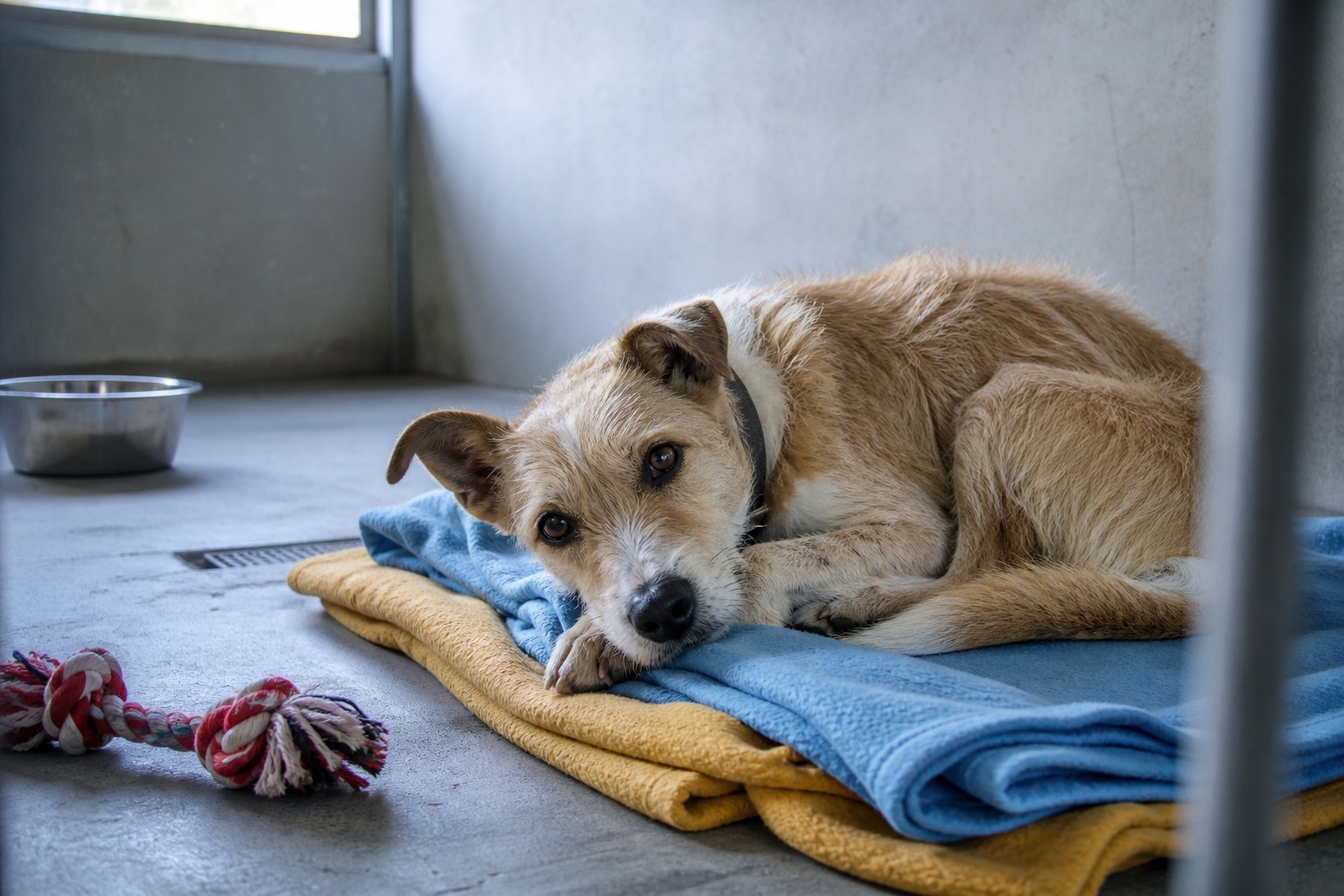
The detail that sticks with you is the water. The dogs on the Polk County, Missouri, property had no bowls. What they drank was rainwater, collected in trash left lying in the yard.
Twenty-seven living dogs came off that property on November 8, 2024, pulled out by the Humane Society of Missouri’s Animal Cruelty Task Force. Several more were found already dead. The survivors were chained to whatever was around: trees, dog-houses, pieces of furniture. Most were severely underweight. Several had injured legs. One had an injury to his face.
Here is the part that makes people angry. Investigators had been to that property four times over roughly 60 days before any dog was removed.
That sounds like failure. It isn’t. It’s the system working the only way it can, and understanding why is the difference between a rescue that holds up and one that falls apart in a courtroom.
Why nobody just took the dogs
The instinct, reading a story like this, is to ask why an investigator who sees a starving dog chained to a tree doesn’t simply put it in the truck.
Because a dog is, legally, property. Removing one without a warrant is seizing someone’s property, and a seizure that skips the paperwork can be challenged, reversed, and used to hand the animals back to the person who starved them. The fastest-feeling route is also the one most likely to end with the dogs going home to the same yard.
So the task force did the slow thing. An investigator returned to the property repeatedly, documented what she saw, and tried to work with the owner directly, warning him that the dogs could be removed if their condition and their environment didn’t improve. He was given the chance to fix it. He didn’t. When the investigator came back and found the dogs’ health and safety had only gotten worse, that documented pattern, not a single bad afternoon, is what supported a warrant.
The Polk County Sheriff removed the dogs under that warrant and placed them with HSMO. The dogs went to the group’s Macklind Avenue headquarters in St. Louis for health evaluations and emergency treatment.
Four visits over 60 days is not a story about rescuers dragging their feet. It’s a story about rescuers building a case that a defense attorney can’t dismantle.
The rescue is not the finish line
The photos of dogs coming off a property feel like an ending. They’re closer to a beginning, and the next step is the one almost nobody outside animal welfare knows about.
Seizing a dog does not mean owning a dog. HSMO had physical custody of those 27 animals, but not legal custody. That gets decided at a disposition hearing, and in this case the court set one for December 4, 2024. Until a judge rules, the dogs are essentially evidence. They can be fed, treated, and cared for, but they cannot be adopted out, because they still legally belong to the person they were taken from.
This is why shelters in these cases so often say they cannot give a timeline. They genuinely don’t have one. Only after custody is awarded can the real sequence start:
- Medical clearance. Every dog needs a clean bill of health from the veterinary team.
- Behavior evaluation. The animal behavior team assesses each dog individually.
- Adoption, case by case. Dogs are released as they recover, not as a group.
A dog who spent his life on a chain is not simply a thin dog who needs dinner. Rebuilding him takes months, and the medical half of that is more delicate than most people assume.
“You cannot feed a starved dog back to health quickly, as much as everyone in the building wants to,” says Dr. Nina Kohl. “Flood a body that has been running on nothing with a big meal and you can crash its electrolytes badly enough to kill it. So the first stretch is small portions, repeated bloodwork, and a great deal of patience.”
The behavior side runs on the same clock.
“A dog who has only ever known a chain and a patch of dirt often has no framework for a house,” says Dr. Nina Kohl. “The evaluation isn’t an exam they pass or fail. It’s a map of what each one still has to learn.”
What actually helps
In the weeks after a large seizure, the shelter’s costs are immediate and the animals’ needs are unglamorous. HSMO asked the public for donations of dog beds, blankets, newspapers, and dog toys, alongside direct financial support for the ongoing treatment these dogs needed for the health problems neglect had caused.
If you want to be useful in a case like this one, a few things are worth knowing:
- Money is more flexible than stuff. Direct donations cover veterinary work, which is the largest cost and the one no one donates a blanket for.
- Check the wish list before you buy. HSMO publishes what it actually needs, which changes week to week. Well-meant deliveries of the wrong thing become a storage problem.
- Report early, and report specifically. The 60-day paper trail in this case existed because somebody’s observations got written down. HSMO’s Animal Cruelty Hotline is 314.647.4400; in an active emergency, call local police as well.
When you report, note dates, what you actually saw, and the condition of the animals and the property. Vague concern is hard to act on. A documented pattern is what a warrant is made of.
What’s new since this was written
This case was not an outlier, and the year that followed made that painfully clear.
Eleven days after the 27 dogs came off that property, the same task force went back into Polk County and pulled 15 more dogs out of another starvation case. Then, on July 30, 2025, ACT carried out what the organization called its largest dog rescue in more than a decade: roughly 211 dogs removed from a single home in Christian County, Missouri, nearly all of them small breeds like Shih Tzus and Chihuahuas, many malnourished and dealing with skin problems and infestations. More animals, including cats and birds, were found at the property the following day.
The pattern that connects them is scale. These are not single-dog neglect calls. They are properties where the number of animals quietly outran anyone’s ability to care for them, and where the situation was visible to neighbors long before it was actionable in court.
That’s the argument for calling early. The paper trail that freed 27 dogs in Polk County started with someone noticing, and it took two months of documented visits to finish. The sooner that clock starts, the sooner it runs out.
References
- Humane Society of Missouri. Animal Cruelty Task Force Rescues 27 Dogs, Some on the Brink of Starvation. November 11, 2024.
- Humane Society of Missouri. Animal Cruelty Task Force Rescues 15 Dogs from Starvation in Another Polk County Case. November 19, 2024.
- Humane Society of Missouri. Animal Cruelty Task Force Performs Largest Dog Rescue in More than a Decade. July 2025.
- Humane Society of Missouri. Animal Cruelty Task Force.
- Spectrum News. Missouri Humane Society rescues 150 dogs in Christian County. July 30, 2025.
Marcus Webb writes about the gear, gadgets, and everyday choices that make life with a pet easier. His coverage runs from product picks to training and the causes worth paying attention to, always with an eye on what actually earns a place in your home.
Meet our experts ↗Keep reading
 Living93 Dogs Died in Her Care. A Year Later, the Case May Never See a JailMarcus Webb · 4 min
 Living27 Golden Retrievers, One Backyard: Inside a Rhode Island RescueNina Vasquez · 4 min
 LivingThe Animal Pad's Secret Isn't 300 Volunteers. It's That Almost None LeaveLeila Torres · 6 min
 LivingThe Prison Puppy Program Has One Rule Ghislaine Maxwell Can't Get AroundNina Vasquez · 4 min
 LivingA Vegas Shelter Started Paying People $200 to Foster. That Tells You How Bad It Got.Nina Vasquez · 5 min
 LivingBritain Banned a Dog That Officially Doesn't ExistJames Okafor · 7 min