


Your Spider Plant Is Safe for Your Dog. So Why Do They Keep Eating It?
Spider plants are non-toxic to dogs, so the useful question isn't whether they're dangerous. It's why pets are so drawn to chewing them, and what that obsessive nibbling can actually cause.

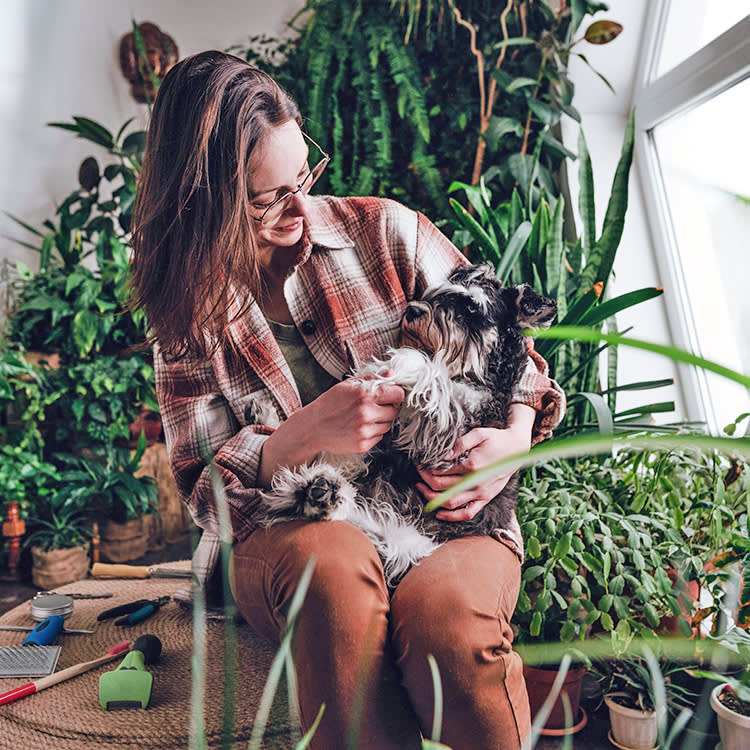
The headline answer is the easy part: spider plants are not toxic to dogs, and you can keep one without worrying it will poison your pup. The ASPCA backs that up plainly. So if all you needed was permission to own a spider plant, you have it, go enjoy those arching, ribbon-striped leaves.
But “is it toxic” turns out to be the less interesting question, because the answer is no and the story ends there. The question spider-plant owners actually live with is the one nobody answers: why does my dog keep going after this specific plant, gnawing and batting at it like it owes them money? That has a real answer, and understanding it is what actually solves the chewed-up-plant problem.
First, the safety, settled
Spider plants (Chlorophytum comosum) are popular for good reason. They are nearly impossible to kill, thriving in indirect light with minimal water, and native to South Africa they have evolved to be tough and forgiving. They also reproduce charmingly, sending out “spiderettes,” little dangling offshoots that root into whole new plants.
On safety, the verdict is clean. The American Society for the Prevention of Cruelty to Animals lists the spider plant as non-toxic to dogs, cats, and horses. There is no poisonous compound to fear and no antidote to keep on hand. The only caveat is the universal one: eating a large quantity of any plant can irritate a dog’s stomach and cause vomiting or loose stool, simply because dogs are not built to digest a pile of fibrous greenery. That is a stomachache, not a poisoning.
Now the part that explains the chewing
Here is what the standard “it’s non-toxic, the end” articles leave out. Pets, especially cats but plenty of dogs too, are not chewing the spider plant by random accident. The plant is genuinely attractive to them, for reasons worth knowing.
Spider plants are thought to contain mild compounds with a subtle stimulating, faintly mood-altering quality, sometimes compared to a very weak, plant-world echo of the effect catnip has on cats. It is not intoxication in any meaningful sense, and it is far gentler than the comparison makes it sound, but it appears to make the plant rewarding to nibble rather than merely available. For a dog, that can turn a houseplant into a habit.
The plant’s shape compounds the appeal. Those dangling spiderettes twitch and sway in any breeze, behaving exactly like small moving prey. To an animal wired to chase and pounce, a plant that wiggles is an invitation. Layer that on top of the ordinary instinct many dogs have to chew grass and greenery, sometimes to settle a stomach, sometimes just because, and you get a plant that is unusually good at getting itself eaten.
Owners come in frustrated that their dog keeps demolishing one specific plant, and they assume the dog is being defiant. Usually the dog just finds that plant rewarding. With spider plants I reassure people that it is not poisoning their pet, then I shift the conversation to management, because you cannot really argue a dog out of something they enjoy. You redirect it.
The risks that are actually worth your attention
Because toxicity is off the table, the real-world hazards are mechanical and behavioral, and they are easy to manage once you know to look for them.
- Choking and obstruction. The long, fibrous leaves are the genuine concern, not the chemistry. A small dog can choke on a length of leaf, and a dog who swallows a large tangle of plant material can, rarely, develop a gut blockage. Watch for repeated unproductive retching, a dog who cannot settle, or persistent vomiting after a big binge, and call your vet if you see them.
- The stomach upset of a big binge. A dog who eats a lot in one go may vomit or have diarrhea for a day. Usually self-limiting; worth a vet call if it drags on or your dog seems unwell.
- The plant losing the fight. Less about your dog and more about your plant, but a determined chewer will strip a spider plant bare. That matters here because the fix for your plant is the same as the fix for your dog’s nibbling habit.
How to actually stop it
Since the attraction is partly built into the plant, the winning move is environmental, not disciplinary. Spider plants are made for hanging baskets and high shelves, so put yours where the dangling plantlets are out of jumping and reaching range. That single change neutralizes most of the problem by removing the temptation rather than fighting it.
Then give the urge an approved outlet. A dog who chews plants often wants something to chew or forage; a sanctioned chew toy, a snuffle mat, or a bit of dog-safe greenery they are allowed to nibble redirects the behavior to something you both can live with. Scolding rarely works on a behavior the dog finds intrinsically rewarding; substitution does.
A quick safe-versus-toxic refresher
Spider plant is a great anchor for the broader habit every plant-owning dog parent should build: confirm before you bring it home. A few common houseplants on each side:
Reliably non-toxic to dogs: spider plant (Chlorophytum comosum), areca palm (Dypsis lutescens), parlor palm (Chamaedorea elegans), calathea, Boston fern (Nephrolepis exaltata), and bamboo.
Genuinely toxic, keep out of reach: sago palm (Cycas revoluta), a severe liver toxin that can be fatal; oleander (Nerium oleander); aloe vera; philodendron; pothos (Epipremnum aureum); peace lily (Spathiphyllum); and snake plant (Dracaena trifasciata).
These lists are starting points, not a complete catalog, so look up anything new before it joins the household.
The bottom line
A spider plant is one of the safest green things you can own around a dog. It is non-toxic, full stop. The reason it still ends up shredded is that pets find it genuinely appealing, thanks to mild rewarding compounds and prey-like plantlets that practically beg to be batted at. So skip the worry about poison and solve the real problem: hang the plant up high, redirect the chewing to something allowed, and keep an eye on the one true hazard, those long leaves, in small dogs. Do that, and you get to keep both your spider plant and your peace of mind.
References
- ASPCA. “Toxic and Non-Toxic Plants: Spider Plant (Chlorophytum comosum).” https://www.aspca.org/pet-care/animal-poison-control/toxic-and-non-toxic-plants/spider-plant
- Cortinovis, Cristina, and Francesca Caloni. “Epidemiology of Intoxication of Domestic Animals by Plants in Europe.” The Veterinary Journal, vol. 197, no. 2, 2013, pp. 163–168. https://doi.org/10.1016/j.tvjl.2013.03.007
- Bertero, Alessia, et al. “Plants and Zootoxins: Toxico-Epidemiological Investigation in Domestic Animals.” Toxicon, vol. 196, 2021, pp. 25–31. https://doi.org/10.1016/j.toxicon.2021.03.019
- ASPCA Animal Poison Control Center. https://www.aspca.org/pet-care/animal-poison-control
Common questions
Why does my dog keep eating the spider plant?
Because it is genuinely appealing to pets. The plant contains mild compounds thought to have a subtle stimulating or mood-altering effect, a little like a faint catnip, and its dangling plantlets twitch and sway like prey. Add the instinct many animals have to chew greenery, and a spider plant becomes a hard target to resist.
What happens if a dog eats a spider plant?
Usually very little. The most likely outcome is nothing, or mild, short-lived vomiting or diarrhea if your dog eats a lot of it. The more practical hazard is the long, fibrous leaves, which can be a choking risk for small dogs and, rarely, contribute to a gut blockage if a large tangle is swallowed.
How do I stop my dog from destroying my spider plant?
Move it out of reach, hanging baskets and tall shelves play to the plant's strengths, and give your dog an approved chewing or foraging outlet so the urge has somewhere to go. Because the attraction is partly behavioral, redirecting the behavior works better than scolding the dog away from a plant they find genuinely rewarding.
Not a substitute for your vet. Our guidance is educational. For urgent symptoms, contact a vet or emergency clinic right away. Editorial standards
Dr. Chen is a small-animal veterinarian who leads health and safety coverage at The Pet Times. She writes and reviews the bulk of our illness, condition, and safety content, translating clinical guidance into clear, practical advice owners can act on at home.
Meet our experts ↗Keep reading
 LivingThe Age of the Emotional Support Peacock Is Over. Here's What Replaced It.Dr. Priya Nair · 6 min
 Product PicksNo One Is Checking Your Dog's Toys. Here's the 60-Second Test That DoesTom Hadley · 8 min
 Health & WellnessThe Carrot in Your Dog's Bowl Was on a Recall List. Here's the Real LessonDr. Ravi Mehta · 5 min
 TrainingThe Cue That Beats Your Dog to the Chicken BoneDr. Nina Kohl · 8 min
 LivingTwo Years, Two Best in Show Winners, Two Sets of Cut-Off Ears. That's Not a Coincidence.Dr. Ravi Mehta · 11 min
 Health & WellnessA Coyote Killed Three Dogs at Crissy Field. It Wasn't Bad Luck.Dr. Amara Solis · 5 min