


The Cue That Beats Your Dog to the Chicken Bone
Most people train 'leave it' by yelling it at a dog who already has the thing. That's too late. The cue only works if you win the half-second before the grab, and there's a five-minute drill that buys you that half-second.

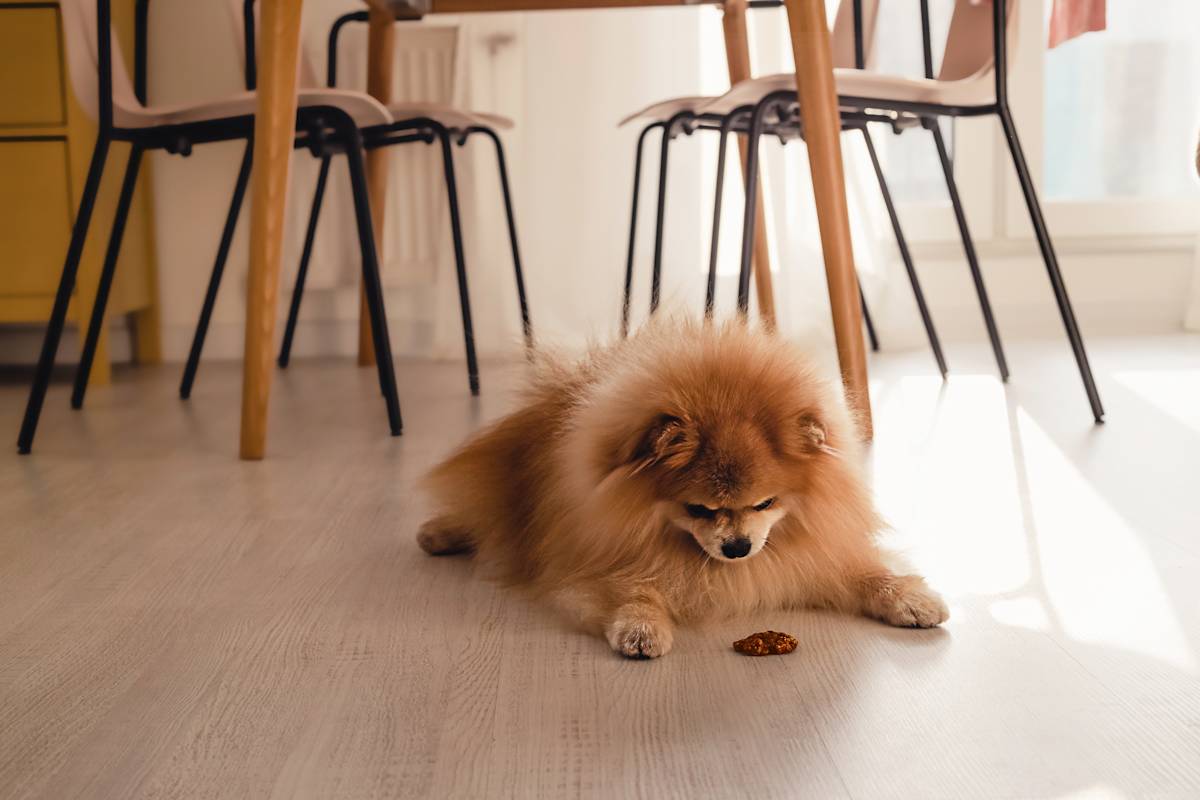
There is a specific half-second in every dangerous ingestion. Your dog’s head comes up, the ears tip forward, the body loads, and then they are moving toward something on the ground. That half-second is the entire game. Once the object is in their mouth, you are no longer training, you are negotiating, and you are negotiating from a terrible position with someone who can swallow.
Almost everyone gets “leave it” backwards. They shout it at a dog who has already committed, which teaches the dog that “leave it” is the sound a human makes right before a chase begins. A cue that only activates after the grab is not a safety cue at all. It is a starting pistol.
The real version of this cue lives in the half-second before. And it turns out you can buy that half-second with a drill that takes five minutes and one hand.
Why the ground is so much more interesting than you
To you, the chicken wing bone on the sidewalk is garbage. To your dog it is a hot, greasy, salt-crusted, marrow-scented artifact that fell from the sky. There is no version of this where they think it is gross. Scavenging is not a character flaw; it is a dog doing what dogs are extremely good at.
Which is why the stakes are real. The ASPCA Animal Poison Control Center helped more than 334,000 animals through toxic exposures in 2025, fielding calls about over 376,000 individual items pets got into. Over-the-counter medications and supplements were the single biggest category at 16.9 percent of exposures, with food and drink close behind at 16.4 percent, and chocolate at 13.6 percent. Recreational drugs, including cannabis edibles left within reach, made up almost 2 percent. The center also logged a 400 percent jump in kratom exposures in a single year.
Nearly all of that is stuff on a surface, at nose height, that a dog picked up. And that is before you count the things that do not poison a dog but instead lodge somewhere: corn cobs, peach pits, socks, skewers, rib bones. Those become surgery.
By the time a dog has something in their mouth, you have already lost most of your options. The cue that saves dogs is the one that lands while their head is still coming up. That is a completely different skill from prying something out, and people train the wrong one.
The deal your dog is actually being offered
Here is the reframe that makes everything else click.
“Leave it” is not obedience. It is a trade with terms your dog can verify. The terms are: give up the thing in front of you, and something better arrives from a different direction. Not the same thing back. Something better, from elsewhere.
That second clause is where most people quietly ruin the cue. They tell the dog to leave the treat, the dog complies, and then, out of kindness, they hand over the very treat the dog was told to leave. Congratulations, you have just taught your dog that “leave it” means wait a second and then take it. You have built a delay, not a stop.
So before the first rep, you need two tiers of food. Something ordinary that your dog will give up, and something excellent that arrives as payment. The gap between those two tiers is the whole lesson.
The five-minute hand drill
This is the foundational rep. It fits in a kitchen, it needs nothing but food, and it is the version to do a hundred times before you ever try it on a sidewalk.
Offer the boring treat, flat on an open palm. Say nothing at all. No cue word yet. Let your dog see it, smell it, and get interested.
Close your fist the moment they commit. Not roughly, not with a jerk, just shut. Your dog will now run their entire catalogue of strategies against your knuckles: nosing, licking, pawing, chewing, possibly a theatrical complaint. Every one of those has worked on a human at some point in their life. Ignore all of it. Do not repeat the cue, do not scold, do not look at them.
Pay the exact instant they quit. This is the rep. Watch for the moment they pull back, or turn the head, or simply pause. It can be tiny. Mark it, and deliver the excellent treat from your other hand. The boring treat in the closed fist stays there, permanently. It never gets earned.
Then hold the pause a little longer each session, so a half-second of restraint becomes two seconds, then five. When your dog is offering the turn-away on their own, before your fist even closes, you say the words: “leave it,” right as they look away. Now the word has been welded to a behavior your dog already knows how to produce, which is the only reliable way to attach a cue to anything.
Then get it on the floor, which is much harder, because the floor is where the real world keeps its garbage. Hover a hand above the treat, ready to cover. Cue, cover if you must, pay from the other hand.
Work slowly. Stay inside your dog’s emotional comfort zone. A frustrated dog is not learning, they are enduring, and the whole point is that this should be a good deal, not a hostage situation.
Where it usually falls apart, and what to do about it
The cue works in your kitchen and dies on the street. This is not disobedience. Nothing generalizes for dogs by default; a cue learned in the kitchen is genuinely a kitchen cue until you teach it elsewhere. Rebuild from step one in the yard, then the quiet sidewalk, then the busy one. Expect to lose a level of difficulty each time you change the room. That is normal, not backsliding.
Your dog only complies when they can see food. The treat has become part of the cue rather than the payment. Get the food off your body, into a pouch or a jar on the counter. Cue first, pay after. Then pay unpredictably, sometimes lavishly, sometimes with praise, so complying always carries the possibility of a jackpot.
You’ve been using one word for two different jobs. “Leave it” means never touch it. “Drop it” means open your mouth, it’s already in there. Those are different cues, needing different words, because the dog is in a completely different emotional state in each case. Blur them and you get a dog who hears the leave-it word, assumes a negotiation is starting, and clamps down.
You said it, then chased. The single most damaging pattern. Lunging at your dog turns a bone into a prize worth defending, and it can teach resource guarding in a handful of repetitions. If your dog already has something dangerous, do not go after it. Go get the good treats, make a loud cheerful noise, and buy it back.
When “leave it” isn’t enough
Some dogs eat everything, compulsively and fast. If your dog is swallowing rocks, fabric, or feces regularly, that is worth a vet visit rather than more drilling. Compulsive scavenging can track back to gastrointestinal disease, malabsorption, or anemia, and a dog with a medical driver will out-motivate any training plan you build.
And if your dog does swallow something: do not induce vomiting on your own, especially with anything sharp, caustic, or unknown. Call your vet or the ASPCA Animal Poison Control Center at (888) 426-4435 and let them decide. Bringing up a corn cob can do more damage on the way out than it did going down.
What newer research adds
The way this cue is taught has quietly shifted. Trainers used to include a correction step, a leash pop or a scolding, on the theory that the dog needed to learn that the object was forbidden. The current evidence has moved decisively away from that. Studies comparing aversive-based and reward-based training have repeatedly found more stress-related behavior and no gain in obedience from the punishment-based approach, and the American Veterinary Society of Animal Behavior’s position statement now recommends reward-based methods as the standard of care.
For a safety cue, this matters more than it does for a party trick. A dog trained with corrections learns that the object plus your approach predicts something unpleasant. That is exactly the dog who will grab and bolt when it counts, because your arrival has become part of the threat. A dog trained on trades learns that your approach predicts chicken. That dog looks up at you, which is the entire behavior you were trying to buy.
References
- ASPCA Animal Poison Control Center. “The Top 10 Toxins of 2025.” American Society for the Prevention of Cruelty to Animals. https://www.aspca.org/news/top-10-toxins-2025
- ASPCA. “Animal Poison Control.” https://www.aspca.org/pet-care/animal-poison-control
- American Veterinary Society of Animal Behavior. “Position Statement on Humane Dog Training.” https://avsab.org/wp-content/uploads/2021/08/AVSAB-Humane-Dog-Training-Position-Statement-2021.pdf
- Vieira de Castro, A. C., et al. “Does training method matter? Evidence for the negative impact of aversive-based methods on companion dog welfare.” PLOS ONE, 2020. https://journals.plos.org/plosone/article?id=10.1371/journal.pone.0225023
Common questions
What if my dog just barks or paws at my closed hand?
Ignore all of it and keep the hand shut. Barking, pawing, licking, and nudging are your dog running through their catalog of things that have worked before. The instant they stop and back off even slightly, pay them from the other hand. You are not punishing the pushing, you are only ever paying the giving-up.
Is 'leave it' the same as 'drop it'?
No, and confusing them is why people fail. 'Leave it' means never make contact. 'Drop it' means open your mouth, the thing is already in there. They need separate cue words and separate training, because the dog's emotional state in each moment is completely different.
My dog only listens when I'm holding treats. Now what?
That means the treat has become part of the cue instead of the payment. Move the food off your body, into a pouch, a jar on the counter, or your pocket, and pay after the dog complies rather than waving the reward first. Start rewarding on a random schedule, so a correct response might pay big, small, or in praise.
Dr. Kohl is a board-certified veterinary dentist with a particular interest in preventive oral care. She reviews all dental health content at The Pet Times and contributes practical guides on home dental routines, professional cleaning, and oral disease prevention.
Meet our experts ↗Keep reading
 TrainingBefore You Cut a Hole in Your House, Answer This: What Else Can Fit Through It?Marcus Webb · 8 min
 TrainingYour Dog Doesn't Need a Muzzle. Train Them for One Anyway.Dr. Mara Chen · 7 min
 LivingThe Kayak Isn't What Hurts Dogs. The Water Is.Dr. Ravi Mehta · 8 min
 TrainingThe Viral 'Run Away From Your Dog' Trick Works. You Get to Use It Once.Dr. Mara Chen · 7 min
 TrainingThat Bootie Wobble Isn't Funny. You Just Blindfolded Their Feet.Dr. Nina Kohl · 8 min
 Training'Drop It' Is the One Cue That Might Save Your Dog's LifeDr. Nina Kohl · 8 min