


A Coyote Killed Three Dogs at Crissy Field. It Wasn't Bad Luck.
Three dogs died at San Francisco's most beloved off-leash beach in a matter of weeks. The pattern behind it, and the leash habit that would have prevented most of it.

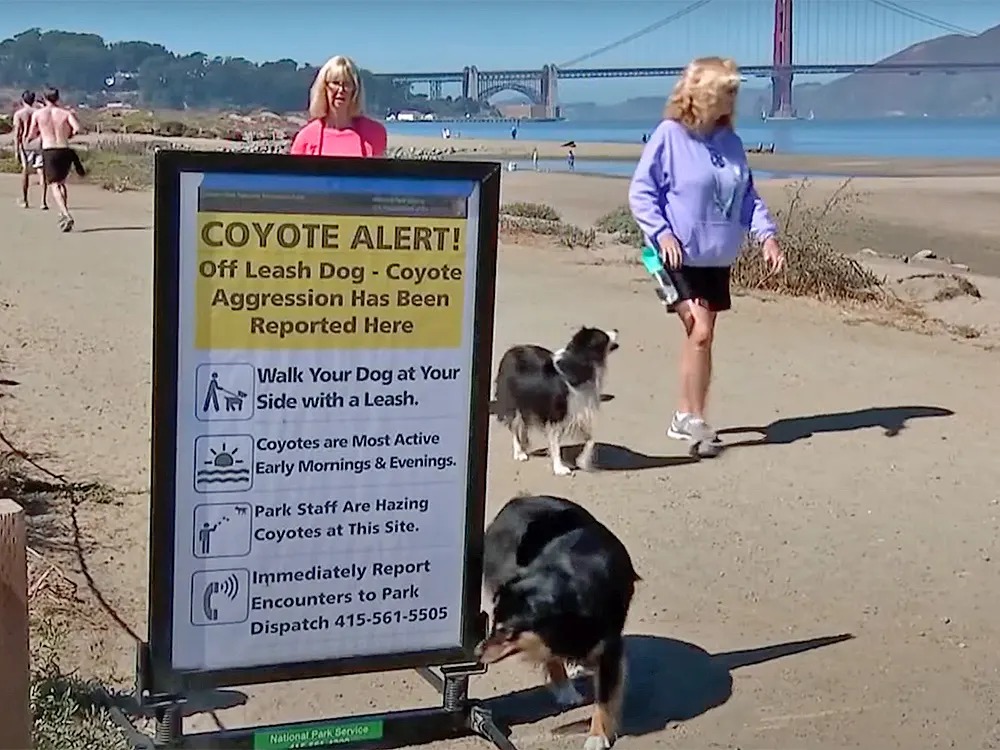
Crissy Field is supposed to be the good part of owning a dog in San Francisco. There is a dog fountain, a rinse station, a long flat run of sand, and the Golden Gate Bridge hanging over all of it. For a stretch of weeks in the fall of 2024, it was also where three dogs were killed by a coyote, and the reason that happened is more instructive, and more preventable, than “wild animals are dangerous.”
The thesis worth holding onto is this: these deaths were not a run of terrible luck. They were the predictable behavior of a coyote that had stopped being afraid of people, and the dogs most at risk were the ones out ahead of their humans, off leash. Understand why, and you can keep your own dog out of the small category that ends up on a warning sign.
What actually happened
Between mid-September and early October 2024, three dogs died after coyote encounters at Crissy Field and the neighboring Presidio. At least one owner said she was nearly attacked herself while shielding her dog. The Golden Gate National Recreation Area posted alerts around the area and warned people to leash up, and staff began actively hazing coyotes to push them back from the beach.
Here is the detail that changes how you should read the story. DNA testing tied the fatal attacks to a single animal. This was not a pack turning on pets or a sudden population explosion. It was one coyote that had learned dogs were catchable prey and people were nothing to fear. In October 2024, federal officials located and killed that specific coyote, and the cluster of attacks stopped.
Why one coyote got that bold
Coyotes are supposed to want nothing to do with us. When that instinct erodes, there is almost always a reason, and it usually rhymes with a person.
A coyote that strolls up to a beach full of people has been taught, over many small encounters, that humans mean food and not danger. Every dropped sandwich, every ‘aw, look, I’ll toss it a bit of my lunch,’ chips away at the wariness that normally keeps them at a distance. By the time it is picking off dogs, the damage was done months earlier.
Local advocates described exactly that pattern at Crissy Field, saying the coyotes had grown “really, really bold” and too comfortable around people who had been feeding them. Beaches that should have been neutral ground had effectively become hunting grounds. A fed coyote is not a friendly coyote. It is a coyote that has lost the one behavior, keeping its distance, that made coexistence possible.
The off-leash math
Rangers were blunt about the fix, and the biology backs them. “It’s very important for dogs to be kept close by,” a GGNRA spokesperson said. “While coyotes may be reluctant to approach people, they have no reservations about approaching dogs that are on their own.”
That is the whole game. A dog forty yards down the beach, nose down, is a solitary target the size of the prey coyotes already hunt. The same dog on a leash beside you is standing inside a human’s personal space, and the coyote’s remaining caution usually holds. Off-leash freedom is one of the real joys of a place like Crissy Field, but during an active advisory it is also the variable most under your control.
The 30 seconds that matter: how to handle an encounter
If a coyote does approach, your job is to instantly become the least appealing thing on the beach. This is called hazing, and it works because it re-teaches the fear that got eroded.
Make yourself big. Wave your arms overhead, open your jacket wide, stand tall. Make yourself loud. Shout, stomp, shake a set of keys or a soda can loaded with rocks. If you have a small dog, scoop them up so they are not a low, grabbable target. Then back away slowly while keeping your eyes on the animal. Do not turn your back and do not run, which can flip a hesitant coyote into a chasing one. As one urban-coyote researcher put it, if the hazing is not working, the move is simple: pick up your dog and walk away.
Coyotes are most active around dawn and dusk, so tighten your vigilance in those windows. And carry your phone: Crissy Field encounters can be reported to the GGNRA at 415-561-5505, which is how officials build the picture that eventually identified a single problem animal.
What newer developments add
The resolution of the Crissy Field case is itself the update, and it is a hopeful one. Because officials could confirm through DNA that a single, uniquely bold coyote was responsible, they were able to remove that one animal rather than the entire local population, and the attacks ended. It is a reminder that these events are usually driven by specific, habituated individuals, not by coyotes as a species suddenly turning on dogs.
The broader lesson has only gotten louder as coyotes settle deeper into cities from San Francisco to Chicago. Coexistence holds as long as coyotes stay afraid of us, and the fastest way to break it is to feed them, on purpose or by leaving food and trash out. Keeping wildlife wild is not just good for the coyotes. On a beach like Crissy Field, it is what keeps your dog off the warning sign.
References
Common questions
When are coyotes most active?
Early mornings and evenings are the highest-risk windows, though bold, food-habituated coyotes will approach at any hour. Be most alert around dawn and dusk.
Does keeping my dog leashed really help?
Yes. Coyotes are usually reluctant to approach a person, but they will readily target a dog that has wandered away on its own. A leash keeps your dog inside your protective bubble, which is the single most effective thing you can do.
Not a substitute for your vet. Our guidance is educational. For urgent symptoms, contact a vet or emergency clinic right away. Editorial standards
Dr. Solis is a board-certified veterinary dermatologist with over twelve years of clinical experience. She advises on skin conditions, allergies, and grooming practices that affect coat and skin health. All dermatology and allergy content at The Pet Times is reviewed by her team before publication.
Meet our experts ↗Keep reading
 Health & WellnessSomeone Threw Poisoned Bread Into Yards. The Dogs Found It First.Dr. Priya Nair · 5 min
 Health & WellnessThe Summer Weed That Burrows Into Your Dog and Doesn't StopDr. Ravi Mehta · 8 min
 TrainingThe Cue That Beats Your Dog to the Chicken BoneDr. Nina Kohl · 8 min
 Health & WellnessA Man Shot a Dog for Running at Him. He Was Never Charged.Marcus Webb · 8 min
 Health & WellnessThe 'Beards Are Dirtier Than Dogs' Study Says No Such ThingDr. Priya Nair · 6 min
 FoodThe Potato Is Innocent. It's the Garnish That Hurts Your DogDr. Mara Chen · 6 min