


The Carrot in Your Dog's Bowl Was on a Recall List. Here's the Real Lesson
A deadly E. coli outbreak turned a wholesome dog snack into a hazard. What the Grimmway carrot recall taught pet parents about shared human foods, and why dogs cut both ways on E. coli.

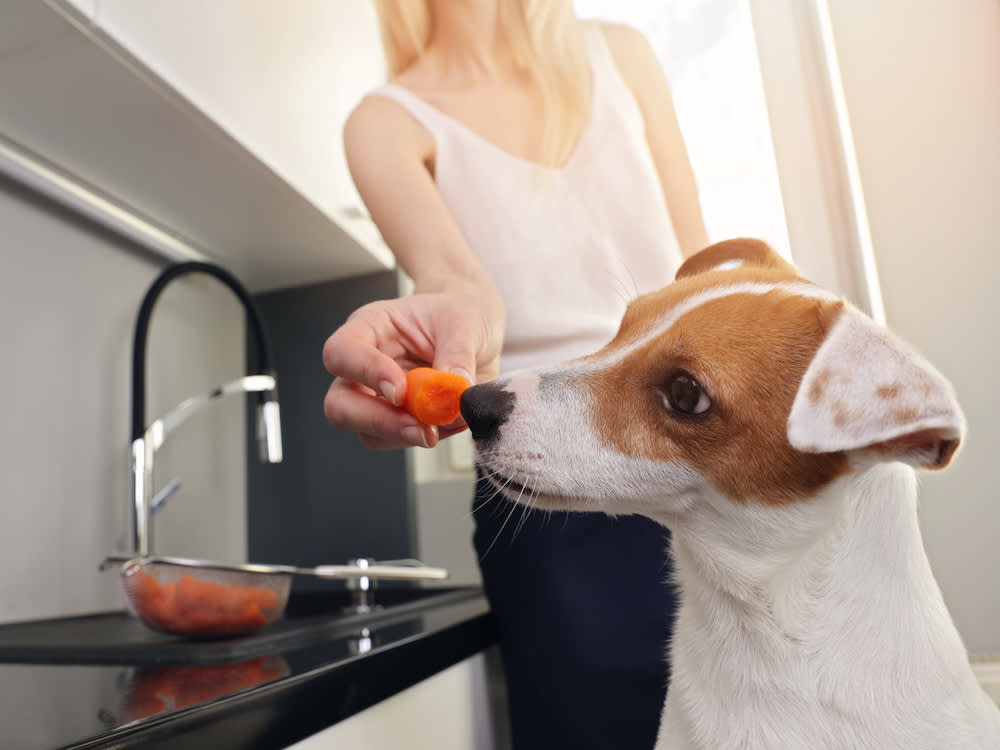
If you keep a bag of baby carrots in the fridge as a guilt-free training treat, this one hit close to the bowl. In November 2024, a carrot, the single most wholesome thing most of us hand a dog, landed at the center of a deadly nationwide E. coli outbreak. That collision is worth sitting with, because it captures a blind spot most pet parents share: we treat “human food that’s good for dogs” as automatically safe, and a recall is the moment that assumption breaks.
Here is the more useful way to read this recall. It is not really a carrot story. It is a reminder that anything you share off your own plate carries your food supply’s risks straight into your dog’s body, and that with a pathogen like this one, your dog is not just a victim, they are also a way it spreads to you.
First, the fast answer: check your fridge, then check your dog
Grimmway Farms, a large California grower that packs carrots under a long list of store brands, recalled its organic whole and baby carrots after they tested positive for E. coli. The affected product is off shelves, but the recall specifically targeted carrots that may still be sitting in people’s homes. So the first move is a pantry check.
Two categories were pulled:
- Organic whole carrots bought at retail between August 14 and October 23, 2024.
- Organic baby carrots with best-if-used-by dates from September 11 through November 12, 2024.
The whole carrots were sold under these labels: 365, Bunny Luv, Cal-Organic, Compliments, Full Circle, Good & Gather, GreenWise, Marketside, Nature’s Promise, O-Organics, President’s Choice, Simple Truth, Trader Joe’s, Wegmans, and Wholesome Pantry.
The baby carrots were sold under: 365, Bunny Luv, Cal-Organic, Compliments, Full Circle, Good & Gather, GreenWise, Grimmway Farms, Marketside, Nature’s Promise, O-Organics, President’s Choice, Raley’s, Simple Truth, Sprouts, Trader Joe’s, Wegmans, and Wholesome Pantry. On November 21, the recall expanded to cover additional bag sizes of the organic whole carrots, so err toward tossing anything close.
The FDA’s instruction was blunt: anyone with the affected products at home should not eat or use them, should toss them out, and should scrub and disinfect any surface they came into contact with. That guidance covers the dog bowl too. If you fed any recalled carrots to your dog in the days before the recall, move to the next section and start watching.
What this strain of E. coli actually does to a dog
Not all E. coli is dangerous. Dogs carry harmless strains in their gut all the time. The strain in this outbreak, Shiga toxin-producing E. coli O121:H19, is a different animal, and it is the reason people were hospitalized.
In dogs, an infection with a toxin-producing strain looks like a bad, stubborn gastrointestinal illness: watery or bloody diarrhea, vomiting, a dog who won’t eat, lethargy, and dehydration, sometimes with fever or gums that look pale or faintly bluish. The timing is the part worth memorizing.
The window people get wrong is the delay. Signs usually don’t show for one to three days after exposure, so a dog can seem completely fine the evening you shared the snack and be genuinely sick two mornings later. In a puppy, a senior, or a dog with a weak immune system, that gap is exactly when a treatable gut infection can slide into sepsis. Don’t wait it out.
That sepsis risk in puppies is not a scare line. A young dog’s system can be overwhelmed quickly, and the same Shiga toxin that causes hemolytic uremic syndrome and kidney injury in vulnerable people can drive serious systemic illness in a small dog. Treatment, when it is needed, usually means IV fluids to rehydrate and correct electrolytes plus targeted antibiotics such as ceftiofur or cephalexin, and hospitalization is common for puppies. That is a vet’s call, not a home remedy, which is the whole point of catching it early.
The part the recall notices leave out: dogs cut both ways
Here is the net-new piece, and the reason this belongs in your safety file rather than your recipe file. With a pathogen like Shiga toxin-producing E. coli, your dog is not only at risk of getting sick. A dog that ingests the bacteria can shed it in their stool, which makes contact with an infected dog or their feces a documented risk factor for people picking up the infection. In a household, that turns one contaminated snack into a small chain: the food, the dog, and then the humans cleaning up after the dog.
Practically, that means during any outbreak of a foodborne pathogen, the safe move is not just tossing the food. It is washing your hands after handling your dog’s waste, cleaning the bowl and feeding area, and being a little more careful than usual with kids and anyone immunocompromised in the home until you’re sure the dog is well. The recall told you to sanitize the counter. Extend that instinct to the leash-and-poop-bag end of the house too.
The rule this leaves you with
Carrots are still a great dog snack. Plain, washed, cut to a safe size, they are low in calories and easy to love. The lesson here is not “fear the carrot.” It is that “healthy for dogs” and “safe right now” are two different claims. A food can be nutritionally perfect and still be recalled tomorrow, and the fastest way to know is to treat pet-food and human-food recalls as the same alert. When a fruit or vegetable you share gets pulled, pull it from the dog’s menu too, watch your dog for the three-to-four-day window, and mind the two-way spread. That habit costs you nothing and is the actual protection this outbreak was trying to teach.
References
- U.S. Food and Drug Administration. “Outbreak Investigation of E. coli O121:H19: Organic Carrots (November 2024).”
- U.S. Food and Drug Administration. “Grimmway Farms Recalls Organic Whole and Select Organic Baby Carrots Due to Potential E. coli Contamination.” November 16, 2024.
- Centers for Disease Control and Prevention. “Investigation Update: E. coli Outbreak Linked to Organic Carrots, November 2024.”
- PetMD. “E. coli Infection in Dogs.”
- Texas A&M College of Veterinary Medicine & Biomedical Sciences. “Keep Your Family Safe From Dangerous E. coli.”
Common questions
What are the symptoms of E. coli in dogs?
Watery or bloody diarrhea, vomiting, loss of appetite, lethargy, dehydration, and sometimes fever or pale-to-bluish gums. Signs usually show up within 24 to 72 hours of exposure. Puppies, senior dogs, and immunocompromised dogs can go downhill fast, so do not wait to call the clinic.
Are carrots still safe to give my dog?
Carrots themselves are a healthy, low-calorie snack. The 2024 recall was about specific contaminated organic lots, not carrots as a food. Once recalled product is out of your home, plain washed carrots are fine again in moderation.
Not a substitute for your vet. Our guidance is educational. For urgent symptoms, contact a vet or emergency clinic right away. Editorial standards
Dr. Mehta is a board-certified veterinary nutritionist who evaluates pet food formulations, ingredient quality, and the science behind dietary trends. He writes and reviews all nutrition content at The Pet Times, including our food rankings and feeding guides.
Meet our experts ↗Keep reading
 Health & WellnessThe Sweetener That Kills Dogs Often Isn't Labeled "Xylitol"Dr. Ravi Mehta · 8 min
 Health & WellnessWhite Chocolate Skips the Poison. It Keeps the Trap.Dr. Mara Chen · 6 min
 FoodSkittles Aren't the Candy That'll Send Your Dog to the ERDr. Lena Park · 6 min
 Health & WellnessThe Onion Danger to Your Dog Is the Wait, Not the BiteDr. Mara Chen · 6 min
 FoodYour Meatloaf Could Hospitalize Your Dog. This One Won't.Dr. Lena Park · 7 min
 FoodTo Your Dog, Spicy Food Isn't a Flavor. It's a Burn AlarmDr. Priya Nair · 9 min