


The Onion Danger to Your Dog Is the Wait, Not the Bite
Onions are toxic to dogs in every form, but the real trap is the delay: a dog can seem fine for days before the damage shows. Here is the dose math, the timeline, and what to do.

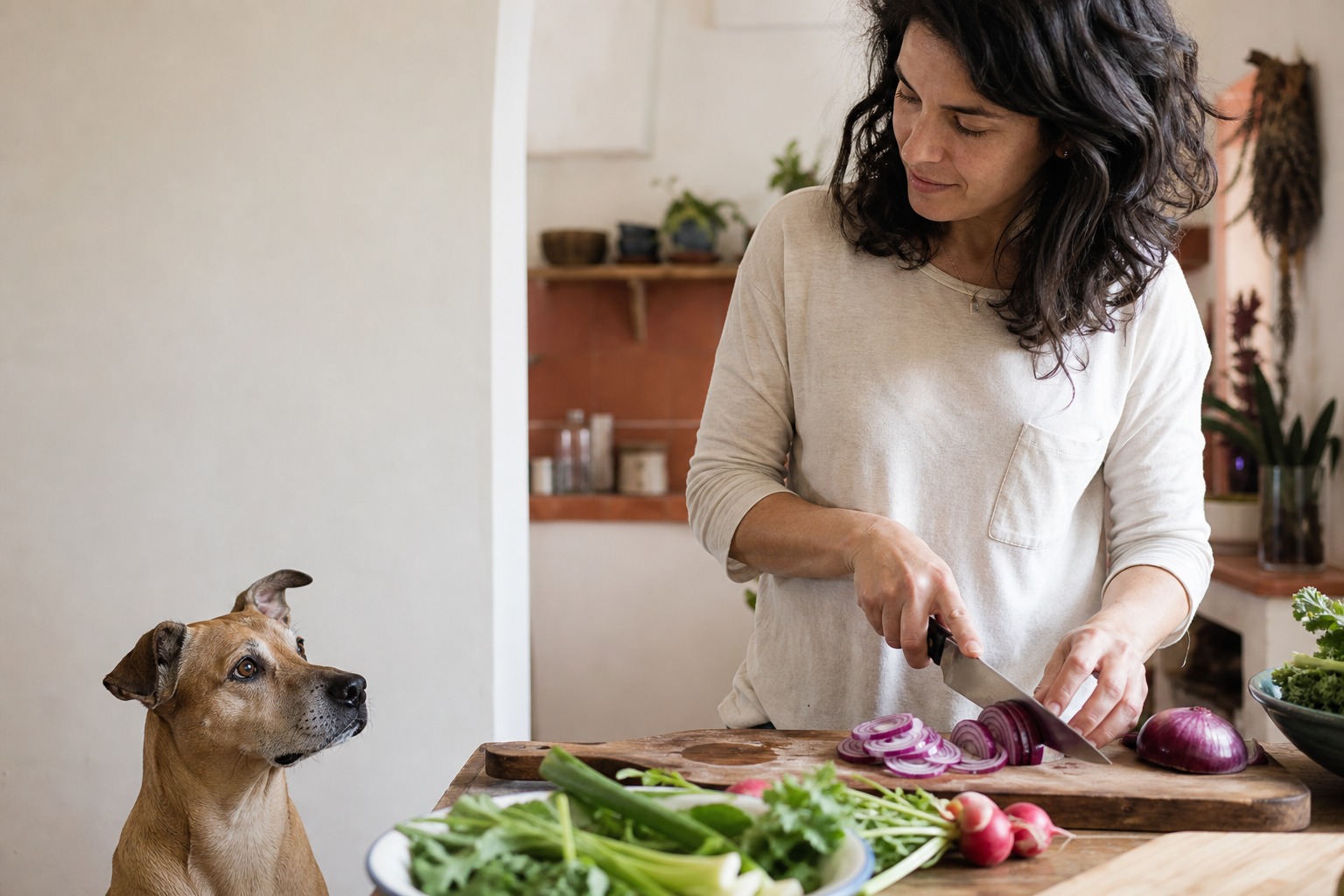
Here is the single most useful fact about onions and dogs, the one that changes how you react: a dog who eats onion can look perfectly normal for days before the poisoning shows up. Owners take that early calm as good news. It is the opposite. The onion has already started damaging red blood cells, and the visible collapse, pale gums, weakness, labored breathing, is simply running on a delay.
So the mistake is almost never “I fed my dog an onion on purpose.” It is “my dog seemed fine, so I waited.” This article is built around that delay, because understanding it is what gets a dog to the vet in time.
The timeline is the whole story
Onion toxicity does not hit like chocolate or xylitol, where trouble comes fast. It unfolds in two waves.
In the first day, you might see digestive signs, vomiting, diarrhea, a dog going off their food, as the compounds irritate the gut. Or you might see nothing at all. This is where the false reassurance lives.
Then, over roughly three to five days, the real event arrives. The toxin oxidizes the dog’s red blood cells, forcing tiny clumps called Heinz bodies to form. The body destroys those damaged cells, and the dog slides into hemolytic anemia, too few red blood cells to carry oxygen. That is when the frightening signs show up: pale or whitish gums, deep lethargy, fast or heavy breathing, a yellow tint to the eyes or belly, and dark, brownish urine.
The line I repeat to every client is that a dog acting fine the night they ate onion tells you nothing. The blood-cell damage is a slow burn. I would rather see a dog on day one and have it be minor than have someone wait until day four, when the dog is pale and weak and we are now managing a crisis instead of preventing one.
Because of this lag, “wait and see” is exactly the wrong instinct. Onion is a call-your-vet-today situation even when your dog is bouncing around like normal.
The dose math, in real kitchen terms
The other reason onion is deceptively dangerous is that the toxic amount is smaller than people assume. Research puts meaningful signs at around 15 to 30 grams of onion per kilogram of a dog’s body weight, with sensitive dogs affected by as little as 5 grams per kilogram.
Translate that. A medium onion weighs roughly 150 grams. For a 10-kilogram (22-pound) dog, the lower risk threshold works out to well under a whole onion, on the order of a heaping tablespoon or two of chopped onion. For a small dog, a stray meatball bound with onion, a few bites of onion-heavy leftovers, or a lick of French onion dip can get into the danger zone. This is not a “they’d have to eat a bowlful” toxin.
Two multipliers make it worse:
- Concentration. Onion powder and dehydrated onion are dramatically more potent by weight than the fresh bulb, because the water is gone and the toxin is packed tighter. A teaspoon of onion powder in a rub or a gravy is not a trivial amount.
- Garlic. People assume garlic is the “gentle” allium. It is actually about five times more toxic than onion gram for gram. The same warning covers leeks, shallots, chives, scallions, and ramps, the entire Allium genus.
Why dogs and not us
You eat onions constantly with zero harm, so what is different about a dog? The toxin, a group of sulfur compounds often summarized as N-propyl disulfide, attacks the machinery that keeps red blood cells intact. Human red blood cells shrug it off. Canine red blood cells are unusually vulnerable to this kind of oxidative hit, which is why a seasoning that is a health food for you is a blood toxin for them. There is no dog-safe onion, no safe cooking method, and no proven safe dose. It is a hard line, not a moderation question.
Where the exposure actually comes from
Almost nobody hands a dog a raw onion. The real risk hides in prepared food, which is why the durable habit here is reading ingredients before you share anything off your plate. The usual culprits:
- Seasoning blends, bouillon, and gravy mixes (onion and garlic powder are near-universal)
- Soups, stews, and stir-fries
- Pizza, burgers, and meatballs bound with onion
- Baby food and jarred sauces
- Restaurant leftovers and takeout containers a counter-surfing dog can reach
If your dog raids a takeout bag or a seasoned roast, treat it as an exposure, not a maybe.
What to do if your dog gets into onion
Move quickly, even with a normal-acting dog:
- Estimate what and how much. Fresh onion, cooked dish, or powder, and roughly how much, plus your dog’s weight. This is what a vet uses to gauge risk.
- Call now, do not wait for symptoms. Reach your vet or a poison hotline the same hour. Given the delayed timeline, early is the entire advantage.
- Do not induce vomiting on your own unless a professional tells you to. Timing and technique matter, and the wrong move can cause its own harm.
- Expect monitoring, not a one-and-done visit. Because anemia can surface days later, your vet may want bloodwork over several days to catch a dropping red-cell count before it becomes an emergency.
The safe way to share
Onion is a good reminder to keep shared foods plain and short on ingredients, since allium hides almost everywhere. Plenty of foods give your dog a real treat without the risk:
- Butternut squash, plain and cooked
- Carrots, raw or cooked
- Plain scrambled or boiled egg
- Green beans or a few blueberries
And the firm no-list beyond onion and its cousins: grapes and raisins, chocolate and coffee, and large amounts of cheese. Keep treats and table scraps to a minor share of the day so the bulk of your dog’s calories come from a complete, balanced dog food.
The bottom line
Onions are toxic to dogs in every form, cooked, raw, dried, or powdered, and garlic is worse. But the fact that saves dogs is not “onions are bad,” which most owners already know. It is that the damage runs on a three-to-five-day delay, so a calm, normal-seeming dog is not a safe dog. If your dog eats onion or anything made with it, call your vet or a poison hotline that day, and be ready for a few days of watching rather than a single check.
References
- Kovalkovičová, N., et al. “Some Food Toxic for Pets.” Interdisciplinary Toxicology. https://www.ncbi.nlm.nih.gov/pmc/articles/PMC3546605/
- Salgado, B. S., et al. “Allium species poisoning in dogs and cats.” Journal of Venomous Animals and Toxins including Tropical Diseases. https://www.ncbi.nlm.nih.gov/pmc/articles/PMC5598110/
- Merck Veterinary Manual. “Garlic and Onion (Allium spp) Toxicosis in Animals.” https://www.merckvetmanual.com/toxicology/food-hazards/garlic-and-onion-allium-spp-toxicosis-in-animals
- Pet Poison Helpline. “Onions.” https://www.petpoisonhelpline.com/poison/onions/
Common questions
My dog ate onion but seems totally fine. Are we in the clear?
Not necessarily, and this is the most important thing to understand about onion. The red-blood-cell damage builds over days. Digestive upset can show in the first day, but anemia often does not appear until three to five days later. A normal-looking dog the evening of is not proof of safety. Call your vet or a poison hotline the moment you know.
Can dogs have onion powder or cooked onion?
No. Cooking does not deactivate the toxin, and chopping can release more of it. Onion powder and dehydrated flakes are the most dangerous form because the toxin is concentrated, so a small sprinkle in a seasoning blend or gravy can matter.
Is garlic safer than onion?
No, it is worse per gram. Garlic is roughly five times more toxic than onion by weight because it carries more of the same red-blood-cell-damaging compounds. The whole allium family, garlic, leeks, shallots, chives, scallions, and ramps, is off limits.
Not a substitute for your vet. Our guidance is educational. For urgent symptoms, contact a vet or emergency clinic right away. Editorial standards
Dr. Chen is a small-animal veterinarian who leads health and safety coverage at The Pet Times. She writes and reviews the bulk of our illness, condition, and safety content, translating clinical guidance into clear, practical advice owners can act on at home.
Meet our experts ↗Keep reading
 FoodOne Slim Jim Has as Much Saturated Fat as a Whole Serving of FriesDr. Priya Nair · 6 min
 FoodThe Danger Isn't Exotic. It's on Your Counter Right NowDr. Lena Park · 10 min
 Food"Dogs Are Basically Wolves" Is How Raw Chicken Gets Fed. Here's the Catch.Dr. Lena Park · 7 min
 FoodSkittles Aren't the Candy That'll Send Your Dog to the ERDr. Lena Park · 6 min
 FoodThe Christmas Food That Sends Dogs to the ER Isn't Chocolate. It's the Gravy.Dr. Priya Nair · 8 min
 Health & WellnessThe Carrot in Your Dog's Bowl Was on a Recall List. Here's the Real LessonDr. Ravi Mehta · 5 min