


Secure, Anxious, or Avoidant? How to Read Your Cat's Cuddle Chemistry
A study measured oxytocin in 30 cats and found the love-hormone payoff depends entirely on attachment style. Here's how to tell which of the three your cat is, and what each one needs from you.
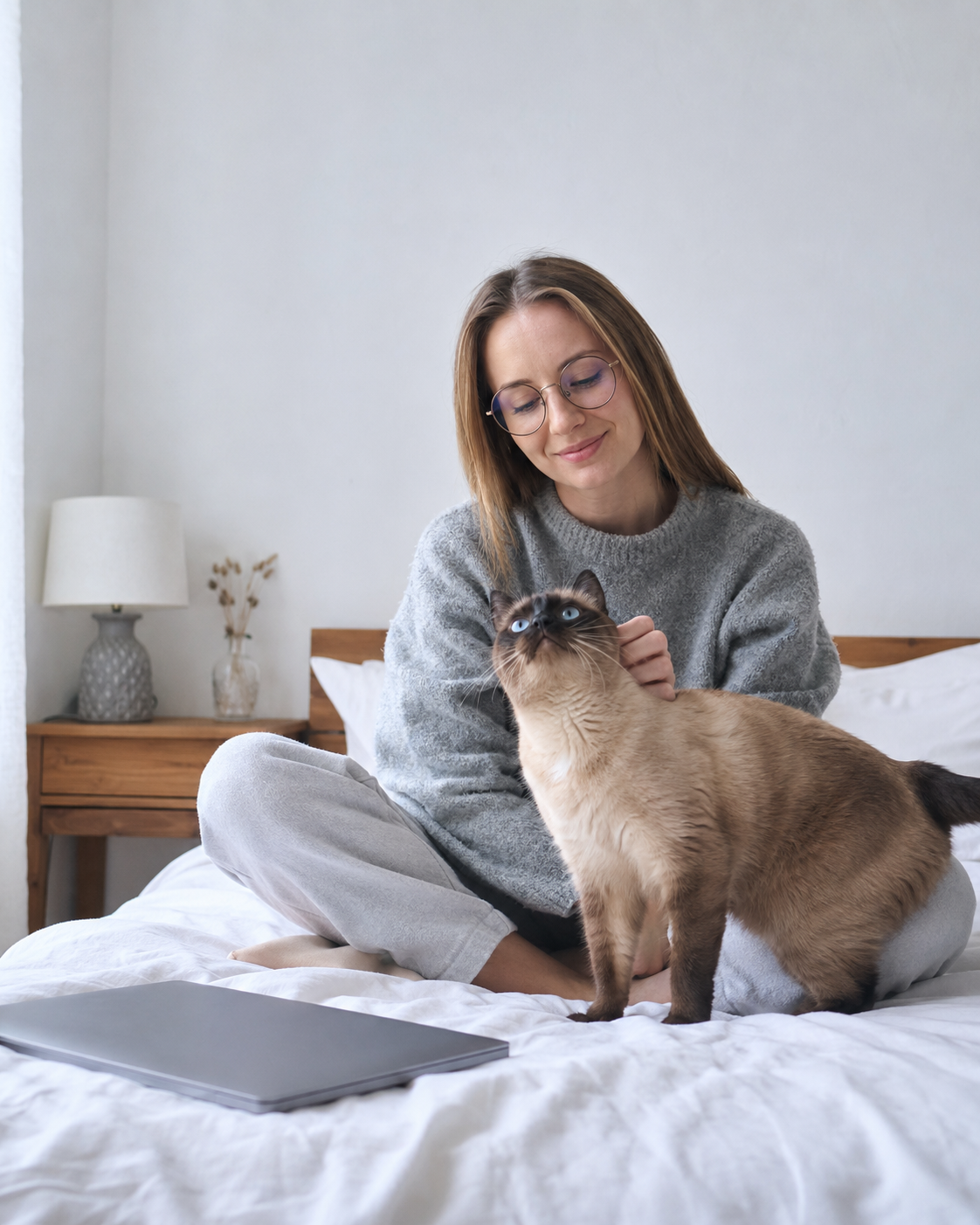
The dog people got their answer years ago: oxytocin, the bonding hormone, surges in both dogs and humans when they spend time together. Cat owners have wanted the same tidy confirmation. A study in Applied Animal Behaviour Science finally delivered it, but with an asterisk so useful it is really the whole point. Cats do get an oxytocin boost from their people. Which cats, and under what conditions, depends entirely on the cat’s attachment style. That turns a feel-good science headline into something you can actually use, because it means the same lap that soothes one cat stresses another, and you can learn to tell which is which.
The experiment, briefly
Researchers recruited 30 cats through social media, all at least a year old and living with their owners for four months or more. First they sorted the cats by attachment style using a secure base test adapted from human research: two minutes with the owner in a room, two minutes alone after the owner left, two minutes after the owner returned. How each cat handled the separation and reunion placed it into one of three groups, secure, anxious, or avoidant, which split almost evenly, about a third each. Then the team watched each cat and owner interact at home for fifteen minutes and measured oxytocin from saliva taken before and after.
The three types, and how to spot yours at home
The real value here is diagnostic. You do not have a lab, but you have a couch and a hundred daily interactions, and the behavioral fingerprints are clear enough to read. Here is what each style looked like and how it shows up in ordinary life.
The secure cat: seeks contact, and leaves calmly when done. In the study these cats initiated more interactions and tried to escape them less. At home, a secure cat approaches on its own, settles, and when it has had enough it simply gets up and walks off without drama. The tell is the ease of both the arrival and the departure. Their oxytocin started low and rose after interacting, the classic bonding payoff.
The anxious cat: clings, then panics when actually held. These cats constantly wanted to be near their person but became overwhelmed the moment that person tried to hold them. If your cat trails you room to room, cries for attention, then squirms, flattens, or bolts when you pick it up, that push-pull is the signature. Crucially, their oxytocin ran high at baseline and dropped after a forced interaction. The clinginess is not a request to be grabbed. It is a request for proximity without capture.
The avoidant cat: keeps its distance from the start. These cats mostly stayed away, and their oxytocin showed no meaningful change either way. An avoidant cat is not broken or unloving; it regulates through space.
The anxious cat is the one people misread most. They see a cat that follows them everywhere and assume it wants to be scooped up and held. Then the cat freaks out and the owner feels rejected. It’s not a mixed signal. The cat wants you close and wants to keep all four feet on the ground. Offer a lap, never a grab, and a so-called difficult cat often becomes an easy one.
What the chemistry proves that behavior alone couldn’t
The oxytocin data is what makes this more than a personality quiz. It shows that forced contact is not neutral, it is measurably stressful. The anxious cats’ hormone levels fell after handling they did not choose. That is a physiological receipt for something owners often override: when a cat endures affection rather than seeking it, the interaction is doing the opposite of bonding.
There is an honest wrinkle worth naming. Owners of secure cats also happened to force fewer interactions, so the arrow could point either way. Maybe secure cats would also resent a forced cuddle, or maybe some cats become anxious precisely because contact keeps getting pushed on them. Either reading lands on the same instruction: let the cat set the terms. It is also a small study, 30 cats, using a secure base test that is less validated for cats than for dogs, so hold the categories as a practical lens rather than a fixed diagnosis.
Turning the type into a plan
Once you know your cat’s style, the response is straightforward.
For a secure cat, more is more. The study found that the longer a secure cat spent with its person, the bigger the oxytocin release. If you have a cuddler, that time is genuinely building the bond, so take it.
For an anxious cat, change the shape of contact, not the amount of love. Sit on the floor and let them come to you. Pet without restraining. Skip the pick-up-and-hold entirely, or keep it to a few seconds on their initiative. You are not withholding affection; you are removing the part that spikes their stress.
For an avoidant cat, respect the distance and let closeness be their idea. Parallel presence, being in the same room without demands, is often the whole relationship, and it is enough.
The two-way version
A nice symmetry has emerged in related work: when owners pet or cradle their cats in a relaxed, unforced way, the owner’s oxytocin tends to rise too, and the cat’s climbs alongside it, as long as the cat is choosing it. The bond is a genuine chemical handshake. It just has to be offered rather than imposed, which, once you can read your cat’s type, is easier to get right.
References
- Ito, Y., et al. “The effects of owner-cat interaction on oxytocin secretion in pet cats with different attachment styles.” Applied Animal Behaviour Science, 2025. https://www.sciencedirect.com/science/article/abs/pii/S016815912500022X
- Vitale, K.R., Behnke, A.C., Udell, M.A.R. “Attachment bonds between domestic cats and humans.” Current Biology, 2019. https://www.cell.com/current-biology/fulltext/S0960-9822(19)30086-3
- American Association of Feline Practitioners. “Feline Environmental Needs Guidelines.” https://catvets.com/guidelines/practice-guidelines/environmental-needs-guidelines
Dr. Solis is a board-certified veterinary dermatologist with over twelve years of clinical experience. She advises on skin conditions, allergies, and grooming practices that affect coat and skin health. All dermatology and allergy content at The Pet Times is reviewed by her team before publication.
Meet our experts ↗Keep reading
 TrainingYour Cat Doesn't Care About the Bathroom. They Care That You Finally Sat Down.Dr. Priya Nair · 8 min
 TrainingThe Paw on Your Mouth at 4 A.M.? You Trained That.Dr. Amara Solis · 6 min
 TrainingYour Cat Isn't Aloof, Waterproof, or Low-Maintenance: 8 Myths to RetireDr. Nina Kohl · 8 min
 TrainingThat 'Come Here' Cat Video Works. Your Own Voice Works Better.Dr. Lena Park · 7 min
 TrainingYour Cat Holds a Picture of You in Their Head, Even When You Leave the RoomDr. Mara Chen · 4 min
 TrainingYour Cat Screams at 3am Because You Never Let It Finish the HuntDr. Mara Chen · 8 min