


You're Not Breaking Up a Fight. You're Interrupting a Conversation.
Neck bites, body slams, snarling, pinning. Behavior researchers have watched hundreds of hours of it and almost never seen it turn into a real fight. Here's how to tell the difference, and the four times you should actually step in.

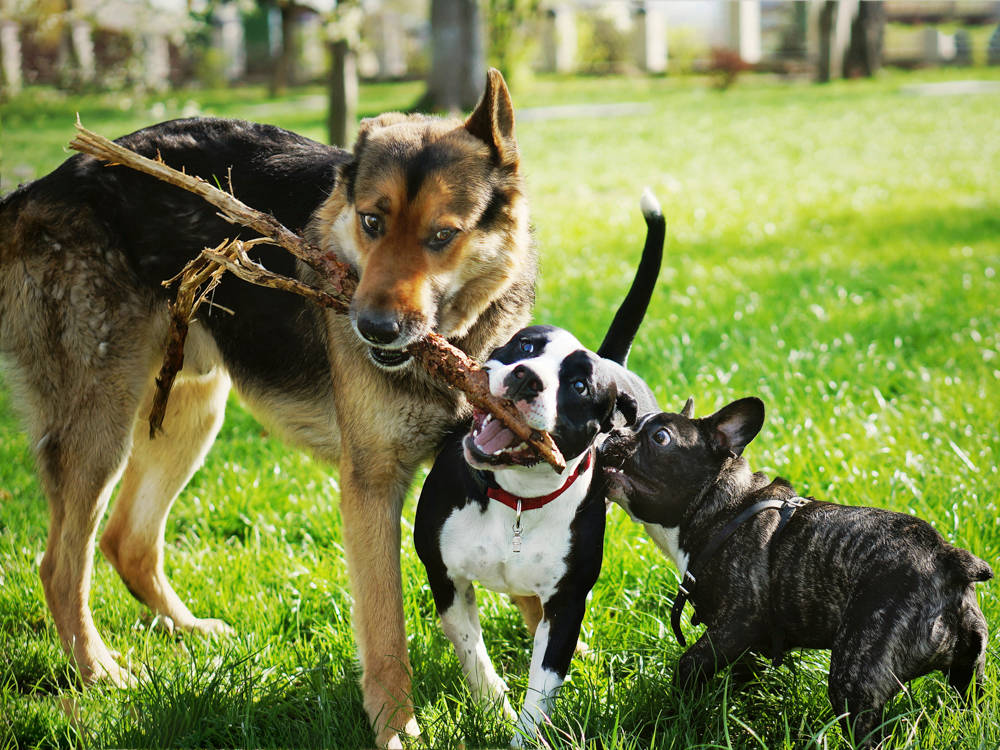
Two dogs are going at each other on the grass. One has the other pinned by the neck. There’s snarling. Teeth are visible. Somebody’s owner is already jogging over.
Nine times out of ten, that person is about to interrupt a perfectly healthy conversation between two friends, in a language they both speak fluently and she doesn’t speak at all.
That’s the uncomfortable finding at the heart of decades of dog-play research: the behaviors that make humans panic are, overwhelmingly, not the ones that predict a fight. In hundreds of hours of recorded play between two dogs with an established relationship, researchers watching for escalation have documented essentially none. Meanwhile, we break the play up constantly, on the theory that stepping in is the safe, neutral choice. It isn’t neutral. It’s an interruption, and for a lot of dogs, play is the negotiation they use to build a friendship in the first place.
The point of this piece is not “never intervene.” It’s that you should intervene for the right reasons, and the reasons most people use are wrong.
Five things that look like a fight and usually aren’t
Cross these off your alarm list. All of them are normal in play between dogs who know each other:
- Neck biting, including grabbing a partner and steering them to the ground by it.
- Pinning, repeatedly, by the same dog.
- Body slams and hip checks.
- Snarling, growling, and bared teeth.
- Mounting, rearing up, standing over, sitting on, chin-overs (draping the underside of the chin across a partner’s neck).
Those are also, obviously, the exact behaviors you’d see in a real fight. Which is why researchers in the field call it play fighting, and why the human eye gets it wrong so often. The overlap is real. The difference is in the details underneath.
The three tells that make it play
The bite is pulled. A playing dog inhibits the force of the bite. That’s the whole ballgame. A dog can look savage and still be holding back so precisely that a partner walks away without a scratch, week after week, for years. A real bite is not trying to leave no mark.
Dogs voluntarily hand each other the advantage. It’s called self-handicapping, and no dog does it in a real fight. A stronger dog flops onto their back, lets themselves get caught in a chase, or holds an awkward posture that costs them the upper hand. Researchers now distinguish several flavors of it: social (the stronger dog takes the weaker position), kinematic (holding a physically demanding, off-balance posture), and even sensory (closing the eyes mid-tussle). All of it is a dog making themselves easier to beat, on purpose.
They keep announcing that it’s play. The play bow, front end down, rear end up, is the famous one, but the signal set is bigger: bouncy, exaggerated, deliberately inefficient movement, and loose, open mouths. Marc Bekoff’s work found that dogs are most likely to bow right before or right after an especially rough move, like a bite with a head shake. Read that again, because it’s remarkable. The dog knows the thing they just did could be misread, and immediately clarifies.
The anthropologist Gregory Bateson had a word for this: meta-communication, or communication about communication. It’s what you’re doing when you smile while teasing a friend so they know you’re kidding. Dogs are doing the same job with the same purpose. It’s what lets two animals perform actions that look like violence and mean the opposite.
Even the growl is a different animal. Researchers who recorded dog growls in multiple contexts found that play growls are acoustically distinct from threatening ones, and when the recordings were played back to other dogs, the dogs told them apart with no visual context at all. Your dog can hear the difference between a play growl and a real one. You, standing three feet away with a leash in your hand, mostly can’t.
The snarl face during play is theater, and dogs are good at it. Watch what happens when something interrupts a play bout, a car door, a squirrel. The scary faces drop instantly, both dogs go neutral and alert, and then, when the coast is clear, they put the masks back on and start again. That’s not aggression. That’s two actors resuming a scene.
The consent test: how to check, in ten seconds
You don’t have to guess. You can ask.
Gently hold one dog back for a moment, then read what they do:
- They lean into you and look away from the other dog. That’s relief. They wanted out. Help them stay out.
- They pull against you toward the other dog, and when you release them they run straight back in, or throw a play signal. That’s consent. Let them play.
That’s it. The dog will tell you. Note which dog you test, too. In an uneven-looking bout, the one you’re worried about is usually the one on the bottom, and the answer is frequently that the dog on the bottom is having the time of their life.
The 50/50 rule was wrong
For years the assumption was that play requires fairness. Take turns being on top, or the underdog quits. It sounded sensible and it was never actually tested.
Then it was. Researchers spent a decade studying paired play between adult dogs, between adults and adolescents, and between puppy littermates, and the fairness rule collapsed. Dogs do not need to trade off the assertive role for play to work. Role reversals happen, but they’re rarely balanced, and unbalanced pairs play happily for years.
It goes further than “tolerated.” In one litter, a puppy repeatedly and preferentially sought out the one littermate who took the dominant role in 100 percent of their bouts, choosing her more than twice as often as any other sibling, including another sister who presumably played more evenly. Among the adult dogs studied, the dog who was almost always on top was actively sought out and invited to play by the others.
So a lopsided game is not evidence of a problem. Sometimes the dog getting pinned every ten seconds is the one who came looking for it.
The friendship, not the behavior, is what makes it safe
This is the piece that gets lost when people reduce dog play to a list of forbidden moves.
Nothing on that list is inherently unsafe. It’s unsafe or not depending on who is doing it, to whom, and how well they know each other. Two dogs who play together constantly develop private rituals, mutual fake-snarling, a specific rough opening move, a whole shared grammar, that would be genuinely inappropriate as an introduction to a dog they met four minutes ago.
That’s why the same neck bite is a joke between friends and a threat between strangers. The behavior didn’t change. The relationship did.
When you should actually break it up
Here’s the list worth keeping, in place of the one about neck bites. Step in if:
- It’s more than two dogs. A pair negotiating is one thing. Three or more can tip into ganging up on a single dog, and that dynamic escalates in a way that two-dog play doesn’t.
- There’s a toy in it. Objects turn into things to guard. Rough play with a coveted item is a different, riskier game.
- The consent test comes back “no,” and the other dog keeps coming anyway.
- There’s a serious mismatch in size, age, or experience, and the dogs don’t know each other well. Supervise these actively rather than hoping.
- A young puppy is out of their depth. This one matters more than any of the others. A puppy badly frightened by other dogs early on, in a chaotic class or a crowded park, often carries it: the adult version is a dog who spooks at dogs, throws warnings first, or picks fights, sometimes for life. Protecting a puppy from a bad experience is not coddling. It’s the whole job.
Also, before any of this: teach a reliable recall so you can call your dog out for a breather without having to physically wade in. A pause you can request is worth ten interventions you have to enforce.
Why dogs do this at all
The old theory was rehearsal for combat: rough play as fight practice. The evidence doesn’t hold up. Dogs who spend their entire lives play fighting almost never fight, which is a lot of practice for a match that never gets scheduled.
The better-supported explanations are social. Play appears to build and maintain bonds, exercise the body, develop the brain, and give animals practice at handling the unexpected, at recovering from being knocked off balance, literally and otherwise. All of which are things our dogs need and mostly don’t get enough of.
What newer research adds
One caution has emerged, and it deserves to sit right next to everything above.
A 2024 review took a hard look at the assumption that play always means a dog is having a good time, and concluded that it doesn’t reliably. Play can also occur in mixed or negative emotional states, and treating “they’re playing” as automatic proof of “they’re happy” is sloppier than the field once thought. In practice that means the presence of play behavior is not, by itself, your green light. The individual dog’s body language is. A dog can be technically playing and still be stressed.
Which lands us in a more honest place than either extreme. Don’t break it up because it looks rough. Don’t leave it alone because it’s technically play, either. Watch the specific dogs. Run the consent test. They will tell you, and they are far better at this language than we are.
References
- Ward, C., Bauer, E. B., & Smuts, B. B. (2008). Partner preferences and asymmetries in social play among domestic dog, Canis lupus familiaris, littermates. Animal Behaviour, 76(4), 1187–1199.
- Byosiere, S.-E., Espinosa, J., & Smuts, B. (2016). Investigating the function of play bows in adult pet dogs (Canis lupus familiaris). Behavioural Processes, 125, 106–113.
- Byosiere, S.-E., et al. (2016). Investigating the function of play bows in dog and wolf puppies. PLOS One, 11(12), e0168570.
- Faragó, T., et al. (2010). “The bone is mine”: Affective and referential aspects of dog growls. Animal Behaviour, 79(4), 917–925.
- Cordoni, G., & Palagi, E. (2024). Nuancing ‘emotional’ social play: Does play behaviour always underlie a positive emotional state? Animals, 14(19).
- Bekoff, M. (1995). Play signals as punctuation: The structure of social play in canids. Behaviour, 132(5), 419–429.
Dr. Kohl is a board-certified veterinary dentist with a particular interest in preventive oral care. She reviews all dental health content at The Pet Times and contributes practical guides on home dental routines, professional cleaning, and oral disease prevention.
Meet our experts ↗Keep reading
 Health & WellnessYour Dog Licking Your Feet Is Harmless. The Cream on Your Skin Isn't.Dr. Ravi Mehta · 6 min
 TrainingYou're Not Reading Your Dog. You're Reading the Room Behind Him.Dr. Ravi Mehta · 7 min
 TrainingThe Dog That Bites Your Kid Isn't the One on the SidewalkDr. Mara Chen · 8 min
 TrainingIt's Not Why Your Dog Licks Your Legs. It's How Long.Dr. Mara Chen · 7 min
 TrainingYour Dog's Joy Sends 86,000 People to the ER Every YearDr. Nina Kohl · 8 min
 LivingA Wolfdog Is Not a Fluffier Husky. Nobody Can Tell You What You Actually Own.Dr. Ravi Mehta · 8 min