


It's Not Why Your Dog Licks Your Legs. It's How Long.
Every explanation for leg-licking is basically the same explanation. The question that actually matters is duration, and there's one thing on your skin your dog should never be licking off.

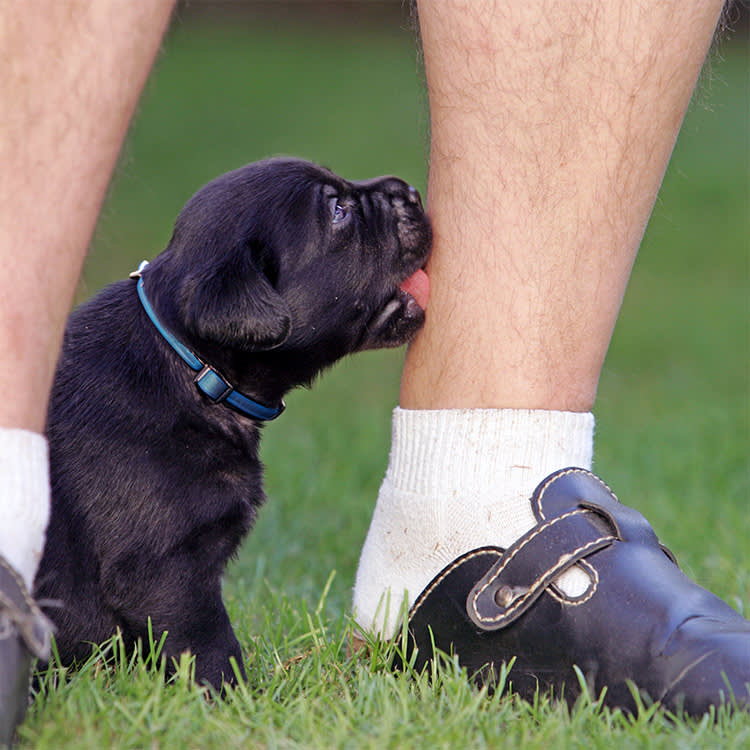
You get out of the shower, or back from a run, and your dog goes for your shins like they’ve been waiting all day. Which, arguably, they have.
Every article about this asks why, produces a list of six sweet reasons, and sends you on your way reassured. That list is fine. It’s also not the useful question, because the honest answer to “why” is boring: your legs are the nearest available salty surface, and your dog has a tongue.
The question that actually tells you something is how long. A dog who licks your calf twice and wanders off is not the same animal as a dog who licks your calf for eleven minutes, every day, and gets agitated when you move.
And there’s a second question nobody asks, which is genuinely a safety issue: what did you put on your legs?
First: it’s normal, and it isn’t even that common
Leg-licking is not a red flag on its own. It’s also not universal. Plenty of dogs never do it, plenty do it constantly, and there’s nothing wrong with either.
It’s simply a low-stakes behavior that some individual dogs land on and others don’t. Two dogs in the same house, raised the same way, will often disagree about it entirely.
So if your dog does this: fine. If your dog doesn’t: also fine. Nothing is being communicated by the absence.
The seven reasons, briefly, because they mostly collapse into three
1. You’re salty
The most common answer, and the least romantic. Sweat contains salt. Dogs like salt. If the licking spikes after you exercise, after you wake up, or on a hot day, you have your explanation and it is not affection. It’s seasoning.
2. You put something on your skin
Lotion, sunscreen, body oil, a fresh coat of anything. Two things can be happening: your dog finds the taste interesting, or your dog finds the smell wrong and is trying to remove it so you go back to smelling like a member of the household.
This is also where the one real hazard lives, and we’ll come back to it below.
3. It’s affection, or something close to it
Licking is a social behavior, part of how dogs interact with the individuals they’re bonded to. Your leg is part of you, so your leg is a legitimate target. Context is what makes it affection rather than salt: a relaxed body, a soft face, a slow tail, an unhurried tongue.
4. It’s grooming, sort of
Dogs do groom each other, though not with the thoroughness cats bring to it. A dog who watched their mother lick their littermates may carry the behavior forward. It’s a real explanation, just not a frequent one.
5. It works
The most underrated reason. If you laugh, shriek, jump, or make any interesting noise at all when your dog licks your leg, you have paid them for it. Dogs repeat what pays. A dog who has trained you to react is going to keep collecting.
6. It’s self-soothing
Licking releases tension. It’s the canine equivalent of a nervous habit, and dogs will do it to themselves and to you. This overlaps with appeasement, the set of behaviors dogs use to defuse a situation, and it shows up more when a dog is uncertain or has just been told off.
This is the reason that turns into a problem if it grows, which is the whole point of the next section.
7. Something in their body is off
Excessive licking of anything, including you, can point at gastrointestinal discomfort, nausea, or an allergy story that also has them chewing their own feet. A dog whose licking has clearly increased, particularly a dog who never used to do it, is worth mentioning to your vet.
Now the question that matters: duration
Here’s the line.
Brief, casual, occasional licking is a behavior. Prolonged, repetitive, hard-to-interrupt licking is a symptom.
Watch for:
- Length. Seconds is normal. Long stretches, multiple times a day, every day, is not.
- Interruptibility. Can you say their name and get their attention? A dog who can be easily redirected is fine. A dog who cannot break off is not.
- Trend. Is this new? Is it more than last month? Change is the signal, not the behavior itself.
- Distress. Does stopping them cause agitation? Do they go back to it immediately?
- Company it keeps. Are they also licking their own paws raw, licking the floor, licking the sofa, chewing at their feet? That constellation is not about you at all. It’s an allergy or a GI workup waiting to happen.
If the licking is long, compulsive, and hard to break, that’s a dog with a stress load or a medical problem, and the right response is a vet visit, not a training plan.
Owners always want to know what the licking means, and I understand why, but I care much more about how long it goes on. Ten seconds is a dog saying hello. Ten minutes is a dog managing something. Those need completely different answers from me.
The safety point nobody makes
This is the piece the standard version of this article is missing, and it’s the reason it’s worth writing again.
Do not let your dog lick medicated skin.
If you use a topical prescription on your legs, your dog should not be licking it off. That includes:
- Hormone creams (estrogen and testosterone gels are common, and are absorbed through skin and mucous membranes)
- Topical pain relievers, including compounded NSAID creams
- Steroid creams
- Psoriasis and eczema treatments
- Medicated sunscreens or acne treatments
- Anything you’ve been told to wash your hands after applying
The FDA has issued warnings about pet exposure to human topical medications, including serious harm and deaths in pets exposed to topical pain medications applied to their owners’ skin. Cats are more vulnerable than dogs, but dogs are not exempt, and a dog who licks a freshly medicated leg is receiving a dose nobody calculated.
The rule is simple: if it says “wash your hands after applying,” your dog cannot lick it. Cover the area, wear pants, and keep your dog off it until it’s fully absorbed. This is not a hypothetical. It’s the most consequential thing on this page.
How to stop it, if you want to
Only if it bothers you. A dog licking your leg is not misbehaving.
Stop paying for it. No laughing, no shrieking, no pushing them away. Pushing is contact and contact is a reward. Stand up and walk away instead. Say nothing.
Change the antecedent, not the behavior. Behavior has a structure: something happens, the behavior occurs, something follows. Most people try to intervene at the behavior, which is the hardest place to intervene. The easier fix is upstream. If the licking always happens the moment you sit down after a run, change that moment: shower first, or hand your dog something to do the second you sit.
Give the tongue a better job. A lick mat with something smeared on it, or a stuffed food toy, redirects the exact behavior onto a legal target. This works far better than suppression, because you’re not asking your dog to stop licking. You’re telling them where to lick.
Never punish it. Especially not if it’s appeasement-driven, where scolding a dog for a calming signal makes them more anxious and produces more licking. You’d be pouring fuel on it.
Bottom line
Your dog licks your legs because you taste like salt and you’re standing right there. That’s most of it, and it’s harmless.
What you actually need to watch is duration. Brief and casual is a dog being a dog. Long, repetitive, and hard to interrupt is a dog telling you something is going on, and that’s a conversation with your vet.
And whatever you do, don’t let them lick a medicated leg.
FAQs
Why does my dog lick my legs in the morning? You’ve been sweating in bed all night, and your skin is salty. That’s usually the entire explanation.
Why does my dog go for my legs right after a shower? Two possible reasons. Soap, shampoo, and lotion smell foreign, and your dog may be trying to restore your normal scent. Or the products simply taste interesting to them.
Can leg-licking point to a health problem? Occasional licking doesn’t. Licking that’s excessive, prolonged, compulsive, or new, especially alongside licking their own paws, the floor, or furniture, can point to gastrointestinal disease, allergies, or anxiety, and deserves a vet visit.
Is it safe to let my dog lick my legs? On clean, unmedicated skin, generally yes. Never let a dog lick skin you’ve applied a topical medication to, including hormone creams, pain creams, and steroid creams. Human topical medications have caused serious harm in pets.
How do I get my dog to stop licking my legs? Stop reacting to it at all, including pushing them away. Change what happens right before it, and give them a lick mat or a food toy as a legal alternative. Don’t punish it.
References
- Firnkes, Alexandra, et al. “Appeasement Signals Used by Dogs during Dog–Human Communication.” Journal of Veterinary Behavior, vol. 19, 2017, pp. 35–44. https://doi.org/10.1016/j.jveb.2016.12.012
- Bécuwe-Bonnet, Vanessa, et al. “Gastrointestinal Disorders in Dogs with Excessive Licking of Surfaces.” Journal of Veterinary Behavior, vol. 7, no. 4, 2012, pp. 194–204. https://doi.org/10.1016/j.jveb.2011.07.003
- U.S. Food and Drug Administration. “Topical Pain Medications Can Be Poisonous to Pets.” https://www.fda.gov/animal-veterinary/animal-health-literacy/topical-pain-medications-can-be-poisonous-pets
- American Veterinary Society of Animal Behavior. “Position Statement on Humane Dog Training,” 2021. https://avsab.org/wp-content/uploads/2021/08/AVSAB-Humane-Dog-Training-Position-Statement-2021.pdf
- “Compulsive Disorders of Dogs.” MSD Veterinary Manual. https://www.msdvetmanual.com/behavior/behavioral-problems-of-dogs/compulsive-disorders-of-dogs
Dr. Chen is a small-animal veterinarian who leads health and safety coverage at The Pet Times. She writes and reviews the bulk of our illness, condition, and safety content, translating clinical guidance into clear, practical advice owners can act on at home.
Meet our experts ↗Keep reading
 LivingA Wolfdog Is Not a Fluffier Husky. Nobody Can Tell You What You Actually Own.Dr. Ravi Mehta · 8 min
 TrainingA Laser Pointer Isn't a Toy. It's a Job Your Dog Can Never Finish.Dr. Nina Kohl · 7 min
 TrainingYour Grumpy Dog Isn't Being Dramatic. Read the Signal Behind the ScowlDr. Nina Kohl · 6 min
 TrainingYou're Not Reading Your Dog. You're Reading the Room Behind Him.Dr. Ravi Mehta · 7 min
 TrainingYour Dog's Joy Sends 86,000 People to the ER Every YearDr. Nina Kohl · 8 min
 TrainingYour Dog Rolling in Poop Isn't Camouflage. That Theory Barely Holds Up.Dr. Nina Kohl · 7 min