


Raw Feeding Promises a Lot. The Evidence Delivers a Lot Less.
Raw meat diets for dogs are marketed on shinier coats and better digestion. The benefits are mostly unproven, no major health body endorses them, and 2025 gave the risk side a stark new example.

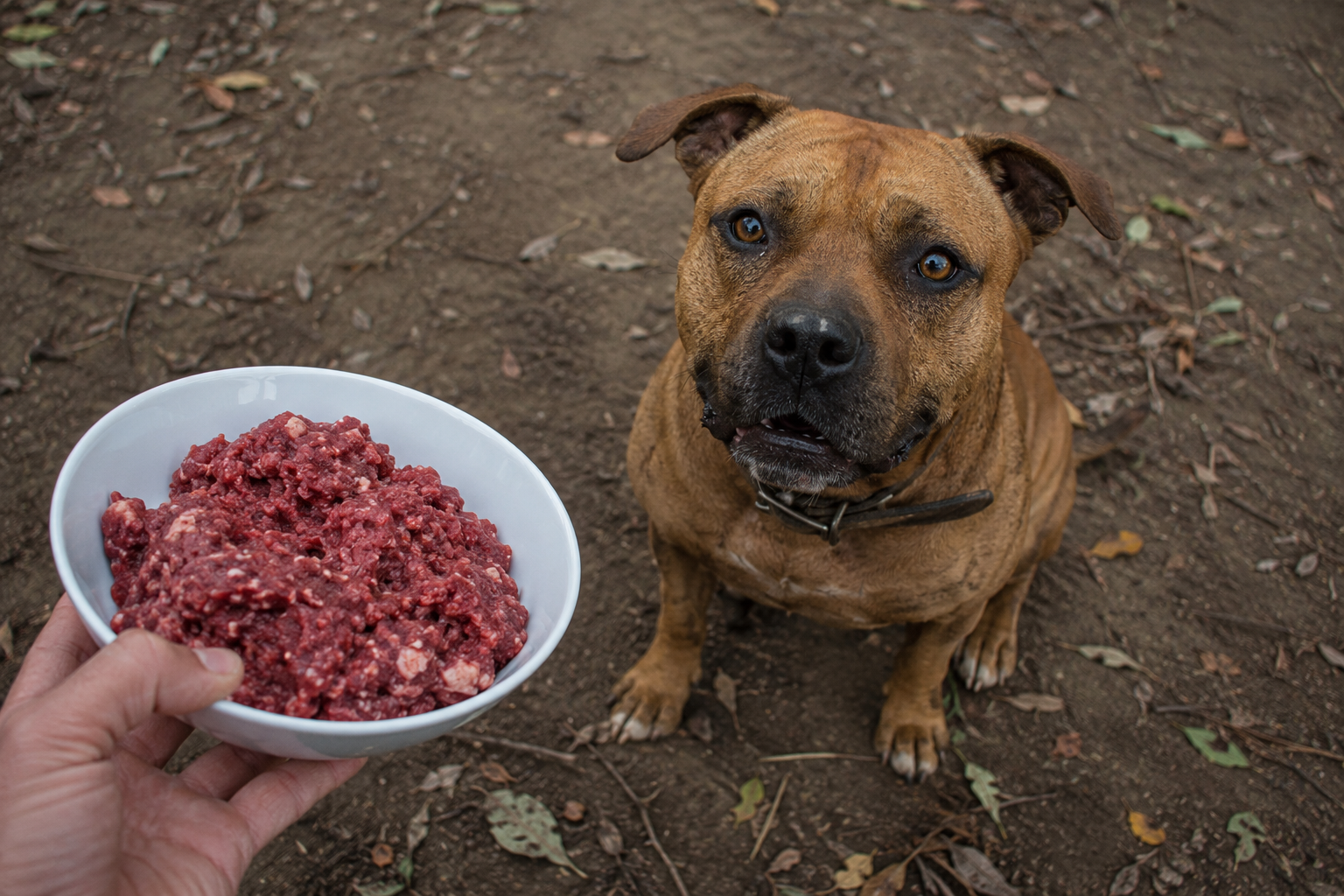
Raw feeding sells a compelling picture: a dog eating the way nature intended, coat gleaming, teeth clean, digestion humming. Over the last couple of decades that picture has moved a lot of product, from frozen patties to freeze-dried kibble to fresh refrigerated meals. The trouble is that when you line up the promises against the actual evidence, the gap is wide, and the risk side of the ledger is real, documented, and as of 2025 harder to wave away than ever. This is not a “wolves ate raw” debate. It is a question of what the data show, and the data are not on raw feeding’s side.
Raw meat is broader than you think
Before weighing risks and benefits, it helps to know what “raw” actually covers, because it is more than the uncooked chicken breast people picture. For our purposes, any uncooked animal muscle, organ, or fat counts as raw meat. Bones get complicated: they are not meat exactly, but a cut like a T-bone brings them along. Food can still count as raw even after light heat, below roughly 118 degrees Fahrenheit.
That definition sweeps in a lot of the pet aisle. Commercial raw diets include freeze-dried, dehydrated, fresh raw, frozen raw, and high-pressure pasteurized foods, and many are not labeled “raw” at all. It also means that low-temperature dehydrated treats, including pig ears and bully sticks, are technically raw. The meats used span chicken, beef, lamb, turkey, fish, duck, venison, and rabbit, though even raw-diet fans tend to steer clear of raw pork because of trichinella.
The benefits are mostly a story, not a finding
Raw-diet proponents point to shinier coats, cleaner teeth, better digestibility, and smaller stools. It is worth being precise about which of these hold up. The one with real support is stool volume: studies do show dogs on raw diets produce less feces. Whether that means anything for the dog’s health, beyond less to pick up in the yard, is unknown.
Everything else is thinner. The evidence on improved digestibility versus traditional kibble or canned food is conflicting, and the coat-and-teeth claims are essentially anecdotal. That does not make them impossible, but “my dog looks great” is not the same as a demonstrated benefit, and it has to be weighed against risks that are far better documented.
I take owners’ observations seriously, but a glossy coat can come from a dozen well-formulated diets, not just a raw one. What I can’t do is point to strong evidence that raw feeding makes dogs healthier, and I can point to plenty showing how it makes them, and their families, sick. When the upside is a maybe and the downside is a documented outbreak, that’s not a close call for me.
Why no major health body endorses it
The risk case is not one veterinarian’s opinion. The FDA, the CDC, the American Veterinary Medical Association, the American Animal Hospital Association, the World Small Animal Veterinary Association, and the Canadian Veterinary Medical Association all advise against feeding raw diets. That is a rare degree of agreement, and it rests on two problems.
The first is contamination. Raw meat can carry Listeria, Salmonella, E. coli, Campylobacter, and Clostridium perfringens, and contamination can enter anywhere from the processing plant to your kitchen counter. These bacteria can cause severe, sometimes life-threatening gastrointestinal, reproductive, or liver disease. And as with raw chicken specifically, dogs who eat contaminated meat do not always get sick themselves. They can harbor the bacteria and shed them to other animals and people, which puts children and immunocompromised household members at particular risk.
The second is antibiotic resistance. Heavy antibiotic use in food-producing animals means the bacteria on raw meat are more likely to be drug-resistant. Dogs fed raw diets have been shown to carry more antibiotic-resistant bacteria in their guts, and raw feeding has been linked to drug-resistant Salmonella infections in people. An infection that is hard or impossible to treat is a categorically different problem than a few days of an upset stomach.
The nutrition problem hiding underneath
There is a quieter issue that gets less attention than the bacteria. Diets built mainly around raw meat are often not balanced to meet a dog’s full nutritional needs. Dogs need more than protein, fat, and carbohydrate. They need essential amino acids, vitamins, calcium, and phosphorus in the right ratios, and raw meat by itself does not deliver that balance. Homemade raw diets in particular can drift into deficiency or dangerous mineral imbalances unless they are formulated with a veterinary nutritionist. A diet can be both microbiologically risky and nutritionally incomplete at the same time.
If you are set on raw
Some owners will feed raw regardless, and the honest guidance is harm reduction rather than a green light. There is no fully safe version. Of the options, high-pressure pasteurization is the least unsafe: it uses enormous pressure, more than 50,000 pounds per square inch, to kill bacteria without heating the food. It is not foolproof, though. Even pasteurized raw products have been recalled for listeria and salmonella contamination.
If you go this route, talk with your veterinarian first about meeting your dog’s nutritional needs, and treat the food in your kitchen exactly like raw meat for people: dedicated surfaces and bowls, thorough hand-washing, careful storage, and real caution if anyone in the household is very young, pregnant, elderly, or immunocompromised. It is also worth a word with your own physician about that household risk.
What’s new since this was written
The abstract risk of “contaminated raw meat” got a concrete, sobering face in 2024 and 2025 with the H5N1 bird flu. The virus spread through poultry and cattle and made its way into commercial raw pet food. Between late 2024 and 2025, clusters of cats became seriously ill after eating raw animal products, with many dying or being euthanized, and specific raw pet food lots tested positive for H5N1. In response, the FDA moved to require pet food makers using uncooked poultry or cattle materials to treat H5N1 as a known hazard in their food safety plans, and multiple raw products were recalled.
Cats have been hit hardest, but dogs can be infected as well, and the episode is a clean illustration of the core argument. Raw feeding does not just risk the familiar bacteria; it exposes pets to whatever novel pathogen is moving through the animal supply at the time, with no cooking step to catch it. Cooking remains the single most reliable way to make animal protein safe for a dog and the people who live with one.
References
- U.S. Food and Drug Administration: Get the Facts! Raw Pet Food Diets Can Be Dangerous to You and Your Pet
- U.S. Food and Drug Administration: Cat and Dog Food Manufacturers Required to Consider H5N1 in Food Safety Plans
- Freeman, L.M. et al. “Current knowledge about the risks and benefits of raw meat-based diets for dogs and cats.” Journal of the American Veterinary Medical Association, 2013.
- Davies, R.H. et al. “Raw diets for dogs and cats: a review, with particular reference to microbiological hazards.” Journal of Small Animal Practice, 2019.
- Bernaquez, I. et al. “Dogs fed raw meat-based diets are vectors of drug-resistant Salmonella infection in humans.” Communications Medicine, 2025.
- Schlesinger, D.P. and Joffe, D.J. “Raw food diets in companion animals: a critical review.” Canadian Veterinary Journal, 2011.
This article covers diet safety and disease risk. If you are considering a major change to your dog’s diet, talk with your veterinarian first, especially if anyone in your household is immunocompromised.
Common questions
Are the health benefits of raw feeding real?
Most are unproven. Claims like shinier coats, cleaner teeth, and better digestion are largely anecdotal. Studies show raw-fed dogs produce less stool, but the wider health benefits have not been demonstrated in good evidence.
What counts as raw meat for dogs?
Any uncooked animal muscle, organ, or fat, and it is broader than raw supermarket cuts. Freeze-dried, dehydrated, fresh raw, frozen raw, and high-pressure pasteurized foods all count, and so do many low-temperature dehydrated treats like pig ears and bully sticks.
What is the safest way to feed raw if I insist on it?
Talk to your vet first, and understand there is no fully safe version. High-pressure pasteurization lowers but does not eliminate risk, and recalls of pasteurized raw products still happen. Handle it like raw meat for people: strict hygiene, separate surfaces, and extra caution if anyone in the home is high-risk.
Not a substitute for your vet. Our guidance is educational. For urgent symptoms, contact a vet or emergency clinic right away. Editorial standards
Dr. Solis is a board-certified veterinary dermatologist with over twelve years of clinical experience. She advises on skin conditions, allergies, and grooming practices that affect coat and skin health. All dermatology and allergy content at The Pet Times is reviewed by her team before publication.
Meet our experts ↗Keep reading
 Health & WellnessBlue Ridge Beef Keeps Getting Recalled. Here's How to Read a Raw-Food RecallDr. Mara Chen · 4 min
 FoodThe Recalled Raw Food Was Never the Only Thing at Risk. Your Kitchen Was.Dr. Nina Kohl · 5 min
 Health & WellnessOne Customer Complained. That's the Only Reason the Duck Was Pulled.Dr. Lena Park · 5 min
 Health & WellnessBlue Ridge Beef Recall of Puppy and Kitten Food Now Covers 16 StatesDr. Ravi Mehta · 4 min
 Health & WellnessA Raw-Food Recall, Decoded: What Blue Ridge Beef's Salmonella Scare MeansDr. Ravi Mehta · 6 min
 FoodSalmonella and Listeria in Darwin's Raw Pet Food: The Exact Lots to TossDr. Amara Solis · 4 min