


Pine Needles Aren't the Scariest Thing on Your Cat's Christmas Tree
Yes, pine needles are mildly toxic to cats. But the needles rank low on a tree full of bigger threats, and the worst one is the water in the stand. Here is the real holiday hazard order.

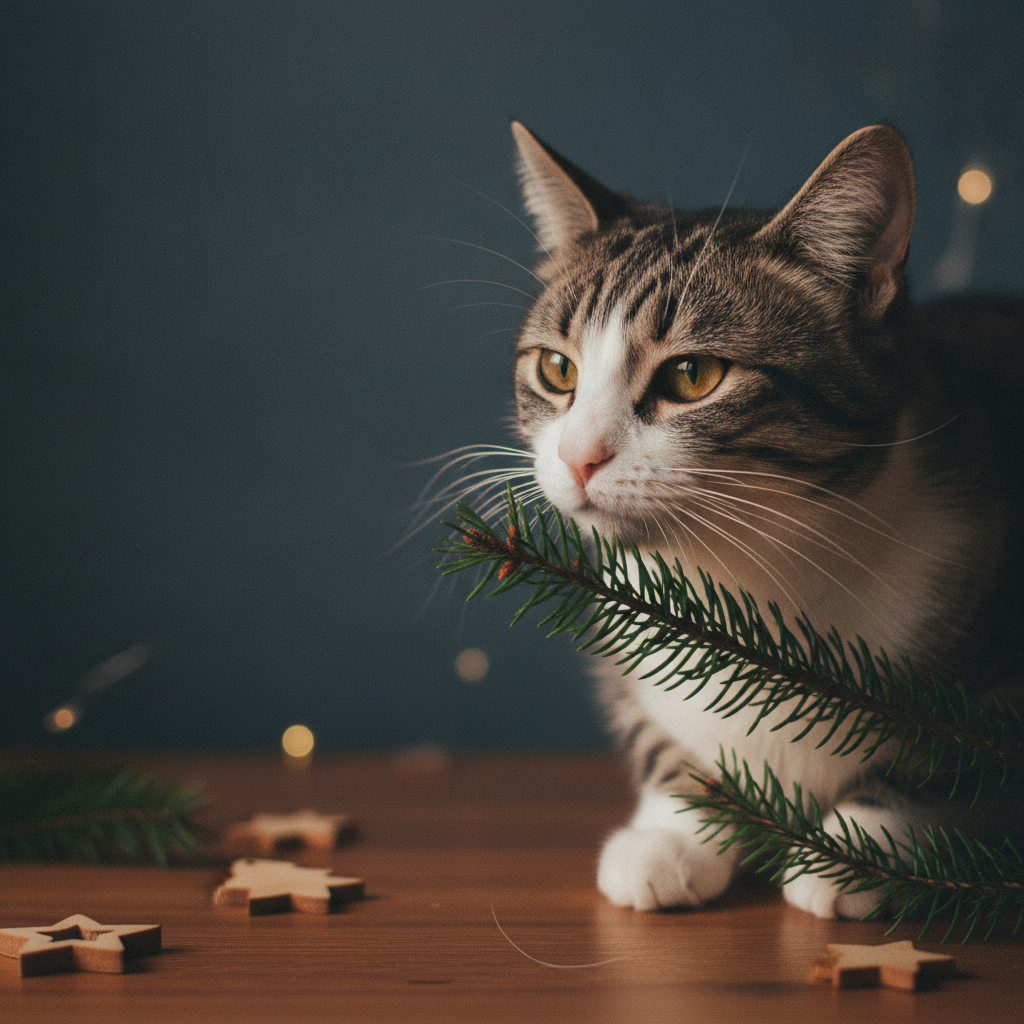
Every December the same warning makes the rounds: keep your cat away from the pine needles. It is not wrong. But it aims your attention at the smallest threat on the tree while bigger ones sit in plain sight, including one your cat is probably already drinking from.
Pine needles are mildly toxic to cats, and we will give them their due. But if you rank everything a cat can get into around a Christmas tree by how much harm it can actually do, the needles land near the bottom. The water in the stand, the tinsel, the lights, the ornaments, those are the ones that send cats to the emergency vet. So let’s put the tree in proper hazard order, starting with why the needles earned their reputation and then moving up to the things that should worry you more.
What pine needles actually do
Pine needles contain pine oil, a volatile terpene, and the reason it matters for cats specifically comes down to liver chemistry.
Cats are missing a big chunk of the liver machinery that clears essential-oil compounds. In most animals, the body grabs a terpene, tags it, and flushes it out. Cats do that step poorly, so pine oil lingers and irritates instead of getting processed and gone. That single quirk is why essential oils as a category deserve more caution around cats than around dogs.
Practically, a cat who chews pine needles can get gastrointestinal upset, vomiting, drooling, and diarrhea, plus a mechanical hazard, because the needles are sharp, do not break down well in the gut, and can choke a cat or scratch the mouth, throat, or intestines. Because cats handle the oil badly, exposure is not limited to eating needles: diffused pine oil in the air and oil that lands on the coat and gets groomed off both count.
The key word, though, is mildly. Toxicity sits on a spectrum that scales with the amount eaten. A cat who mouths a stray needle is very different from one who methodically strips a branch. Serious pine-oil poisoning, which in large doses can progress to liver injury, takes a real quantity. For most cats, the needle is a stomach-ache risk, not a catastrophe, which is exactly why it should not be the only thing on your radar.
The threat people forget: the water in the stand
Here is the hazard that almost never makes the warnings, and arguably should lead them. Your tree stand is a basin of standing water, and to a cat it looks like a fountain at floor level. What is in it is worse than what is on the branches.
That water concentrates the tree’s own sap and terpenes as the trunk soaks. Worse, anything people add to “keep the tree fresh” goes straight into a bowl your cat can reach. Some commercial tree preservatives and homemade recipes contain sugar, which feeds rapid bacterial growth, including bugs that can cause real gastroenteritis; others contain aspirin, which cats metabolize dangerously slowly, or copper-based fungicides, and copper is toxic to a cat’s liver in repeated small doses. Stagnant, sugary water can build heavy bacterial loads within a couple of days.
If a client tells me their cat has been drinking from the tree stand, I pay far closer attention to that than to a chewed needle. A few sips of preservative-laced or fouled tree water can do more than the needles ever would. The fix is simple: plain water only, and put a barrier over the reservoir so it is not an open bowl.
Use plain tap water in the stand, never additives, and cover or skirt the basin so your cat cannot drink from it. This one change removes a risk most owners never knew they had.
The rest of the tree, ranked
Once you stop fixating on needles, the real danger list comes into focus. Roughly in order of how often they cause trouble:
- Tinsel, ribbon, and string top the list of true emergencies. Cats find linear objects irresistible, and a swallowed strand can saw through the intestine or bunch the gut into an obstruction, a “linear foreign body” that often needs surgery. Skip tinsel entirely in a cat home.
- Electrical cords and lights invite chewing, which can cause mouth burns or electric shock. Bundle and hide cords, and unplug the tree when you are not in the room.
- Ornaments, especially glass and small parts, become chew toys and projectiles. Broken glass cuts paws and mouths; swallowed small ornaments obstruct. Hang the breakables and chewables high.
- The water in the stand (above), which can outrank everything for a dedicated tree-water drinker.
- The needles themselves, mildly toxic and a choking risk, but the least of the list for most cats.
Reading that order is the whole point. The classic “watch the needles” advice is not wrong, it is just incomplete, and incomplete in the direction that leaves the worst hazards unaddressed.
What to do if your cat eats needles (or drinks the water)
Stay calm and call your veterinarian. For needles, your vet will usually have you watch for pine-oil signs: tremors, drooling, vomiting, diarrhea, labored breathing, low body temperature, low heart rate, and ataxia (wobbliness). Note how much your cat ate.
Crucially, do not induce vomiting. Pine oil is absorbed quickly and unlikely to come back up, and forcing vomiting with essential oils on board risks aspiration into the lungs, plus dehydration. Never give human medications.
When a cat eats something toxic, the move is to call, not to wait and watch on your own. Even with a mild toxin like pine, an early phone call lets us decide whether it is a monitor-at-home situation or a come-in situation. With needles, I also always ask what else the cat got into, because the answer is usually where the real risk is.
If your cat also drank tree water or chewed tinsel, lights, or an ornament, say so up front; those change the plan entirely. Treatment for needle cases is supportive, fluids and anti-nausea medication for persistent GI signs, with hospitalization reserved for severe cases.
Prevention, in order of payoff
You will not train a cat out of being fascinated by a giant new indoor plant covered in dangling toys, so prevention does the heavy lifting:
- Plain water in the stand, covered. Highest payoff for the least effort.
- No tinsel, ever, in a cat home. It removes the most common surgical emergency.
- Secure cords and unplug lights when unsupervised.
- Hang breakable and small ornaments out of reach, breakables up high, nothing chewable on the lower third.
- Block the tree itself if you can: a closed-off room is ideal, a tall gate or a foil-skirted base helps for cats who dislike walking on foil.
- Sweep fallen needles so the floor is not a snack tray.
Safer-tree notes
A few swaps and clarifications:
- Spruce and fir are often called safer than pine, and their oils are somewhat milder, but they are not safe. The needles pose the same choking and puncture risk, and the same essential-oil caution applies. Treat any needled tree the same way.
- Artificial trees produce no toxic oils, which removes the chemical risk, but the fake needles still choke and obstruct, and the water, lights, tinsel, and ornament risks are unchanged. An artificial tree is a partial fix, not a free pass.
- Holly and mistletoe are genuinely more toxic than pine needles, capable of gastrointestinal, neurological, and cardiovascular effects, so keep them out of a cat’s reach entirely.
The bottom line
Pine needles are mildly toxic and a real choking hazard, and they are still the smallest problem on your Christmas tree. The water in the stand, the tinsel, the cords, and the ornaments can hurt your cat faster and worse. Use plain water and cover the basin, lose the tinsel, secure the lights, hang the breakables high, and the needles become the manageable footnote they should have been all along.
References
- “Pine Oils / Essential Oil and Liquid Potpourri Poisoning in Cats.” Pet Poison Helpline. https://www.petpoisonhelpline.com/poison/essential-oils/
- “Christmas Tree Preservatives.” National Capital Poison Center (Poison Control). https://www.poison.org/articles/christmas-tree-preservatives
- “Holiday Hazards.” ASPCA Animal Poison Control. https://www.aspca.org/pet-care/animal-poison-control
- “Holly” and “Mistletoe.” ASPCA Toxic and Non-Toxic Plants. https://www.aspca.org/pet-care/animal-poison-control/toxic-and-non-toxic-plants
Common questions
What is the most dangerous part of a Christmas tree for a cat?
Often the water in the stand, which people rarely think about. Tree water concentrates sap, terpenes, and any preservative or fungicide added to it, and stagnant, sugar-fed water grows bacteria fast. A cat using the stand as a water bowl can get more harm from a few sips than from chewing a needle. Use plain water only and cover the reservoir.
What should I do if my cat eats pine needles?
Stay calm and call your vet. Most cases mean watching for vomiting, drooling, diarrhea, tremors, or wobbliness, and many cats are fine. Do not induce vomiting, because pine oil is absorbed fast and is unlikely to come back up, and vomiting essential oils risks aspiration. Note how much your cat ate and whether they also drank tree water or chewed anything else.
Why is pine oil specifically bad for cats?
Cats lack robust glucuronidation, the liver pathway that clears many essential-oil compounds, so terpenes from pine, fir, and spruce build up rather than being processed and excreted. That is why essential oils as a class are riskier for cats than for many other animals, and it applies to diffused pine oil and oil on the fur, not just swallowed needles.
Not a substitute for your vet. Our guidance is educational. For urgent symptoms, contact a vet or emergency clinic right away. Editorial standards
Dr. Chen is a small-animal veterinarian who leads health and safety coverage at The Pet Times. She writes and reviews the bulk of our illness, condition, and safety content, translating clinical guidance into clear, practical advice owners can act on at home.
Meet our experts ↗Keep reading
 Health & WellnessThe Spider Plant Gets a Pass. The Watering Can Is the ProblemDr. Lena Park · 6 min
 Health & WellnessThe 'Stray Cat Telegraph' Is Nonsense. It Still Beats Standing on the Porch Yelling.Dr. Nina Kohl · 7 min
 Health & WellnessThe Daisy Problem Is a Naming Problem: Which 'Daisies' Actually Hurt CatsDr. Mara Chen · 6 min
 Health & WellnessThe Monarch Bird Flu Cases Were Not a Fluke. They Were a PatternDr. Ravi Mehta · 5 min
 Health & Wellness"Keep Cats Indoors" Is Only Half the Bird Flu Advice. The Other Half Is the BowlDr. Nina Kohl · 4 min
 Health & WellnessFoxtails Aren't Just a Dog Problem. For Cats They Can Be Deadly.Dr. Amara Solis · 5 min