


The Spider Plant Gets a Pass. The Watering Can Is the Problem
Spider plants are one of the few houseplants a cat can safely live with. The real hazards are what you add to the pot, not the plant itself.

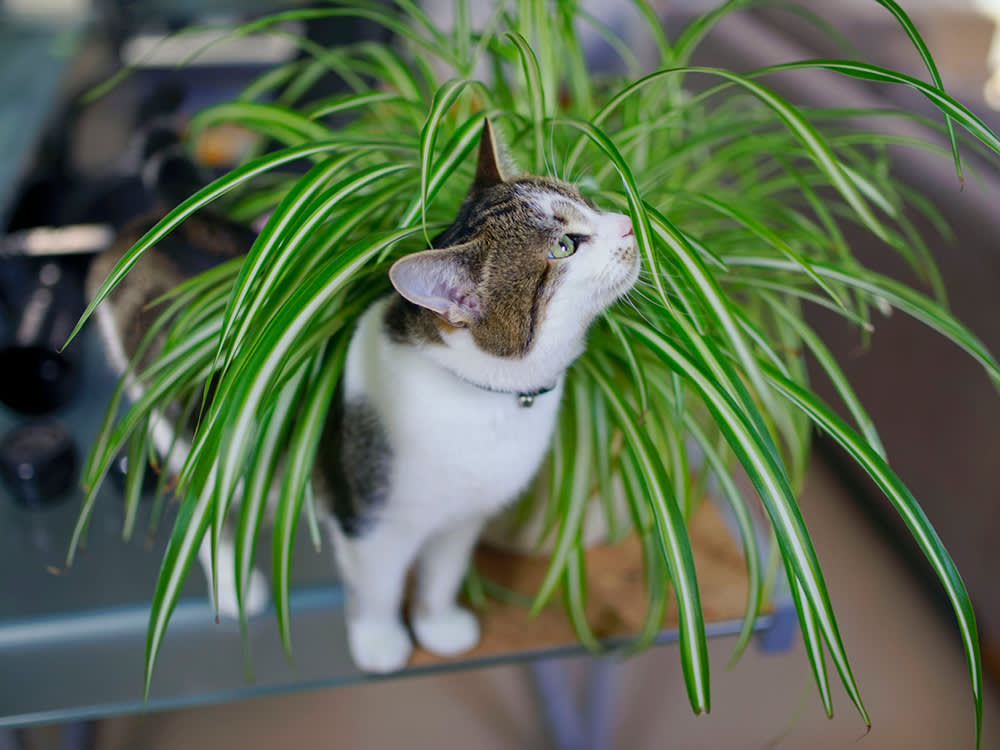
If you have spent any time reading plant-toxicity lists, you know the experience is mostly bad news. Lilies, kidney failure. Sago palm, liver failure. Dieffenbachia, a chemical burn in the mouth. So here is a rare bit of good news for cat parents: the spider plant is genuinely safe. It sits on the ASPCA’s non-toxic list, it is nearly impossible to kill, and your cat can live alongside it without you bracing for a vet bill.
But “safe plant” and “safe setup” are not the same thing, and that gap is where cats actually get hurt. The spider plant itself will not poison your cat. The fertilizer you feed it, the runoff that pools in the saucer, and the assumption that every wispy green plant is just as harmless absolutely can. So this is less a warning about the plant and more a guide to the three things around it that deserve your attention.
First, the verdict: the plant is fine
Spider plants (Chlorophytum comosum), also sold as ribbon plants or spider ivy, contain no compounds known to be toxic to cats. The ASPCA lists them as non-toxic, and veterinary toxicology references agree. A cat can rub against one, nap under the cascading leaves, or take an experimental bite without any risk of true poisoning.
What a cat cannot do is eat a large quantity without consequences, and this is the nuance most “safe plant” lists skip. Non-toxic is a statement about chemistry, not about your cat’s stomach. Plant fiber is roughage, and a cat who strips half a spider plant in an afternoon can vomit, drool, or have loose stool for a day, the same way they might after gorging on grass. That is mechanical irritation, not toxicity, and it almost always resolves on its own.
One myth worth retiring: spider plants do not get cats high. The claim circulates because cats are weirdly enthusiastic about chewing the leaves, but there is no documented psychoactive compound and no research supporting a “feline LSD” effect. The draw is the crunch and the movement, the same instinct that makes a cat shred a paper bag.
Hazard one: what’s in the soil
Here is the part the plant’s reputation hides. A spider plant is safe. Spider plant soil may not be.
Most fertilizers, whether granular, liquid, or those slow-release spikes, contain concentrated nitrogen, phosphorus, and potassium, and many add iron or other minerals. Eaten directly or licked off the leaves and stems after feeding, fertilizer can cause vomiting, diarrhea, and in larger amounts more serious signs. Some potting mixes also contain additives like cocoa-shell mulch or systemic insecticides that are a problem on their own.
The practical rule: treat the pot as the hazard, not the plant. After you fertilize, keep your cat away until you have watered it in and the surface has dried. Skip cocoa mulch entirely in a cat household. And do not let your cat treat freshly fed soil as a snack or a second litter box.
Hazard two: the saucer of standing water
This one is invisible and easy to miss. When you water or feed a spider plant, the excess drains into the saucer below, carrying dissolved fertilizer salts and any soil additives with it. To a cat, that saucer is just a low, convenient bowl of water, and many cats prefer drinking from odd sources over their own dish.
If you fertilize, dump the runoff rather than leaving it to sit. If your cat is a committed plant-saucer drinker, switch to bottom-less drainage or elevate the plant so the runoff is out of reach. Plain water in a saucer is harmless. Fertilizer tea is not.
Hazard three: the lookalikes that aren’t safe
The most dangerous thing about a spider plant may be the confidence it gives you. Long, arching, ribbon-like leaves are a common silhouette, and several plants that resemble a spider plant from across the room are not safe at all. Dracaena (often sold as a “corn plant” or “dragon tree”) has strappy leaves and is toxic to cats, causing vomiting, drooling, and dilated pupils. Some grass-like ornamentals and “airplane plant” mislabels add to the confusion.
Identify before you trust. If you cannot say with certainty that a plant is Chlorophytum comosum, look it up by its scientific name on the ASPCA’s database before you let your cat near it.
When a vet visit is actually warranted
For a true spider plant, the bar is high, because the plant is not toxic. Call your vet if:
- Your cat vomits more than two or three times, or keeps vomiting beyond a few hours
- There is blood in the vomit or stool
- Your cat stops eating, hides, or seems lethargic for more than a day
- You know or suspect they ate fertilizer, fertilizer runoff, or a misidentified lookalike plant
That last line is the one that matters most. A few chewed spider plant leaves rarely earn a phone call. Fertilizer or a mystery plant earns one right away, and when in doubt, the ASPCA Animal Poison Control Center (888-426-4435) can tell you in minutes whether you are dealing with a nuisance or an emergency.
The plants that send cats to my exam room are almost never the ones on the toxic list, because owners already keep those out of reach. It’s the safe plant that got fertilized, or the houseplant nobody could name. Knowing your plant by its real name is worth more than any blanket rule.
Living happily with a spider plant and a cat
You do not need to banish the spider plant, and that is the whole point. Keep it fed responsibly, dump the runoff, drink-proof the saucer, and make sure the plant is actually the plant you think it is. Do that and the spider plant earns its reputation as one of the few houseplants you can own without watching your cat like a hawk.
If your cat is a dedicated leaf-shredder and you would rather protect the foliage than the cat, a hanging basket or a high shelf settles it. But that is for the plant’s sake. The cat was never really the one in danger.
Other genuinely cat-safe plants
If you want to build out a green, cat-proof room, these are non-toxic per the ASPCA:
- Prayer plant (Maranta leuconeura): loves bright, indirect light, and its leaves fold up at dusk and open at dawn.
- Watermelon peperomia (Peperomia argyreia): compact, with rind-patterned leaves and no toxic compounds.
- Boston fern (Nephrolepis exaltata): lush and cat-safe, though a cat may treat the fronds as a toy.
- Areca palm (Dypsis lutescens): a true non-toxic palm, unlike the deadly sago, which only looks like a palm.
The ones to keep out entirely
For contrast, these are the leaves that actually justify a high shelf:
- Lilies (true Lilium and Hemerocallis): the single most dangerous plant for cats; even pollen or vase water can cause fatal kidney failure.
- Sago palm (Cycas revoluta): liver failure and seizures; a few seeds can be lethal.
- Dieffenbachia: calcium oxalate crystals that cause oral burning, drooling, and trouble swallowing.
References
- ASPCA Animal Poison Control Center, Toxic and Non-Toxic Plants Database (Spider Plant, Chlorophytum comosum)
- ASPCA Animal Poison Control Center, Toxic and Non-Toxic Plants Database (Dracaena, Sago Palm, Lily)
- Pet Poison Helpline, Fertilizer Toxicity in Pets
- North Carolina Extension Gardener Plant Toolbox, Chlorophytum comosum
Common questions
Do spider plants make cats high?
There is no scientific evidence that spider plants are hallucinogenic for cats. The plant is mildly fibrous and crunchy, which is most of its appeal. If your cat seems unusually drawn to it, that is curiosity and texture, not a chemical effect.
What is actually dangerous about a spider plant for cats?
Not the plant, but what is around it: fertilizer in the soil, fertilizer-laced runoff in the saucer or pot, and the false confidence that all dangling green leaves are safe. Lookalike plants and treated soil cause more trouble than the spider plant ever will.
Not a substitute for your vet. Our guidance is educational. For urgent symptoms, contact a vet or emergency clinic right away. Editorial standards
Dr. Park is a board-certified emergency and critical care specialist. She reviews our health and safety content for clinical accuracy and contributes guides on recognising urgent conditions. Her focus is helping owners act quickly and correctly when it matters most.
Meet our experts ↗Keep reading
 Health & WellnessGarlic and Cats: The Toxin That Hides in Plain Sight on Your PlateDr. Amara Solis · 6 min
 Health & WellnessYour Orchid Is Safe for Cats. What's Next to It Might Not Be.Dr. Amara Solis · 5 min
 Health & WellnessThe Flea and Tick Protection Vets Actually Pick for CatsDr. Ravi Mehta · 9 min
 Health & WellnessBefore You Buy a Self-Cleaning Litter Box, Understand the One Way They KillDr. Mara Chen · 10 min
 Health & WellnessThe Tuna Recall Your Cat's Snack Habit Just Made PersonalDr. Amara Solis · 6 min
 Health & WellnessOutdoor Cats Die Years Younger. The Data Is Worse Than You Think.Dr. Priya Nair · 5 min