


The Daisy Problem Is a Naming Problem: Which 'Daisies' Actually Hurt Cats
Not every flower called a daisy is the same plant. Here's how to tell the cat-safe daisies from the toxic Chrysanthemum lookalikes, and what to do if your cat takes a bite.

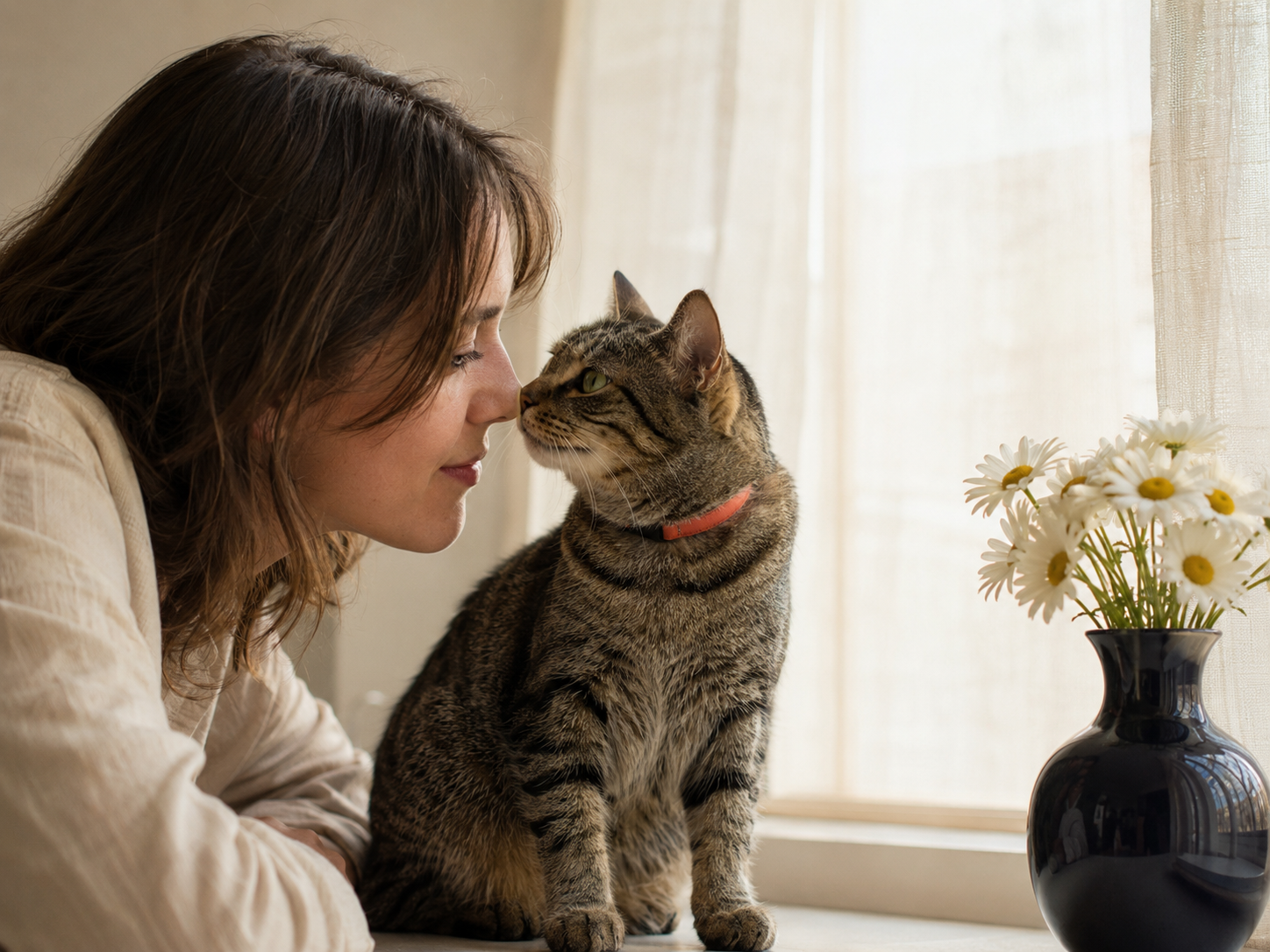
If you have ever stood in a garden center holding a tray of cheerful white-and-yellow flowers and wondered whether they are safe for your cat, the honest answer is: it depends entirely on which flower you are actually holding. And here is the catch that trips up almost everyone. The word “daisy” is not the name of one plant. It is a nickname shared by dozens of unrelated flowers, some harmless to cats and some genuinely toxic, that all happen to share the same round, sunny shape.
That naming overlap, not the daisy shape itself, is the real hazard. A cat parent who learns “daisies are toxic” or “daisies are fine” has only learned half a fact, because both statements are true depending on the species. So instead of giving you a verdict on a flower nickname, this guide sorts out which “daisies” you might actually have, which ones can hurt your cat, and how to act when you are not sure.
The two plants hiding behind one word
When people picture a daisy, they usually mean one of two very different things.
The first is the true English daisy, Bellis perennis, the low-growing lawn flower with a yellow button center and short white petals. The ASPCA lists Bellis perennis as non-toxic to cats. On its own, it is not the flower to fear.
The second is the much larger and more popular group of “daisies” in the Chrysanthemum genus and the wider Asteraceae family: florist mums, Shasta daisies, gerbera-style blooms, and the showy potted “daisies” that dominate garden-center displays in spring and fall. Many of these are toxic to cats. The trouble is that they are bred to look like an idealized daisy, which means they often resemble the harmless Bellis more closely than Bellis resembles itself.
The mistake I see is people treating ‘daisy’ like a single safe or unsafe answer. Two flowers can sit side by side on a shelf, look like twins, and one is on the non-toxic list while the other is a mum that will make a cat sick. If you can’t name the species with confidence, assume it’s the toxic one.
Why the toxic daisies hit cats harder than dogs
The reason Chrysanthemum-type daisies deserve real caution is not vague “plant poison.” It is specific chemistry. These plants contain pyrethrins, the naturally occurring compounds that humans extract and concentrate into household and garden insecticides, along with bitter sesquiterpene lactones the plant uses to defend itself.
Cats matter here in a way dogs do not. Cats are unusually sensitive to pyrethrins because of how their livers process certain compounds, which is the same reason cat owners are warned never to use dog flea products on a cat. So a mum that gives a dog a mildly upset stomach can produce a more pronounced reaction in a cat: drooling, vomiting, incoordination, and in heavy exposures, tremors. The dose and the individual cat both matter, but the species sensitivity is real.
What to actually do if your cat takes a bite
If you catch your cat in the act, take the flower away and gently wipe out their mouth with a damp cloth to clear any lingering plant bits. Then do the single most useful thing you can: identify the plant. Snap a clear photo or set aside a stem and a flower head, because the first question your vet or poison control will ask is what your cat ate.
If your cat has already swallowed part of a flower, do not wait for dramatic symptoms before calling. Reach your veterinarian or the ASPCA Animal Poison Control Center at (888) 426-4435, which is staffed around the clock. Describe the plant, how much you think your cat got, and any symptoms you are seeing.
The symptoms worth watching for include drooling, vomiting, and diarrhea, plus skin irritation, lethargy, wobbliness or trouble walking, and labored breathing. Signs and severity vary with the plant and the amount, which is exactly why professional guidance beats guessing.
One firm rule: do not induce vomiting at home in a cat. It is genuinely unsafe in cats and can cause more harm than the plant. Any decision to empty the stomach belongs to a veterinarian.
What treatment usually looks like
Most plant-poisoning treatment aims to reduce how much toxin the body absorbs, slow that absorption, or speed elimination. In practice, a vet may give activated charcoal to bind toxins still in the gut, medication to protect an irritated stomach, and fluids to keep your cat hydrated through the vomiting. In more serious cases they may decide to empty the stomach under sedation, sometimes with a procedure that uses a tube to remove stomach contents directly. The takeaway is that the useful interventions are the medical ones, performed where your cat can be monitored, not anything you improvise at home.
A safer way to satisfy a grazing cat
A lot of daisy mishaps start with a cat who simply likes to chew greenery. You can meet that urge without the risk. Cat grass (usually wheat, oat, or barley sprouts) gives a chronic nibbler something safe to graze on. Catnip and its quieter cousin silvervine give plant-curious cats a sanctioned target, and for cats who shrug at catnip, cat thyme or valerian can offer a similar pull. Ask your own vet before introducing valerian, since it is potent and a little goes a long way.
How to keep the toxic ones out of reach
Prevention is mostly about controlling the front door, the windowsill, and the vase. Keep cut bouquets and potted mums out of the house, or confined to a room your cat cannot enter, and assume any gift bouquet contains a daisy lookalike until you have checked. Supervise outdoor time, since a garden bed is a buffet of unidentified species. And when a new plant comes home, look it up before it goes on a surface your cat can reach.
Beyond daisies, several common flowers are also toxic to cats, including true lilies (which are an emergency for cats, not a mild upset), daffodils, tulips, English ivy, and jade plants. The habit worth building is simple: identify before you introduce.
The bottom line
“Are daisies toxic to cats?” is the wrong question, because “daisy” is a nickname, not a plant. The true English daisy, Bellis perennis, is non-toxic, but the far more common Chrysanthemum-family daisies are toxic and hit cats harder than dogs thanks to pyrethrins. Since the safe and unsafe versions are nearly impossible to tell apart at a glance, the reliable rule is to treat any daisy you cannot positively identify as toxic, keep it out of reach, and keep the ASPCA Animal Poison Control number, (888) 426-4435, somewhere you can find it fast.
References
- ASPCA. “Toxic and Non-Toxic Plants: Chrysanthemum.” https://www.aspca.org/pet-care/animal-poison-control/toxic-and-non-toxic-plants/chrysanthemum
- ASPCA. “Toxic and Non-Toxic Plants: Daisy (Bellis perennis).” https://www.aspca.org/pet-care/animal-poison-control/toxic-and-non-toxic-plants
- ASPCA Animal Poison Control Center. “Animal Poison Control.” https://www.aspca.org/pet-care/animal-poison-control
- Merck Veterinary Manual. “Houseplants and Ornamentals Toxic to Animals.” https://www.merckvetmanual.com/toxicology/poisonous-plants/houseplants-and-ornamentals-toxic-to-animals
Common questions
What makes the toxic daisies dangerous to cats?
Chrysanthemum-type daisies contain pyrethrins and sesquiterpene lactones, the same family of compounds used in some insecticides. Cats are unusually sensitive to pyrethrins, which is why a plant that only mildly bothers a dog can hit a cat harder.
What should I do if my cat eats a daisy?
Take any plant material out of their mouth, rinse their mouth gently with a damp cloth, and save a piece of the plant or a photo to help with identification. Then call your vet or the ASPCA Animal Poison Control Center at (888) 426-4435. Do not try to make your cat vomit at home.
How do I keep my cat away from daisies?
Keep cut bouquets and potted daisies out of the house or in a room your cat can't enter, and supervise outdoor time. For a plant-obsessed cat, redirect the urge to graze with cat grass, catnip, or silvervine instead.
Not a substitute for your vet. Our guidance is educational. For urgent symptoms, contact a vet or emergency clinic right away. Editorial standards
Dr. Chen is a small-animal veterinarian who leads health and safety coverage at The Pet Times. She writes and reviews the bulk of our illness, condition, and safety content, translating clinical guidance into clear, practical advice owners can act on at home.
Meet our experts ↗Keep reading
 Health & WellnessCat Scratch Fever Isn't a Rock Song. It's a Real Infection (You Still Don't Need to Panic).Dr. Nina Kohl · 5 min
 Health & WellnessYour Cat Isn't 'Toxic.' It's a Living Air Monitor for Your HomeDr. Nina Kohl · 7 min
 Health & WellnessAnother Blue Ridge Beef Recall: Why This Raw Kitten Food Keeps Hitting the FDA's ListDr. Mara Chen · 4 min
 Health & WellnessThe Real Hibiscus Danger to Cats Isn't Hibiscus. It's Its Toxic Look-AlikeDr. Lena Park · 7 min
 FoodYour Cat Ate a Cockroach. The Bug Isn't the Problem. What's on It Is.Dr. Priya Nair · 5 min
 Health & WellnessOnly 5% of a Flea Problem Lives on Your Cat. Here's the Other 95%.Dr. Ravi Mehta · 9 min