


Cats and Peaches: The Sweet Flesh Is Safe. The Pit Is a Trip to the ER
A bite of ripe peach flesh is fine for a cat. The pit is the real story, a choking hazard, a blockage risk, and the one part with real cyanide.

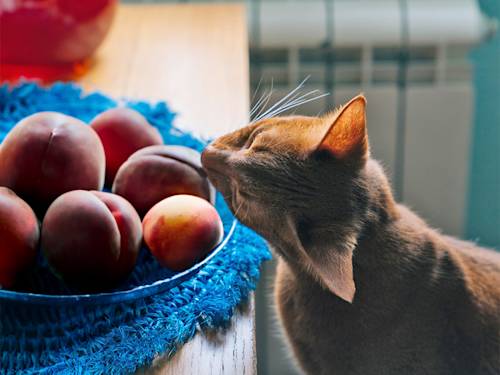
Peaches follow the same pattern as most stone fruit, and the pattern is worth stating up front: the soft part is the safe part, and the hard part is the emergency. A little ripe peach flesh is a fine treat for a curious cat. The pit is where the real danger sits, and it’s a triple threat, a choking hazard, a blockage risk, and the one piece of the peach carrying meaningful cyanide. So the honest headline isn’t “can cats eat peaches.” It’s “get the pit far away from your cat.”
The pit is the part that sends cats to the vet
That big, hard peach pit is exactly the wrong object for a cat. Swallowed whole, it can choke a cat outright, and if it makes it down, it’s a classic cause of intestinal blockage, which is a genuine, sometimes surgical, emergency. Peach pits are notorious for this precisely because of their size and shape.
On top of the physical risk, the pit, along with the leaves and stems, contains cyanide compounds. Realistically, a cat isn’t going to chew through a pit’s hard casing to release much cyanide, so the poisoning risk from an intact pit is low. But wilted peach leaves actually carry higher cyanide concentrations than fresh ones, so the whole plant, not just the pit, deserves to be out of reach. Signs of cyanide trouble would include labored breathing, dilated pupils, weakness, or collapse, all reasons to call your vet immediately.
The practical rule covers every one of these risks at once: never give a cat any part of a peach except the pitted flesh, and don’t leave whole peaches or peach trimmings where a cat can get to them.
With stone fruit, I spend zero energy worrying about a cat nibbling the flesh and all of it on the pit. It’s the perfect size to lodge in a cat’s gut, and by the time they’re vomiting and won’t eat, we may be talking about surgery. Pit it, toss the pit somewhere they can’t reach, and the whole worry goes away.
The flesh is a fine, small treat
Pitted peach flesh is nontoxic and even brings a few minor perks. It’s high in water, so it’s mildly hydrating for a cat who doesn’t drink enough. It has fiber, especially in the skin. And it carries antioxidants like caffeic acid and carotenoids, plus vitamins A, E, and K.
But this stays a treat, not a health food, for two reasons. Peaches are high in fiber, and a sudden fiber load gives a meat-eater’s gut gas and loose stool, so small portions matter. And they’re high in natural sugar, which cats metabolize poorly and which feeds weight gain over time. Cats also can’t taste sweetness, so the very thing that makes a ripe peach delicious to you is invisible to them. Many cats will pass entirely.
Serve it plain. Skip anything canned, syrupy, or baked, those come loaded with added sugar, and sometimes cinnamon, nuts, or dairy, none of which belong in a cat. And keep all treats under about 10 percent of daily calories, with a complete cat food doing the real nutritional work.
What newer research adds
Peaches haven’t changed, but how they arrive in our kitchens has, and that’s the current, practical wrinkle. Pre-cut peach cups, peach-flavored yogurts, dried peach snacks, and peach baked goods are everywhere now, and they’re worse choices for a cat than a fresh peach, not better: they concentrate the sugar and often add ingredients a cat shouldn’t have. Meanwhile, poison-control guidance on the fresh fruit is unchanged, flesh fine in moderation, pit and plant off-limits.
There’s a small seasonal reminder in the produce trend too. As backyard peach and other stone-fruit trees stay popular, vets note that dropped, wilting fruit and leaves in a yard are a more likely exposure than anything on the kitchen counter, especially the higher-cyanide wilted leaves. If you have a fruit tree and an outdoor cat, the ground under it is worth keeping clear.
The bottom line
Peaches are safe for cats in the narrow, sensible way: a small piece of plain, ripe, pitted flesh, offered now and then. Everything that actually threatens a cat lives in the pit and the plant, choking, blockage, and cyanide, so the entire safety plan is to remove the pit and keep the trimmings away. Do that, and a peach is a harmless summer nibble your cat will probably ignore anyway.
References
- ASPCA Animal Poison Control Center. “Peach (Prunus persica).”
- Pet Poison Helpline. “Stone Fruit Pits and Cyanogenic Glycosides.”
- Harvard T.H. Chan School of Public Health, The Nutrition Source. “Potassium.”
- National Research Council. “Nutrient Requirements of Cats.”
Common questions
Are peach pits dangerous for cats?
Yes, but mostly as a physical hazard. A pit can choke a cat or cause an intestinal blockage. Pits, leaves, and stems also contain cyanide, so keep all of them away.
How much peach can a cat eat?
Just a bite or two. Peaches are high in fiber and natural sugar, both of which a carnivore's system handles poorly in quantity.
Not a substitute for your vet. Our guidance is educational. For urgent symptoms, contact a vet or emergency clinic right away. Editorial standards
Dr. Park is a board-certified emergency and critical care specialist. She reviews our health and safety content for clinical accuracy and contributes guides on recognising urgent conditions. Her focus is helping owners act quickly and correctly when it matters most.
Meet our experts ↗Keep reading
 FoodYour Cat Already Hates Lemons. The Part That Can Actually Poison Them Isn't the Sour FleshDr. Priya Nair · 5 min
 FoodRaw Chicken for Cats Got Measurably More DangerousDr. Mara Chen · 6 min
 FoodThe 'Natural' Raw Diet Is Failing Cats on Two FrontsDr. Amara Solis · 7 min
 FoodThe Foods That Poison Cats Are Hiding in Plain SightDr. Lena Park · 8 min
 FoodCats and Cherries: Everyone Fears the Cyanide. The Pit Is What Actually Hurts ThemDr. Lena Park · 5 min
 Health & WellnessCinnamon Won't Hurt Your Cat. Cinnamon Oil Can.Dr. Priya Nair · 5 min