


Nobody Meant to Have 100 Dogs. That's How It Always Starts.
A Louisiana couple took in strays off the road. Two years later there were more than 100 dogs on the property and a flood coming. The arithmetic that gets people there is simpler, and more common, than you think.


The word “hoarder” does a lot of damage, because it lets the rest of us off the hook. It suggests a person unlike us: someone cruel, or unwell, or indifferent to the animals stacked around them. That is not what rescuers usually find. What they usually find is somebody who started by doing something kind and never did the one boring thing that would have stopped it.
That is roughly the story of the property outside New Orleans that Zeus’ Rescues emptied in September 2024.
What was actually on the property
Michelle Cheramie, who founded Zeus’ Rescues, got a text about dogs needing help about an hour from the city. Rain was coming, and the area was expected to flood. She and her coworker Sydney deVictoria-Michel drove out the next morning expecting to find around 80 dogs.
There were more than 100. Mostly small dogs, many of them Chihuahua-types. Forty of them were outside, caked in mud, crawling with fleas.
Here is the part that complicates the easy version of this story: the dogs were fed. They had food. What they did not have was a veterinarian. Not one of them had ever seen one. Some needed deworming. None of them were fixed, and that single fact is the whole engine of the case, because the people living there had been picking up street dogs before those dogs had their litters, and then those dogs had litters anyway.
Cheramie’s read on the couple, given to the New Orleans Advocate, was not condemnation. She thought they had been trying, within their means, to do right by animals nobody else wanted.
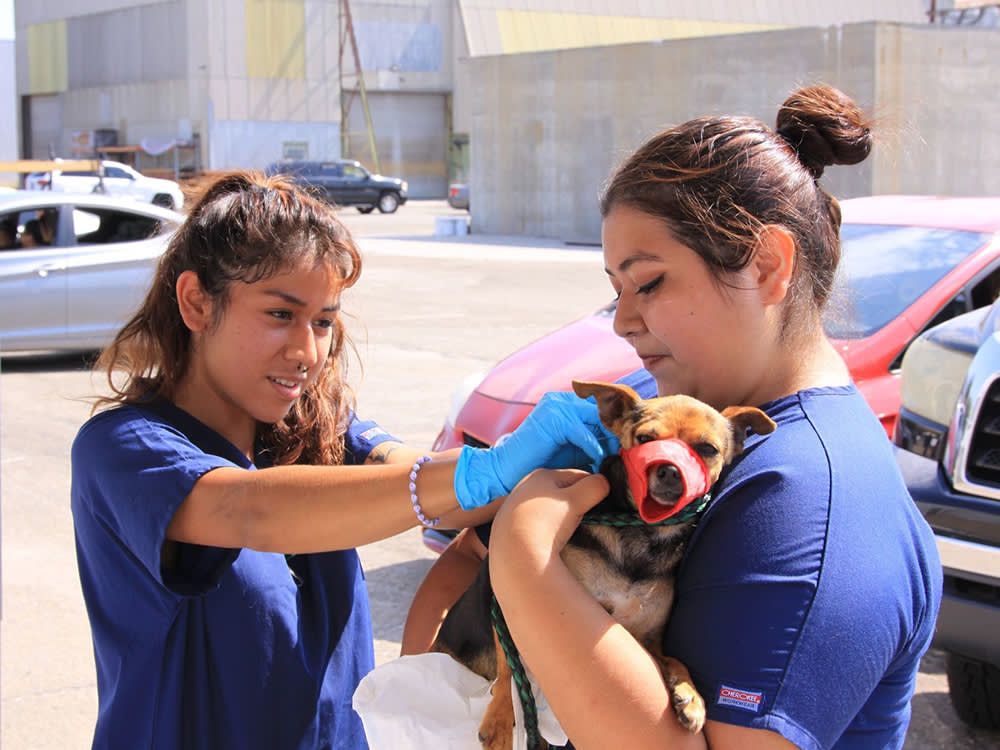
In under two hours, the two of them pulled out 61 dogs.
The arithmetic nobody runs
This is where a rescue story becomes a math story, and it is worth sitting with for a second, because it explains why “we’ll get around to it” is not a neutral choice.
One unspayed female dog and her unspayed offspring are not a linear problem. Dogs reach sexual maturity around six months. A litter can be four to six puppies, sometimes more. Half of those, roughly, will be female, and they will be ready to reproduce before their first birthday. A household with a handful of intact dogs does not slowly grow into a household with a hundred. It grows quietly, then all at once, and by the time the number is frightening, the person who caused it is broke, exhausted, and too ashamed to call anyone.
Spaying and neutering is the least emotionally interesting intervention in animal welfare. It is also the only one that works upstream of every other one.
“The people in these cases almost never start out cruel. They start out soft-hearted and about six months behind the biology,” says Dr. Amara Solis. “By the time somebody calls for help, the dogs are not the emergency anymore, the math is. Fix the math and you prevent the next hundred.”
Where the dogs went
No single shelter can absorb 61 dogs, and the ones you see in the photos are only the ones who fit in the van. A loose network took the rest: Take Paws Rescue, Metairie Humane, Animal Rescue New Orleans, Trampled Rose, and Animal Rescue Corps, which moved a group of about 20 out to placements around the country. The parish worked on collecting the roughly 40 dogs still on the property, with Zeus’ Rescues on standby to take whoever was left.
Every dog was slated for three rounds of vaccines, spay/neuter surgery, a microchip, and deworming before adoption. Zeus’ Rescues warned its followers that the invoice would be enormous, and that was not hyperbole. Multiply a full medical workup and a sterilization surgery by 100 and you are looking at a number most small nonprofits do not have sitting in an account.
What this looks like from the outside, before it’s a headline
Most of these properties have neighbors. The neighbors usually know something is wrong long before anyone calls. If you are the neighbor, here is what actually distinguishes a rough patch from a collapsing situation:
- The number keeps climbing and nobody can tell you what it is. Someone who says “eleven” is managing. Someone who says “a lot” has lost the thread.
- No dog on the property has a vet. Not “we’re behind on shots.” None, ever.
- Nothing is fixed. This is the tell that predicts the next twelve months.
- The person has stopped letting anyone in the house or yard. Shame arrives before the crisis does.
- Puppies keep appearing and nobody seems surprised.
And here is the thing nobody wants to hear: calling animal control is often not the fastest help. A local rescue with a spay/neuter fund can sometimes fix the underlying problem without seizure, without charges, and without 100 dogs entering a shelter system that is already full. Try that number first. Escalate if you get nowhere.
What’s new since this was written
The overload the small rescues absorbed that week has not eased. Shelter Animals Count, which aggregates data from thousands of U.S. shelters and rescues, reported that 5.8 million dogs and cats entered the system in 2025, and that large dogs are sitting there longest, at a median of 20 days versus 14 for small dogs. Small dogs like the Chihuahua-mixes pulled out of that Louisiana yard move faster than most, which is the only lucky thing about them.
Cheramie, meanwhile, has stayed in the news in New Orleans for a very different reason: the long, city-wide hunt for a runaway rescue dog named Scrim, who went missing, was found, and went missing again, and who turned a local rescuer into something close to a folk figure. It is a reminder that the people who show up on flooding mornings to load 61 dogs into a van are mostly running on volunteers, donations, and stubbornness.
If you want to be useful, the most useful thing is unglamorous: fund a spay/neuter clinic in a rural parish or county. That is where the next hundred dogs are currently being conceived.
References
Nina Vasquez writes about life at home with pets and the relationships at the heart of it. Her work covers day-to-day living, people-and-pet stories, and the products that fit into a real household, with a warm, grounded take on everyday pet ownership.
Meet our experts ↗Keep reading
 LivingThe Rescue That Stopped Taking the Dog AwayLeila Torres · 7 min
 Living'Stray' Filmed a Country That Protected Its Street Dogs. That Country Is Gone.Tom Hadley · 7 min
 LivingThe Cheapest Way to Empty a Shelter Is the One Nobody UsesJames Okafor · 6 min
 LivingHe's Fostered Almost 40 Pit Bulls. The Stigma Is the Only Thing He Can't Rehome.Leila Torres · 8 min
 Living27 Dogs Flew to America From a Korean Meat Farm. The Country That Bred Them Is Now Ending the Trade.Leila Torres · 4 min
 Living47 Dogs Rescued in a Week: How South Carolina Started Winning Against DogfightingMarcus Webb · 5 min