


The Cheapest Way to Empty a Shelter Is the One Nobody Uses
Kate Mara quietly paid the adoption fees for ten Georgia dogs who had nowhere to go. The gesture is nice. The research behind it is the actual story, and most shelters are still ignoring it.
Ask a shelter what stands between a dog and a home and you will get a long, honest, exhausting list: space, staff, foster capacity, breed stigma, behavioral history, medical bills, the size of the dog, the color of the dog. Almost nobody says the adoption fee.
And yet the adoption fee is the only item on that list that can be removed instantly, by one person, for the price of a decent night out.
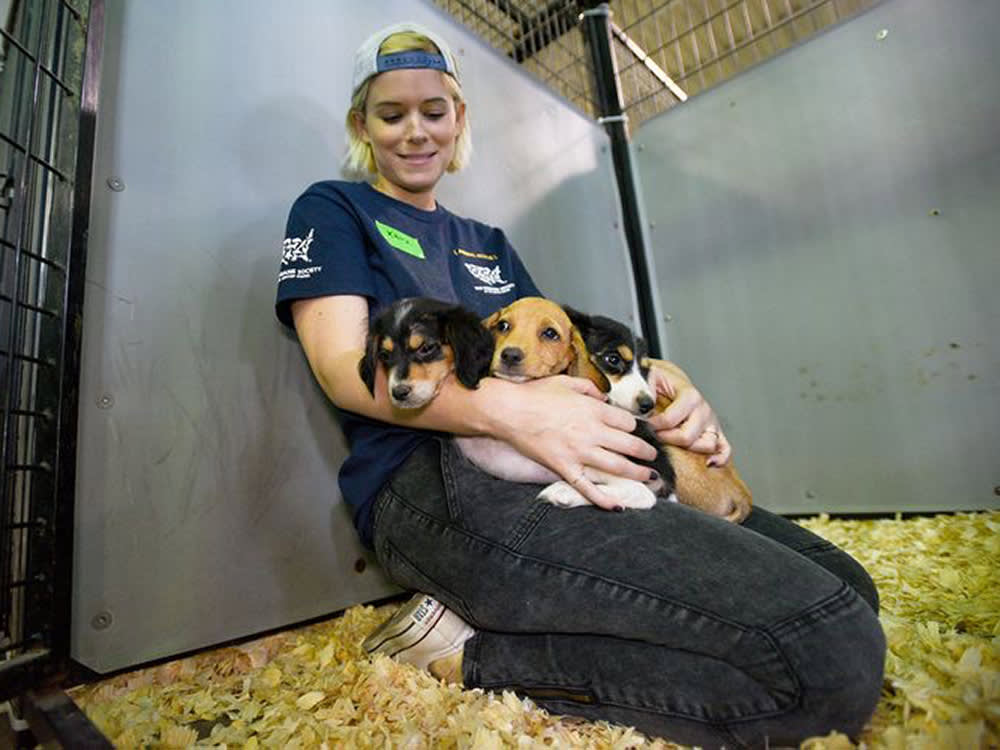
In March 2023, the actress Kate Mara did exactly that. Working with the Animal Legal Defense Fund, she covered the adoption fees for ten dogs in Georgia. Ten. It is a small enough number that it is easy to file the whole thing under celebrity goodwill and move on.
Do not move on. The ten dogs, where they came from, and what the fee waiver actually does are three separate stories, and all three are more interesting than the headline.
Where these dogs came from
They were graduates of Canine CellMates, an Atlanta nonprofit, and specifically of its out-of-custody program, Beyond the Bars.
Canine CellMates pulls dogs from Fulton County Animal Services, an open-intake shelter, meaning these were dogs at genuine risk of euthanasia. It then pairs them with men charged with felonies in Fulton County who have been released from custody on the condition that they participate. Over a year-long course, the men train the dogs, with a certified trainer’s help, and build the tools to break out of the cycle that brought them in. The dogs learn what they need to succeed in a home. At the end, the men’s cases are closed.
Read that plainly: men facing prison instead spend a year teaching a shelter dog to sit, wait, and walk on a loose leash, and both of them come out the other side employable.
Then, per People’s reporting at the time, Canine CellMates’ lease on its headquarters ran out. The dogs, whose names included Luna, Jazzy, and Bronco, had completed the program and had nowhere to be. They landed in foster homes and went up for adoption, with their fees already covered by Mara.
Mara got involved through ALDF after several months living in Atlanta while filming FX’s Class of ‘09. Her stated reason for staying involved was that the city’s humane community kept finding inventive ways to get people and animals in front of each other.
What the fee waiver actually does
The instinct against free adoptions is old and intuitive: if it costs nothing, people won’t value it. People will take a free dog on a whim and dump it.
It is one of the most thoroughly tested beliefs in sheltering, and it is false.
Emily Weiss and Shannon Gramann ran the study in 2009. They compared 173 adopters from a Maine rescue: 95 who paid no fee for an adult cat and 78 who paid $75. Then they measured attachment. There was no significant difference between the groups, on attachment or on how they perceived the shelter. Paying nothing did not make anyone love their animal less.
What the fee does do is filter. It filters out the person who wants the animal but does not have $250 sitting in a checking account this week. That is not a filter for love or competence. It is a filter for liquidity.
“The fee isn’t a screening tool, it’s a toll booth,” says Dr. Lena Park. “If your adoption process is a real conversation, a home check, and an honest talk about vet costs, the fee is doing nothing that the conversation isn’t already doing better. All it’s doing is deciding who can afford to get to the conversation.”
The practical version, for anyone who wants to be useful and has no room for a dog:
- Sponsor a fee, not a dog. Most shelters will take a targeted donation to cover the adoption fee for a specific animal, or for a category (seniors, large dogs, long-stay residents). Ask for the ones who have been there longest.
- Fund the neuter and the vaccines instead. In shelters where the fee is genuinely underwriting medical costs, that is the line item to attack.
- Pay somebody’s first-year buffer. The reason adopters balk is rarely the fee alone; it is the fee plus the unknown vet bill behind it.
Mara’s longer record
This was not a one-off. She has worked with ALDF before, signing on with Hilary Swank, Bella Hadid, Billie Eilish, Joaquin Phoenix, and other public figures to a public letter urging New York’s City Council to outlaw horse-drawn carriages. It followed the collapse of Ryder, an elderly carriage horse, on a Manhattan street in the August 2022 heat, and the footage of his driver hauling at him to get him standing again as the animal struggled even to raise his head. The letter’s argument was blunt: the video is unbearable for a reason, and no animal should be treated that way.
Mara has been vegan for over a decade, as has her sister Rooney. She told VegNews that once she understood what her eating had cost, her reaction was disgust at herself for not having known sooner.
Her closest professional brush with all of this was Megan Leavey in 2017, in which she played a Marine corporal bonded to a military working dog. She trained with the dog beforehand, and describes on-camera work with an animal as the thing that keeps a scene honest: they will hold a sit if you need it, and then do something unplanned that improves the take.
What’s new since this was written
Canine CellMates survived the eviction. The organization is still running Beyond the Bars in Atlanta, and it has since partnered with Best Friends Animal Society to expand the model.
The numbers now attached to it are the reason it deserves more than a celebrity peg. The average recidivism rate in metro Atlanta runs around 70 percent within two years of release. Program organizers put the rate for men who complete Beyond the Bars somewhere near 20 percent. That figure is the organization’s own and has not been through peer review, so hold it loosely. But even discounted heavily, it describes something that almost nothing else in criminal justice can claim, and it costs a fraction of a prison bed.
Ten adoption fees, in that light, is not a small gesture. It is the last dollar in a chain that started with a dog nobody wanted and a man about to go away for years.
References
- Weiss, E. & Gramann, S. “A Comparison of Attachment Levels of Adopters of Cats: Fee-Based Adoptions Versus Free Adoptions.” Journal of Applied Animal Welfare Science, 12(4), 2009. pubmed.ncbi.nlm.nih.gov
- ASPCApro. Research on Fee-Waived Animal Adoptions. aspcapro.org
- Canine CellMates. caninecellmates.org
- 11Alive. “Canine Cellmates: Beyond the Bars nonprofit facing eviction, searching for new home.” 11alive.com
- Animal Legal Defense Fund. aldf.org
- Atlanta Magazine. “Canine CellMates offers prisoners and shelter dogs a second chance.” atlantamagazine.com
James Okafor covers rescue, adoption, and the causes shaping animal welfare. His work follows the people and organisations working to give more pets a home, and the issues owners and advocates care about most.
Meet our experts ↗Keep reading
 LivingItaly's Most Beloved Rescue Dog Was Poisoned. A New Law Now Carries His Name.Nina Vasquez · 4 min
 LivingThe NHL Built a Puppy Bowl, and Every Dog on the Ice Needed a HomeSasha Ford · 4 min
 LivingNobody Meant to Have 100 Dogs. That's How It Always Starts.Nina Vasquez · 5 min
 LivingHe's Fostered Almost 40 Pit Bulls. The Stigma Is the Only Thing He Can't Rehome.Leila Torres · 8 min
 Living27 Dogs Flew to America From a Korean Meat Farm. The Country That Bred Them Is Now Ending the Trade.Leila Torres · 4 min
 LivingWhat It Actually Takes to Fly 29 Street Dogs to a New LifeLeila Torres · 5 min