


'Stray' Filmed a Country That Protected Its Street Dogs. That Country Is Gone.
Elizabeth Lo's documentary follows three free-roaming dogs through Istanbul in a city that once made it illegal to euthanize strays. The film is a masterpiece, and a time capsule of a policy Turkey has since reversed.

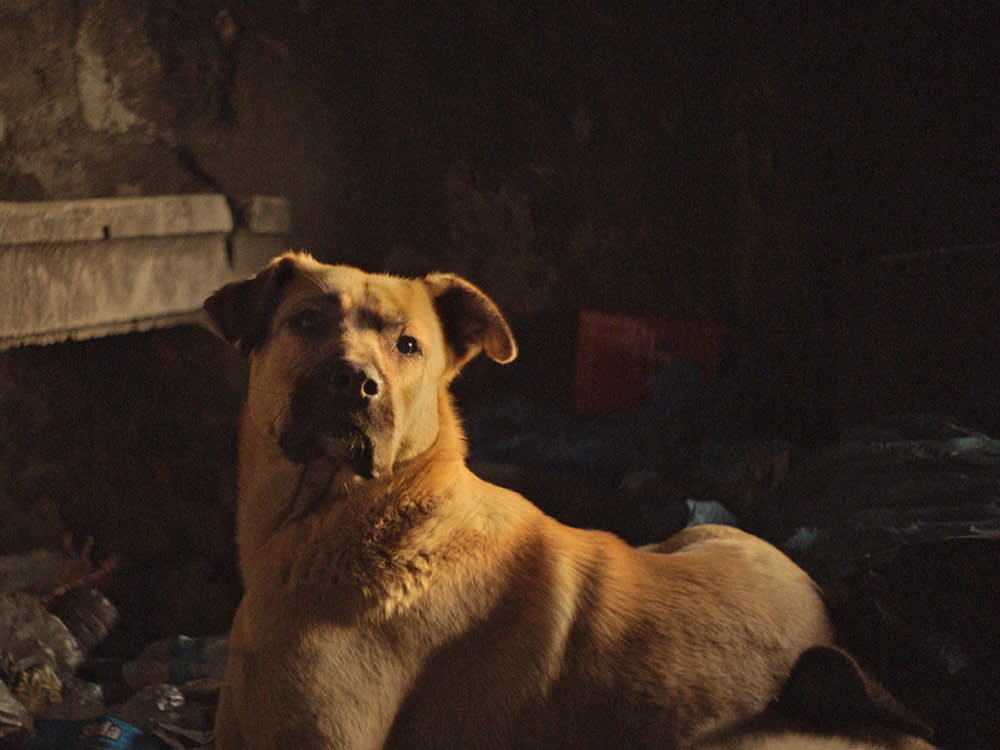
Let’s get the anxious question out of the way first, because it’s the one that keeps dog lovers from pressing play on any film like this: no animals are harmed, and no dogs die. That matters here, because Elizabeth Lo has said the impulse behind Stray, her first feature-length documentary, was the death of her own dog and the grief that followed, an experience she has described as propelling the film’s inquiry into value, hierarchy, and sentience. She would understand starting a review this way.
Released in 2020 as Lo’s debut feature, Stray is a quiet, extraordinary 72-minute film set in and around Istanbul. It follows three unrelated free-roaming dogs, the adults Zeytin and Nazar and a puppy named Kartal, with Zeytin as its clear protagonist. Stately and vulnerable at once, she commands the camera the way old-Hollywood divas commanded a frame, and without leaning too hard on anthropomorphism, it’s difficult not to feel she’s aware of it.
A film that hands the story to the dogs
Stray has no traditional arc and no script. Lo has said she left the narrative to the dogs themselves, letting her camera follow their day-to-day search for food, shelter, and a little company. For any dog lover, that alone is riveting, an unbroken look at what a life on the streets actually asks of an animal.
The dogs’ lives keep intersecting with a trio of homeless young Syrian refugees, who appear to be the ones who named them. The dogs don’t live with the boys, but they pal around together; when the boys call, the dogs come running. Sleeping rough in construction sites and on sidewalks, sometimes chasing a glue-sniffing escape, the boys and dogs form a makeshift family on society’s margins, the dogs serving as both warmth and protection against the cold and the danger. You can see the genuine interdependency, and it’s the emotional spine of the film.
The soundtrack is its own quiet achievement. With no narration, Lo builds an aural world out of “found sounds,” snatches of street noise and overheard café conversation (often about relationship trouble), captured on a directional microphone. In one startling moment we hear a sanitation worker leap off his truck to scold one dog for stealing a bone from Zeytin, breaking up the squabble and returning the bone. In another, a father coaxes his toddler to offer the dogs a bit of food, reassuring the child they’re gentle. There is unkindness in the film, but no outright cruelty. Composer Ali Helnwein’s score sets the stage, and Lo periodically freezes the action to drop in billboard-like quotations from ancient philosophers, Diogenes musing that dogs and philosophers do the most good for the fewest rewards, Themistius on dogs guarding human integrity, that reframe the strays as figures of dignity rather than pity.
The policy that made the film possible
Here is the detail that gives Stray its poignancy, and its unexpected shelf life as a document. Turkey has a fraught history with its street dogs; in the last century the state tried to eradicate them. But in 2004, after widespread public protest against the killings, the country changed course. For years afterward, Turkey stood out as a place where street dogs were not just tolerated but legally protected, free-roaming, fed, and woven into daily urban life, in a way almost nowhere else in the world matched.
The film captures that world in bloom. Grassroots groups like Turkey’s Animal Rights Federation ran humane campaigns, water stations for street animals, a “push the brakes” push urging drivers to take responsibility if they hit an animal, the latter especially resonant given how many scenes show street-smart dogs threading through heavy traffic. Best of all is a vending machine, built by a firm named Pugedon, that trades kibble for a recycled plastic bottle: feed it an empty bottle, and out drops a meal for a hungry dog. Stray lingers on all of it as evidence that a city can choose coexistence.
What lands hardest is Lo’s insistence that Zeytin and the others are not defined by their relationships to people. We watch them slip past the boundaries of class, ethnicity, and gender that hem in the people around them, something only a dog with no owner and no fixed place could do. That’s what makes the final scene devastating in the best way: Zeytin rests on a patch of ground at the city’s edge, an azan, the Muslim call to prayer, rises from a nearby mosque, and she lifts her head and joins in, howling and howling for nearly two minutes. Both sounds go straight to the heart. It is one of the most extraordinary closing images in recent documentary film.
What’s changed since the film, and it’s a lot
If you watch Stray today, you are watching a world that no longer exists, and that transforms the film from a lyrical portrait into something closer to an elegy.
In July 2024, Turkey’s parliament passed a sweeping new law, dubbed by critics the “massacre law,” that upended the very policy Stray celebrates. It orders municipalities to remove free-roaming dogs from the streets and place them in shelters for adoption, and it permits euthanasia for dogs deemed dangerous, aggressive, terminally ill, or unadoptable. The government estimates roughly four million homeless dogs live in Turkey, against a shelter system with capacity for only about 105,000, a gap animal-welfare groups warn makes mass killing or neglect all but inevitable. Municipalities were given until 2028 to build out shelters and required to spend a share of their budgets on the effort. By spring 2026, reporting indicated that Turkey had removed close to a million street animals in the law’s first year, amid ongoing protests from animal-rights advocates and opposition politicians.
In other words, the country that Stray held up as a model, the one place where Zeytin could live free and protected, has legislated its street dogs off the streets. That doesn’t diminish the film. If anything, it sharpens it. Stray now stands as a record of what compassion at the civic scale looked like when it existed, and a reminder of how quickly it can be undone. Watch it for Zeytin. Stay with it for the question it was always asking: which lives do we decide are worth protecting, and what happens when we change our minds?
This piece touches on animal welfare policy and the mistreatment of animals, which some readers may find difficult.
References
- Lo, Elizabeth, director. Stray. 2020. Official site: https://www.straythefilm.com/
- Balkan Insight. “Turkish Parliament Approves Law Allowing Euthanasia for Stray Dogs.” 30 July 2024. https://balkaninsight.com/2024/07/30/turkish-parliament-approves-law-allowing-euthanasia-for-stray-dogs/
- Balkan Insight. “Turkey Removes Nearly One Million Street Animals in a Year.” 23 April 2026. https://balkaninsight.com/2026/04/23/turkey-removes-nearly-one-million-street-animals-in-a-year/
Tom Hadley writes about training and behavior, helping owners understand what their pets are trying to tell them. His work covers everyday manners, decoding common behaviors, and the small changes at home that make dogs and cats easier to live with.
Meet our experts ↗Keep reading
 LivingA Man Cried About His Dog on Live TV. A Shelter's Inbox Exploded.Sara Lim · 5 min
 LivingHe Left 11 Dogs to Die in a Hot Van, Then Cremated the Evidence. A Jury Convicted Him.Nina Vasquez · 5 min
 LivingThe CNN Hero of the Year Fosters Dogs for People in Addiction RecoveryClaire Sutton · 3 min
 LivingHe Left Jail After Five Days. One of His Dogs Was Already Dead.Sasha Ford · 4 min
 LivingSome States Once Banned Black Families From Owning Dogs. A Yale Scholar on Why That Still Echoes.Leila Torres · 6 min
 LivingA Cairo Puppy Lost All Four Paws. Then Women Across the World Went to Work.Nina Vasquez · 6 min